All species › Woodpeckers and allies › Woodpeckers › Arizona Woodpecker
Position in the tree Birds Aves › Birds with a flexible palate Neognathae › All other modern birds Neoaves › Landbirds Telluraves › Raptors, owls, kingfishers and woodpeckers Afroaves › Mousebirds, rollers and woodpeckers Coraciimorphae › Trogons and cavity nesters Cavitaves › Hornbills, kingfishers and woodpeckers Picocoraciae › Kingfishers, bee-eaters and woodpeckers Picodynastornithes
Arizona Woodpecker | Leuconotopicus arizonae
Arizonaspecht | Carpintero de Arizona
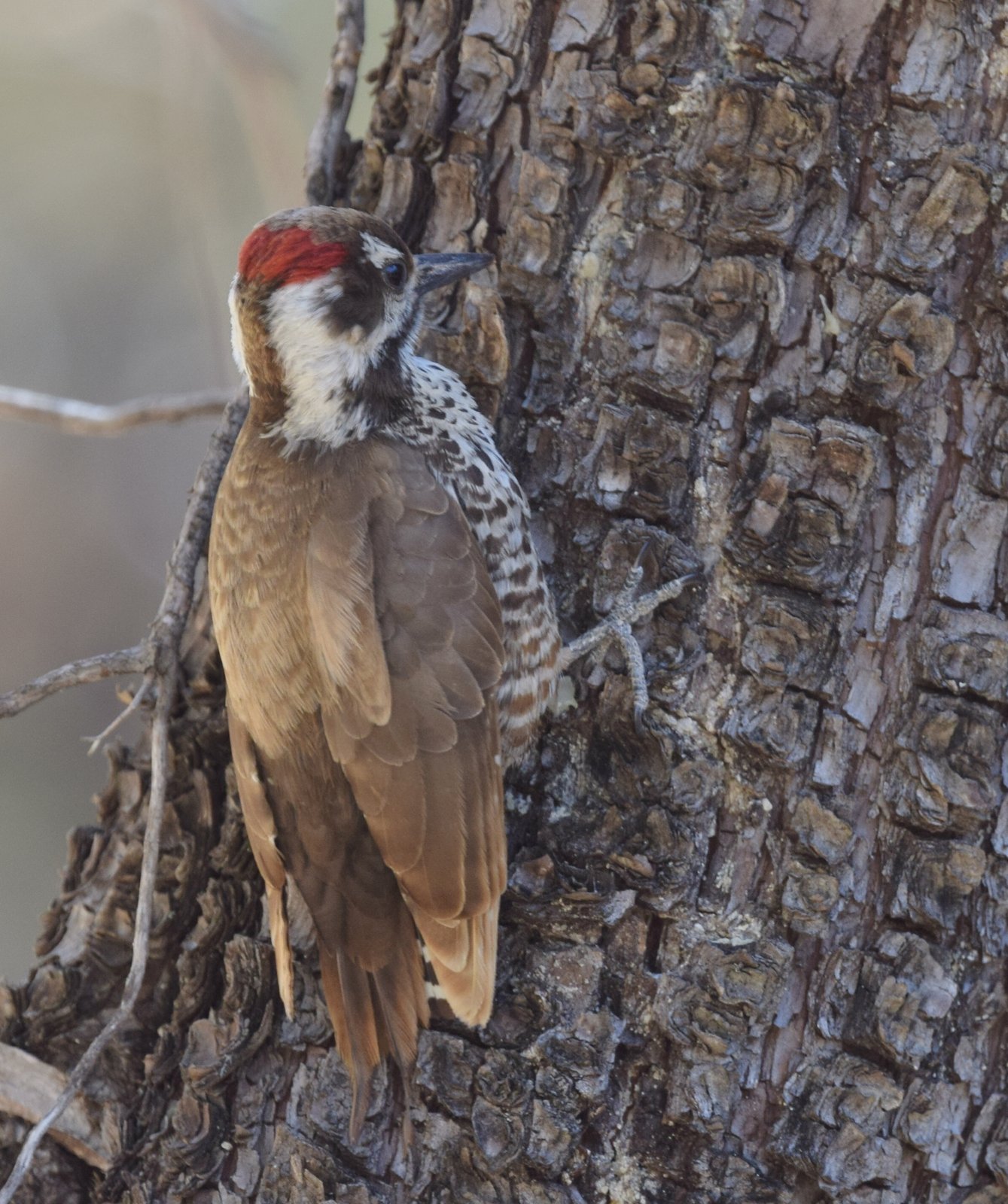
The Arizona Woodpecker is a brown-and-white woodpecker of the oak and pine-oak forests along the Sierra Madre Occidental, from Sonora and Chihuahua to Jalisco and Michoacán. It is a quiet bird that works its way up trunks and branches in a spiral with short hitches. Since Strickland's Woodpecker of central Mexico was split off, it has been treated as a separate species.
Voice
A sharp, slightly hoarse keech, rougher than the call of Hairy Woodpecker, and a rattle of descending, rasping notes, often during encounters. Drums in short, even rolls on dead wood. Largely silent outside the breeding season.
Recording: Barry Edmonston — CC BY-NC-SA 4.0 · converted to mono · xeno-canto
Identification
18–20 cm. Back plain chocolate brown; wings brown with fine white spots. Head brown with a broad brown ear patch, framed by a white stripe above and below the eye, and a white patch on the side of the neck. Underparts white, densely spotted with brown and barred brown on the flanks. Outer tail feathers white with brown bars. The male has a red patch on the nape, the female does not. Males have a noticeably longer bill than females.
Confusion species
Strickland's Woodpecker Leuconotopicus stricklandi of the high volcanoes of central Mexico has a white-barred back and more streaked underparts. Hairy Woodpecker Leuconotopicus villosus has a black head with white stripes and a white back stripe. Ladder-backed Woodpecker Dryobates scalaris, in lower and drier country, has a black-and-white barred back. Smoky-brown Woodpecker Leuconotopicus fumigatus is also brown, but has unmarked underparts and no white stripes on the head.
Habitat
Dry oak and pine-oak forest on mountain slopes and in canyons, mostly between about 1000 and 2500 m, locally lower in sheltered canyons; also riparian woodland with sycamores and walnuts along streams. It eats mainly beetle larvae, supplemented with fruit and acorns. The nest hole is usually excavated in dead wood, often in a dead branch of an oak, sycamore or walnut.
Where the bird is most at home, classified by the vegetation units of Mexico and Central America.



Range and movements
Along the Sierra Madre Occidental from north-eastern Sonora and western Chihuahua south through Sinaloa, Durango and Nayarit to Jalisco, Colima and Michoacán. There are two subspecies: arizonae in the north and fraterculus from southern Sinaloa to Michoacán. Outside the guide area in south-eastern Arizona and the extreme south-west of New Mexico.
- Resident
- dark = core range, pale = thinly spread
How and when to look
In pine-oak forest along the road from Mazatlán to Durango, around Yécora in Sonora and in the mountains of Jalisco, such as the Sierra de Manantlán. It often starts at the base of a trunk, spirals upwards and then flies to the base of the next tree.
Conservation status
Not threatened. Reliable trend data are lacking; logging in the Sierra Madre Occidental degrades the habitat locally.
Scientific name
Leuconotopicus arizonae | (Hargitt, 1886)
Hargitt described the species in 1886 as Picus arizonae; because it was later moved to another genus, the author and year stand in brackets. The genus Leuconotopicus was introduced in 1845 by Malherbe. Leuconotopicus combines Greek leukos 'white' and nōtos 'back' with Latin picus 'woodpecker': 'white-backed woodpecker'. arizonae refers to Arizona, where the type specimens were collected (Santa Rita Mountains). The specimen the first description was based on came from Santa Rita Mountains, Arizona.