All species › Passerines › Antpittas › Streak-chested Antpitta
Position in the tree Birds Aves › Birds with a flexible palate Neognathae › All other modern birds Neoaves › Landbirds Telluraves › Falcons, parrots and passerines Australaves › Falcons and passerines Eufalconimorphae › Parrots and passerines Psittacopasserae
Streak-chested Antpitta | Hylopezus perspicillatus
Brilmierpitta | Tororoí pechilistado
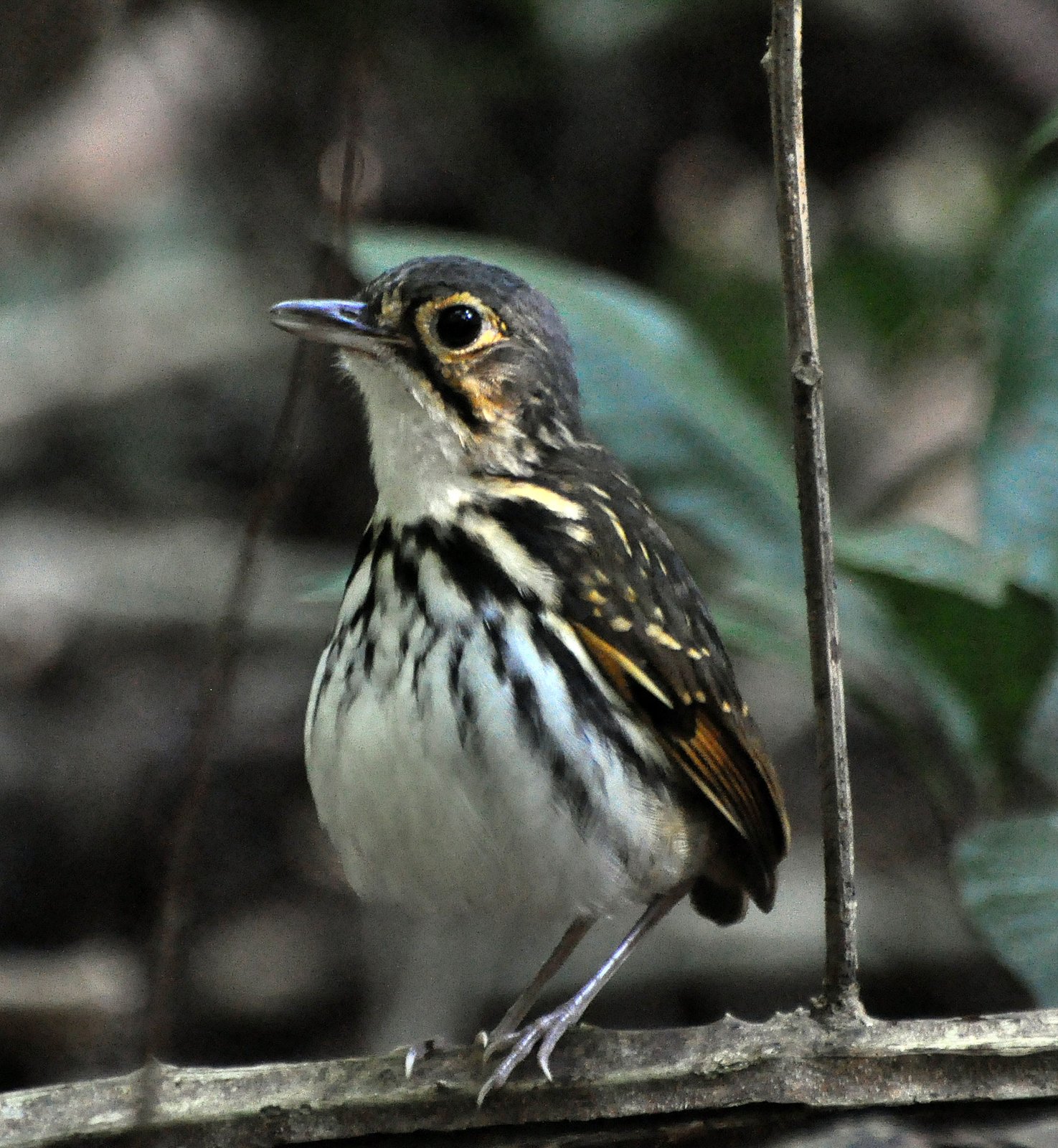
The Streak-chested Antpitta is an antpitta of the floor of humid lowland forest, with a conspicuous pale eye-ring and a heavily streaked breast. It walks on long legs over the leaf litter and is heard far more often than seen. In the guide area it lives from Honduras to Panama.
Voice
A series of six to ten clear, melancholy whistles that first rise slightly and then fall, the last notes slower. Sings from a low branch or a fallen log.
Recording: Sue Riffe — CC BY-NC-SA 4.0 · converted to mono · xeno-canto
Identification
13–14 cm, with a very short tail and long legs. Crown and nape grey, back olive-brown. A broad ochre-buff eye-ring and lores give the face 'spectacles'. Wing-coverts with small ochre-buff spots. Underparts white, breast washed ochre-buff and densely streaked black. Male and female are alike.
Confusion species
Thicket Antpitta Myrmothera dives lacks the pale spectacles and wing spots and has a virtually unstreaked, ochre-orange breast and flanks; it lives in dense thickets. Black-crowned Antpitta Pittasoma michleri is larger, with a black crown, rufous cheeks and black-and-white scaled underparts. Antthrushes of the genus Formicarius walk with a cocked tail and have unstreaked underparts.
Habitat
Floor and understorey of humid evergreen lowland and foothill forest, also mature secondary forest, mostly below about 1200 m. It moves in short hops over the leaf litter in search of insects and other invertebrates, sometimes swaying its body from side to side.
Where the bird is most at home, classified by the vegetation units of Mexico and Central America.



Range and movements
Caribbean slope of Honduras and Nicaragua, Costa Rica (Caribbean slope and the south-west) and Panama. Outside the guide area in western Colombia and north-western Ecuador.
- Resident
- dark = core range, pale = thinly spread
How and when to look
Usually located by its song: follow the sound slowly and then scan the ground and the low branches. A singing bird sometimes stays in the same spot for a long time.
Conservation status
Not threatened. Locally fairly common, but sensitive to the loss and fragmentation of lowland forest.
Scientific name
Hylopezus perspicillatus | (Lawrence, 1861)
Lawrence described the species in 1861 as Grallaria perspicillata; because it was later moved to another genus, the author and year stand in brackets. The genus Hylopezus was introduced in 1909 by Ridgway. Hylopezus is Greek, from hulē 'woodland' and pezos 'walking', after its life on the forest floor. perspicillatus is New Latin for 'spectacled', after the conspicuous buff eye-ring. The specimen the first description was based on came from Isthmus of Panama.