All species › Passerines › Tityras, becards and allies › Speckled Mourner
Position in the tree Birds Aves › Birds with a flexible palate Neognathae › All other modern birds Neoaves › Landbirds Telluraves › Falcons, parrots and passerines Australaves › Falcons and passerines Eufalconimorphae › Parrots and passerines Psittacopasserae
Speckled Mourner | Laniocera rufescens
Geelpluimtreurtiran | Plañidera moteada
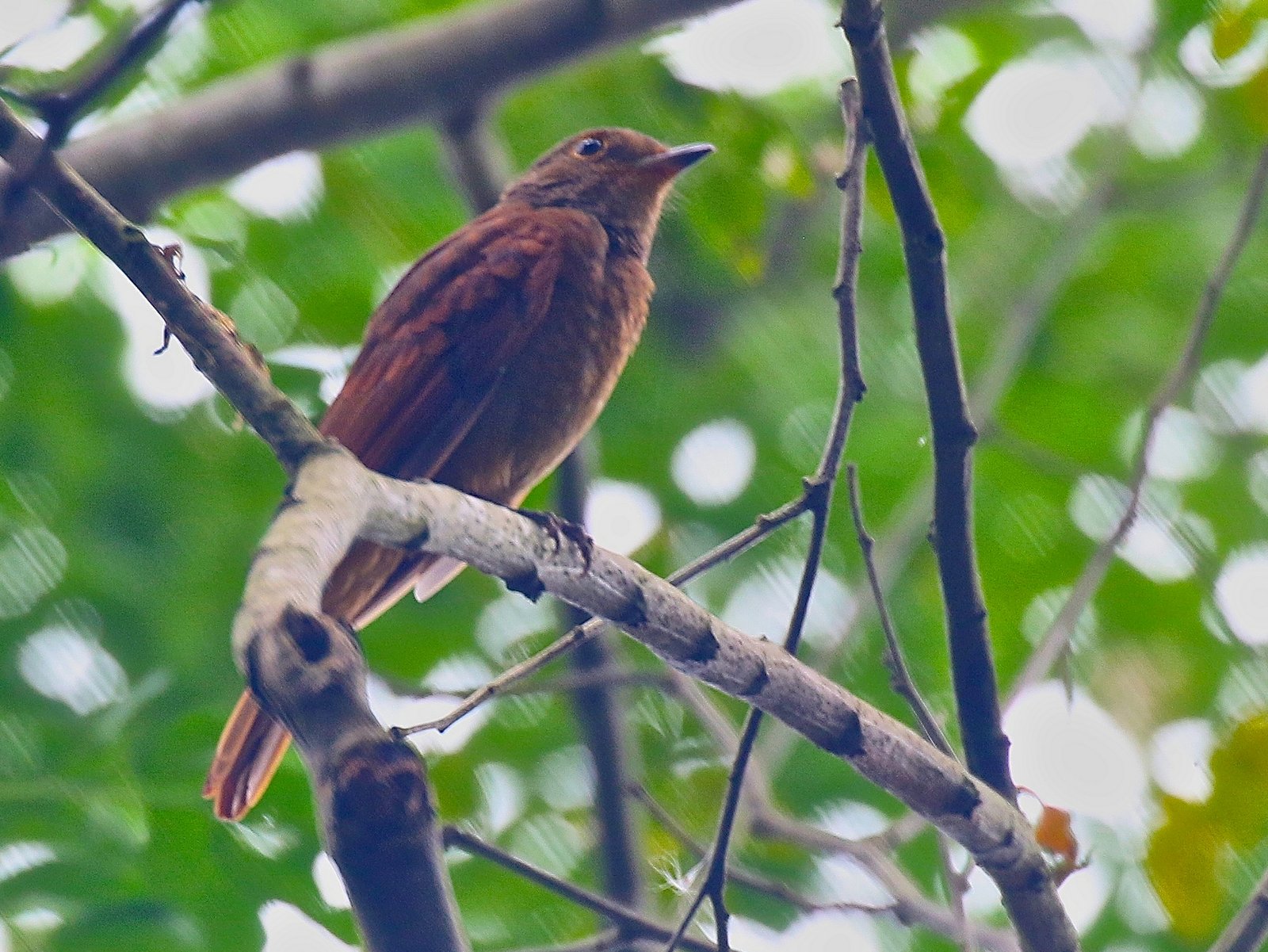
The Speckled Mourner is a rufous-brown, inconspicuous bird of the middle storey of humid lowland forest. It sits still for long periods and is usually noticed only by its persistent, whistled song. Characteristic are the rows of cinnamon spots on the dark wing coverts. In the guide area it lives from south-eastern Mexico to Panama.
Voice
A long, even series of high, clear two-note whistles, roughly tee-yur tee-yur tee-yur, which can continue for minutes and whose source can seldom be pinpointed. Males often sing from fixed perches some distance apart.
Recording: Francis Canto Jr — CC BY-NC-SA 4.0 · converted to mono · xeno-canto
Identification
20–21 cm. Upperparts warm rufous-brown, underparts paler cinnamon-brown, often with faint dark scalloping or barring on the breast. The wing coverts are dark with cinnamon to rufous tips, forming two or three rows of spots. A yellow tuft at the side of the breast usually remains largely hidden under the wing and is most noticeable in the male. Large dark eyes and a fairly broad, dark bill. Young birds are more heavily scalloped.
Confusion species
Rufous Mourner Rhytipterna holerythra is uniformly rufous-brown, without spots on the wings, and more slender. Rufous Piha Lipaugus unirufus is larger and also uniformly rufous. Cinnamon Becard Pachyramphus cinnamomeus is smaller, with a dark lore and unspotted wings.
Habitat
Middle storey and lower canopy of the interior of humid evergreen lowland and foothill forest, mostly below about 800 m; less often in tall secondary forest. It eats large insects and fruit. It sits still on a branch for long periods and then sallies briefly to take prey or fruit.
Where the bird is most at home, classified by the vegetation units of Mexico and Central America.



Range and movements
South-eastern Mexico, through Guatemala, Belize, Honduras and Nicaragua, mainly on the Caribbean slope, to Costa Rica and Panama. Outside the guide area in western Colombia and north-western Ecuador.
- Resident
- Summer visitor (c. Apr–Sep)
- Winter visitor (c. Oct–Mar)
- Passage (Mar–Apr, Oct–Nov)
- dark = core range, pale = thinly spread
How and when to look
Best found by its song: an endlessly repeated two-note whistle in the interior of extensive lowland forest. Then patiently scan the middle storey for a motionless rufous bird.
Conservation status
Not threatened. Rather scarce and often overlooked; depends on extensive, unbroken lowland forest and is therefore sensitive to deforestation.
Scientific name
Laniocera rufescens | (Sclater, 1858)
Sclater described the species in 1858 as Lipaugus rufescens; because it was later moved to another genus, the author and year stand in brackets. The genus Laniocera was introduced in 1841 by Lesson. Laniocera combines Lanius (shrike) with Greek keras 'horn', here 'bill': a bird with a shrike-like bill. rufescens is Latin for 'reddish' (rufescere 'to become reddish'), after the rufous plumage. The specimen the first description was based on came from Cobán, Alta Verapaz, Guatemala.