All species › Passerines › Tityras, becards and allies › Northern Schiffornis
Position in the tree Birds Aves › Birds with a flexible palate Neognathae › All other modern birds Neoaves › Landbirds Telluraves › Falcons, parrots and passerines Australaves › Falcons and passerines Eufalconimorphae › Parrots and passerines Psittacopasserae
Northern Schiffornis | Schiffornis veraepacis
Noordelijke schiffornis | Llorón café
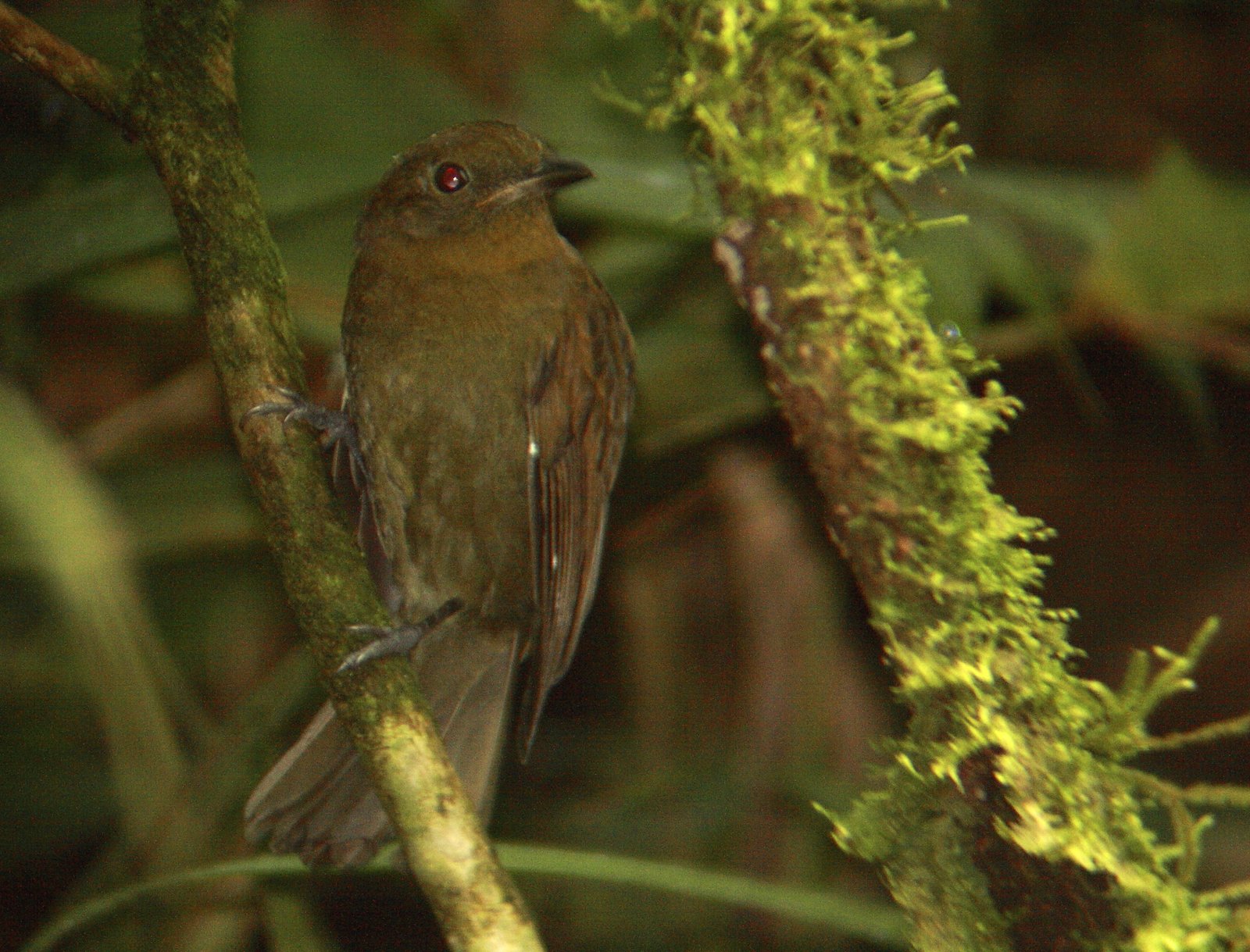
The Northern Schiffornis is a plain olive-brown bird of the understorey of humid forest that is heard more often than seen. With its large dark eyes and rounded head it resembles a large manakin or a small thrush. The species was formerly treated together with the Russet-winged Schiffornis and several South American forms as a single species. In the guide area it lives from south-eastern Mexico to Panama.
Voice
A clear, whistled phrase of three or four notes, the first drawn out, for example tuuu-wee-tuwit; often repeated, also in the middle of the day. The song varies somewhat in form between regions.
Recording: Juan Freile — CC BY-NC-SA 4.0 · converted to mono · xeno-canto
Identification
16–17 cm. Entirely olive-brown, slightly more rufous on wings and tail, slightly greyer and paler on throat and belly. Large dark eye, often with a narrow pale eye-ring. Rather short, dark bill and a rounded head. Male and female are alike. It perches upright and often sits still for long periods on a low branch.
Confusion species
Russet-winged Schiffornis Schiffornis stenorhyncha in central and eastern Panama is barely distinguishable and is identified mainly by range and song; it has slightly rustier wings. Female manakins are smaller and greener. Ochre-bellied Flycatcher Mionectes oleagineus is smaller, with an ochre belly and a narrow bill. Nightingale-thrushes and thrushes such as Swainson's Thrush Catharus ustulatus have spotted breasts.
Habitat
Understorey and lower levels of humid lowland and foothill forest and semi-evergreen forest, also tall secondary forest, from sea level to about 1500 m. It eats insects and small fruit. It builds a cup nest low in a hollow stump, among roots or in an epiphyte.
Where the bird is most at home, classified by the vegetation units of Mexico and Central America.




Range and movements
South-eastern Mexico, including the Yucatán Peninsula, through Guatemala, Belize, Honduras, Nicaragua and Costa Rica to Panama. Outside the guide area in western Colombia and western Ecuador.
- Resident
- dark = core range, pale = thinly spread
How and when to look
Listen in shady forest for the clear, drawn-out whistle. The bird often sits motionless on a low branch or vine and can then only be found with patience.
Conservation status
Not threatened. Fairly common in humid forest but inconspicuous; declines where forest disappears.
Scientific name
Schiffornis veraepacis | (Sclater & Salvin, 1860) (GBIF: Schiffornis turdina)
Sclater & Salvin described the species in 1860 as Heteropelma verae-pacis; because it was later moved to another genus, the author and year stand in brackets. The genus Schiffornis was introduced in 1854 by Bonaparte. Schiffornis honours the German physiologist and zoologist Moritz Schiff (1823–1896), with Greek ornis 'bird'. veraepacis refers to Verapaz in Guatemala (Latin verus 'true', pax 'peace'), where the species was collected. The specimen the first description was based on came from Choctum, Verapaz, Guatemala.