All species › Passerines › Cotingas › Rufous Piha
Position in the tree Birds Aves › Birds with a flexible palate Neognathae › All other modern birds Neoaves › Landbirds Telluraves › Falcons, parrots and passerines Australaves › Falcons and passerines Eufalconimorphae › Parrots and passerines Psittacopasserae
Rufous Piha | Lipaugus unirufus
Rosse piha | Piha rojiza
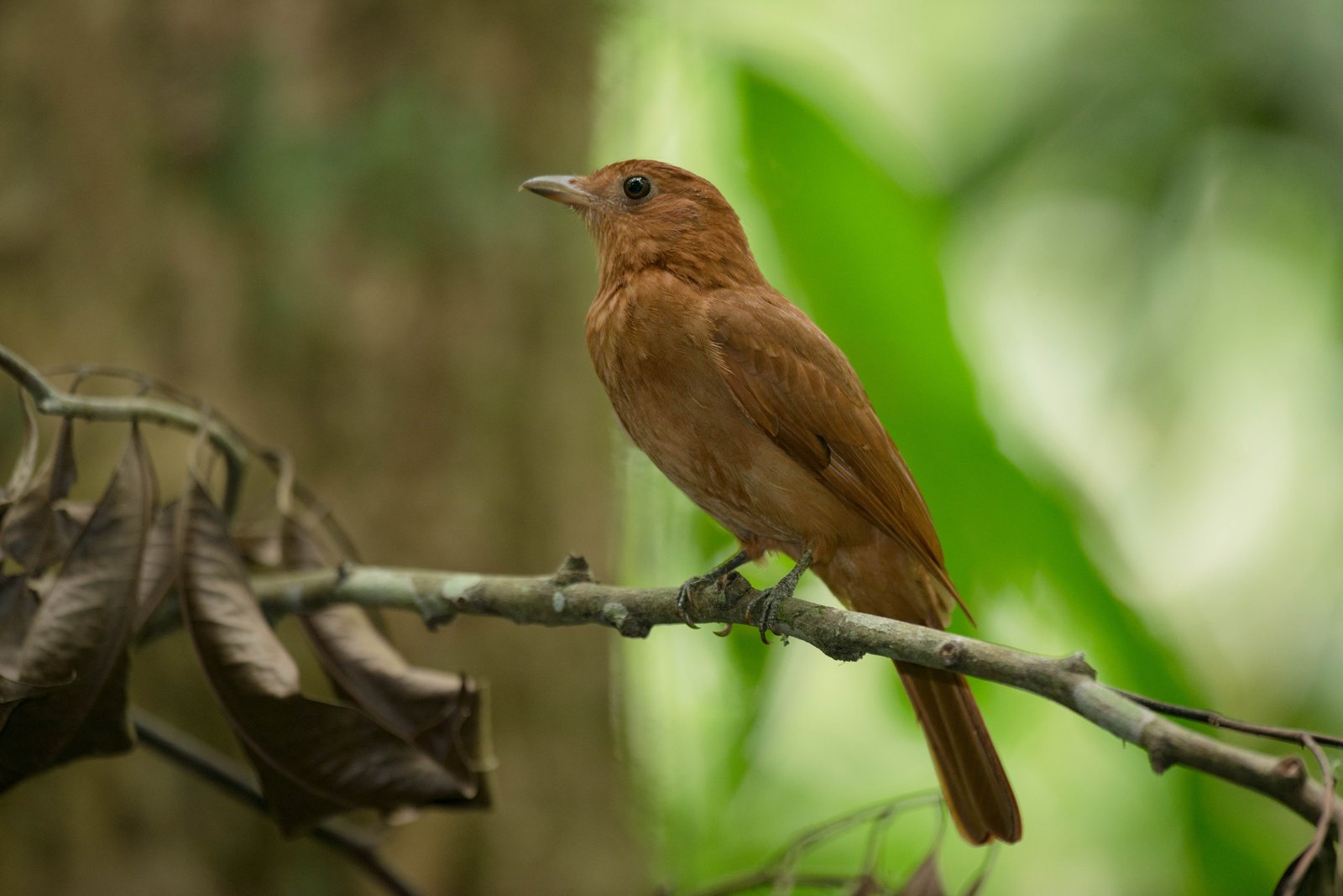
The Rufous Piha is a uniformly rufous-brown cotinga of the interior of humid lowland forest. It sits upright and still for long periods in the middle storey and is noticed mainly for its loud, whistled call. In the guide area it lives from south-eastern Mexico to Panama.
Voice
A loud, clear whistle, often in two or three parts, such as peeer or wee-weeoo. It often calls in response to a sudden loud noise, such as a falling branch or thunder.
Recording: Juan Freile — CC BY-NC-SA 4.0 · converted to mono · xeno-canto
Identification
24–26 cm. Uniform cinnamon to rufous-brown, the underparts slightly paler and the throat palest. Large dark eye and a fairly broad, dark bill. Fairly long tail and an upright posture. Male and female are alike.
Confusion species
Rufous Mourner Rhytipterna holerythra is very similar but smaller and slimmer, with a thinner bill and a different call. Speckled Mourner Laniocera rufescens has pale spots on the wing coverts and fine scaling on the breast. Cinnamon Becard Pachyramphus cinnamomeus is much smaller, paler below, with a dark lore and a pale line above it.
Habitat
Interior of humid evergreen lowland and foothill forest, mostly below 1000 m, also mature secondary forest. It sits still in the middle storey and makes short sallies to pluck fruit or insects from leaves or twigs in flight.
Where the bird is most at home, classified by the vegetation units of Mexico and Central America.



Range and movements
Caribbean slope of south-eastern Mexico, through Belize, Guatemala, Honduras and Nicaragua to Costa Rica, where it also occurs on the southern Pacific slope; in Panama on both slopes. Outside the guide area in western Colombia and north-western Ecuador.
- Resident
- dark = core range, pale = thinly spread
How and when to look
More often heard than seen. Regularly heard at La Selva in Costa Rica and along Pipeline Road (Camino del Oleoducto) in Panama. A loud handclap sometimes provokes a call, after which the bird can be tracked down.
Conservation status
Not threatened. Fairly common in continuous forest; disappears where forest becomes fragmented.
Scientific name
Lipaugus unirufus | Sclater, 1860
Sclater described the species in 1860 and placed it straight away in the genus where it still stands. The genus Lipaugus was introduced in 1828 by Boie. Lipaugus is Greek, from lipaugēs 'dark, deserted by light' (leipō 'to abandon', augē 'brilliance'), after the plain plumage or the dim forest. unirufus is Latin, from unus 'one' and rufus 'rufous': 'all rufous', after the uniform rufous plumage. The specimen the first description was based on came from Playa Vicente, then Oaxaca (now Veracruz), Mexico.