All species › Passerines › Swallows › Southern Rough-winged Swallow
Position in the tree Birds Aves › Birds with a flexible palate Neognathae › All other modern birds Neoaves › Landbirds Telluraves › Falcons, parrots and passerines Australaves › Falcons and passerines Eufalconimorphae › Parrots and passerines Psittacopasserae
Southern Rough-winged Swallow | Stelgidopteryx ruficollis
Zuid-Amerikaanse ruwvleugelzwaluw | Golondrina alirrasposa sureña
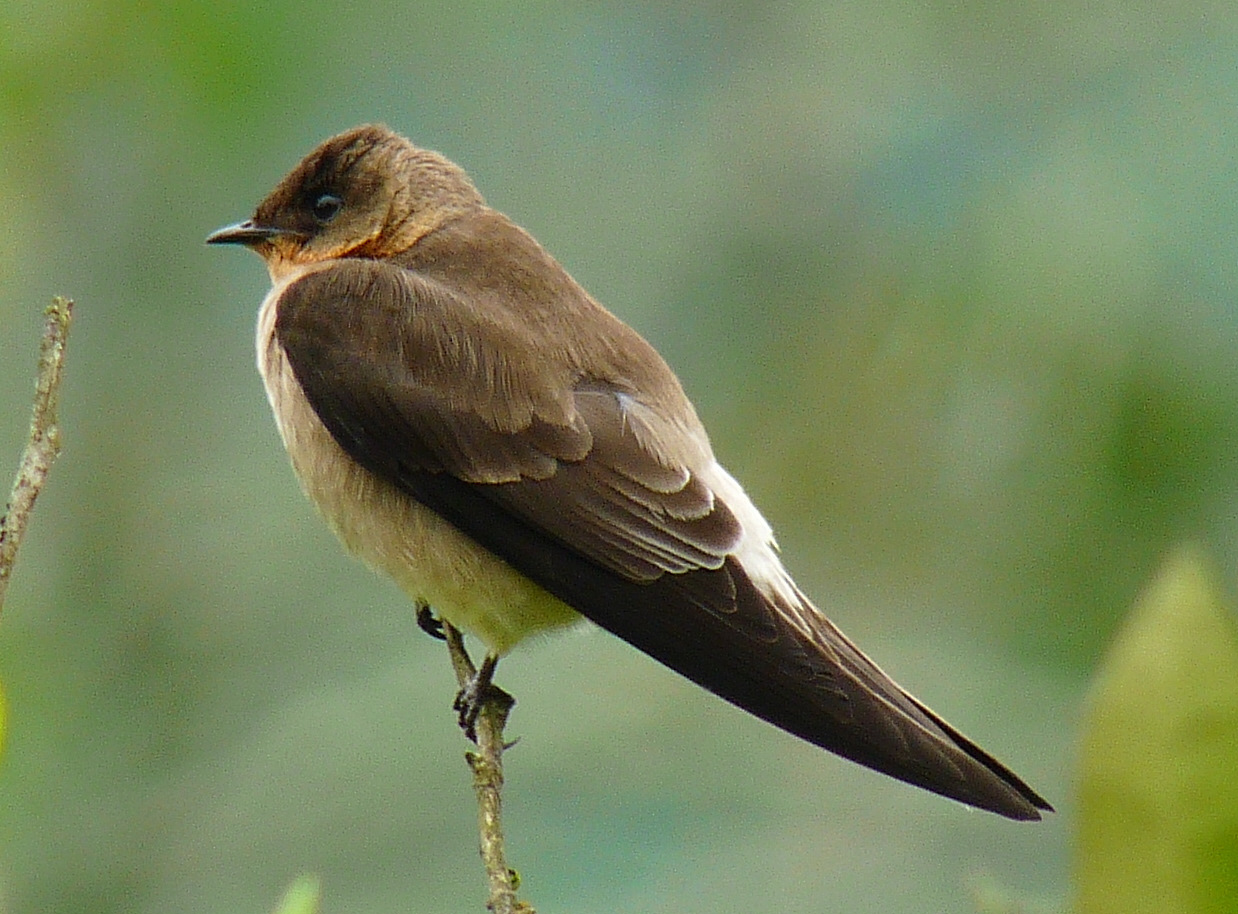
The Southern Rough-winged Swallow is a brown swallow with a cinnamon throat and a pale rump. It hunts low over rivers, roads, forest edges and clearings and likes to perch on wires and bare branches. In the guide area it lives in the lowlands and foothills from Honduras to Panama.
Voice
A short, rolling, slightly rising brrrt, often repeated; also soft, harsh notes.
Recording: Mateus Gonçalves Santos — CC BY-NC-SA 4.0 · converted to mono · xeno-canto
Identification
12–13 cm, with a short, almost square tail. Upperparts plain brown with a distinctly paler, whitish to buffy rump. Throat cinnamon, breast grey-brown, belly yellowish white. Sexes alike; young birds have rusty edges to the wing coverts and a less warmly coloured throat.
Confusion species
Northern Rough-winged Swallow Stelgidopteryx serripennis lacks the pale rump and has a dull grey-brown throat without a cinnamon tone. Bank Swallow Riparia riparia has a white throat and a dark breast band. White-thighed Swallow Atticora tibialis (Panama) is smaller and entirely dark.
Habitat
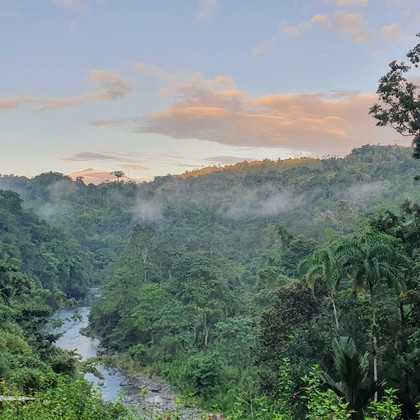
Riverbanks, stream valleys, roadsides, forest edges, clearings, pastures and villages, mainly in humid lowlands and foothills, locally to about 1500 m. It hunts flying insects low over the ground. It nests in burrows in banks and road cuts and in holes in walls and bridges.
Where the bird is most at home, classified by the vegetation units of Mexico and Central America.





Range and movements
From Honduras and Nicaragua through Costa Rica to Panama, on both slopes. Outside the guide area in much of South America, south to northern Argentina.
- Resident
- dark = core range, pale = thinly spread
How and when to look
Common in Costa Rica and Panama; often seen over rivers and along roads through forest, where small groups perch on wires. The pale rump is the best feature in flight.
Conservation status
Not threatened. Common and adapts well to open and human-modified country.
Scientific name
Stelgidopteryx ruficollis | (Vieillot, 1817)
Vieillot described the species in 1817 as Hirundo ruficollis; because it was later moved to another genus, the author and year stand in brackets. The genus Stelgidopteryx was introduced in 1858 by Baird. Stelgidopteryx is Greek, from stelgis 'scraper' and pterux 'wing', after the rough, serrated outer web of the outermost primary. ruficollis is Latin, from rufus 'rufous' and collum 'neck', after the rufous throat. The specimen the first description was based on came from Brazil.