All species › Waders, gulls and terns › Skimmers, noddies, terns and gulls › Sooty Tern
Position in the tree Birds Aves › Birds with a flexible palate Neognathae › All other modern birds Neoaves › Birds of the elements Elementaves › Cranes and waders Gruimorphae
Sooty Tern | Onychoprion fuscatus
Bonte stern | Charrán sombrío
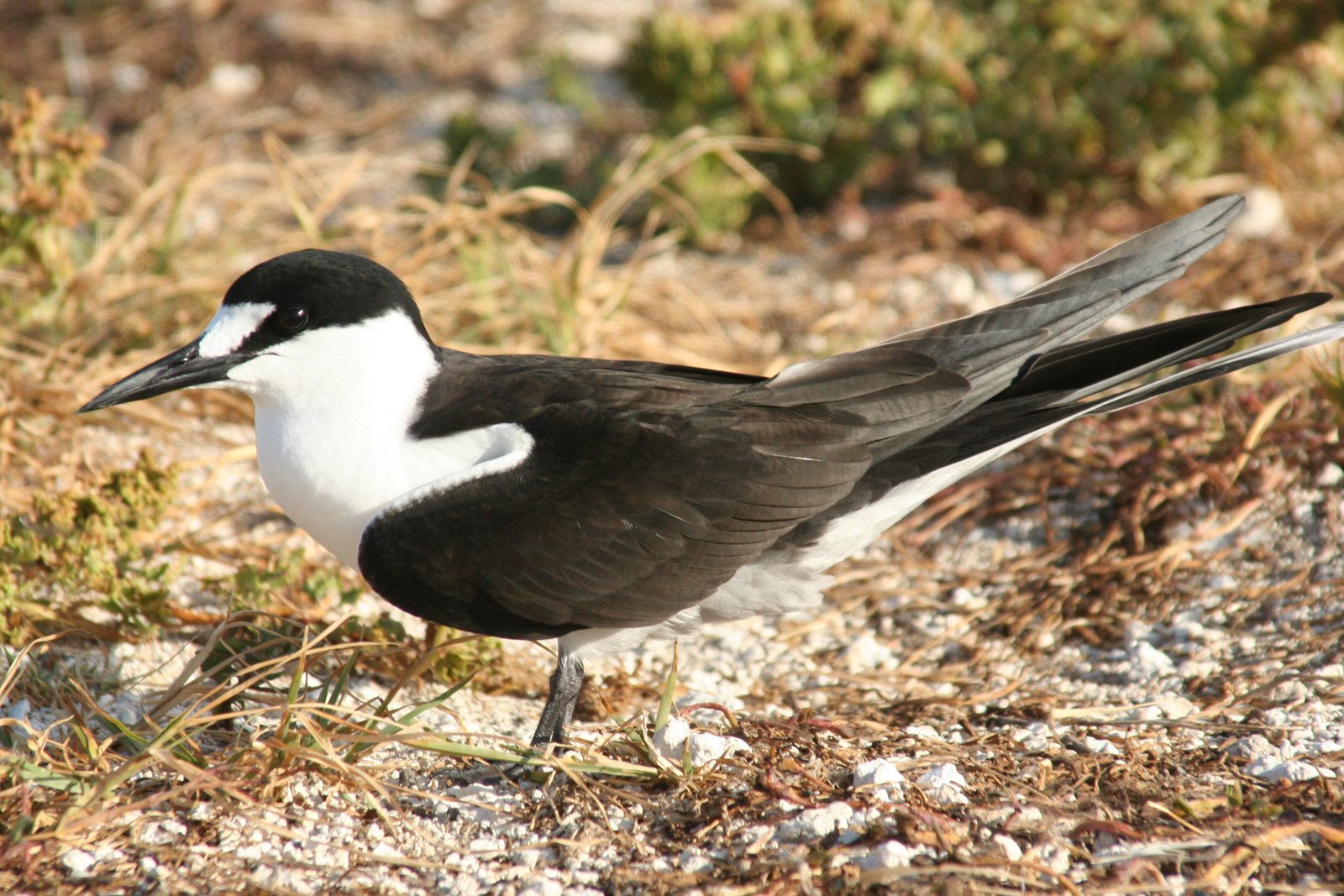
The Sooty Tern is a medium-sized, black-and-white tern of the open tropical sea. It rarely settles on the water and can stay over the ocean for months outside the breeding season. It breeds in dense, noisy colonies on oceanic islands and feeds by picking small fish and squid from the surface, often over shoals of tuna.
Voice
At and above the colony, day and night, a nasal, three-syllabled ker-wak-a-wak or wide-a-wake, which gave the species the nickname wideawake; also harsh alarm calls.
Recording: AUDEVARD Aurélien — CC BY-NC-SA 4.0 · converted to mono · xeno-canto
Identification
33–36 cm excluding the elongated outer tail feathers, with long, pointed wings and a deeply forked tail. Upperparts, wings and tail are black, with white outer edges to the tail. A broad white forehead patch reaches above the eye but not behind it, and a black loral stripe runs from eye to bill. Underparts white; the underwing has white coverts and contrasting dark flight feathers. Bill and legs are black. The sexes are alike. Juveniles are sooty brown with white spots on the back and wings, a paler belly and undertail and a less deeply forked tail.
Confusion species
Bridled Tern Onychoprion anaethetus is smaller and slimmer, with a grey-brown back that contrasts with the black cap, a pale collar and a narrower white forehead patch that extends behind the eye as a supercilium. Juvenile Sooty Terns resemble Brown Noddy Anous stolidus, which has a uniformly brown belly, a pale crown and a wedge-shaped tail.
Habitat
Open tropical and subtropical sea, far from the coast. It breeds in large colonies on the ground on oceanic islands and coral reefs, on sand, among low vegetation or on bare rock; the egg is laid in a shallow scrape.
Where the bird is most at home, classified by the vegetation units of Mexico and Central America.




Range and movements
Breeds in large colonies on the Revillagigedo Islands off the Pacific coast of Mexico and, on the Caribbean side, on Arrecife Alacranes and other reefs off the Yucatán Peninsula. Elsewhere in the guide area mainly at sea and scarce from shore; after hurricanes and tropical storms birds sometimes end up far inland, even on lakes in the interior. Outside the guide area in all tropical oceans, with large colonies on the Dry Tortugas, in the Caribbean, on Ascension and on islands in the Pacific and Indian Oceans.
- Resident
- Summer visitor (c. Apr–Sep)
- Passage (Mar–Apr, Oct–Nov)
- dark = core range, pale = thinly spread
How and when to look
Pelagic boat trips and crossings to offshore islands offer the best chances. After a tropical storm has passed it is worth searching coasts, lagoons and large lakes.
Conservation status
Not threatened. The world population numbers many millions of birds. Colonies have declined locally through egg collecting and introduced rats, cats and goats on breeding islands.
Scientific name
Onychoprion fuscatus | (Linnaeus, 1766)
Linnaeus described the species in 1766 as Sterna fuscata; because it was later moved to another genus, the author and year stand in brackets. The genus Onychoprion was introduced in 1832 by Wagler. Onychoprion comes from Greek onux 'nail, claw' and prion 'saw'. fuscatus is Latin for 'darkened', from fuscus 'dark', after the sooty upperparts. The specimen the first description was based on came from Santo Domingo.