All species › Waders, gulls and terns › Skimmers, noddies, terns and gulls › Black Noddy
Position in the tree Birds Aves › Birds with a flexible palate Neognathae › All other modern birds Neoaves › Birds of the elements Elementaves › Cranes and waders Gruimorphae
Black Noddy | Anous minutus
Witkapnoddy | Charrán-bobo negro
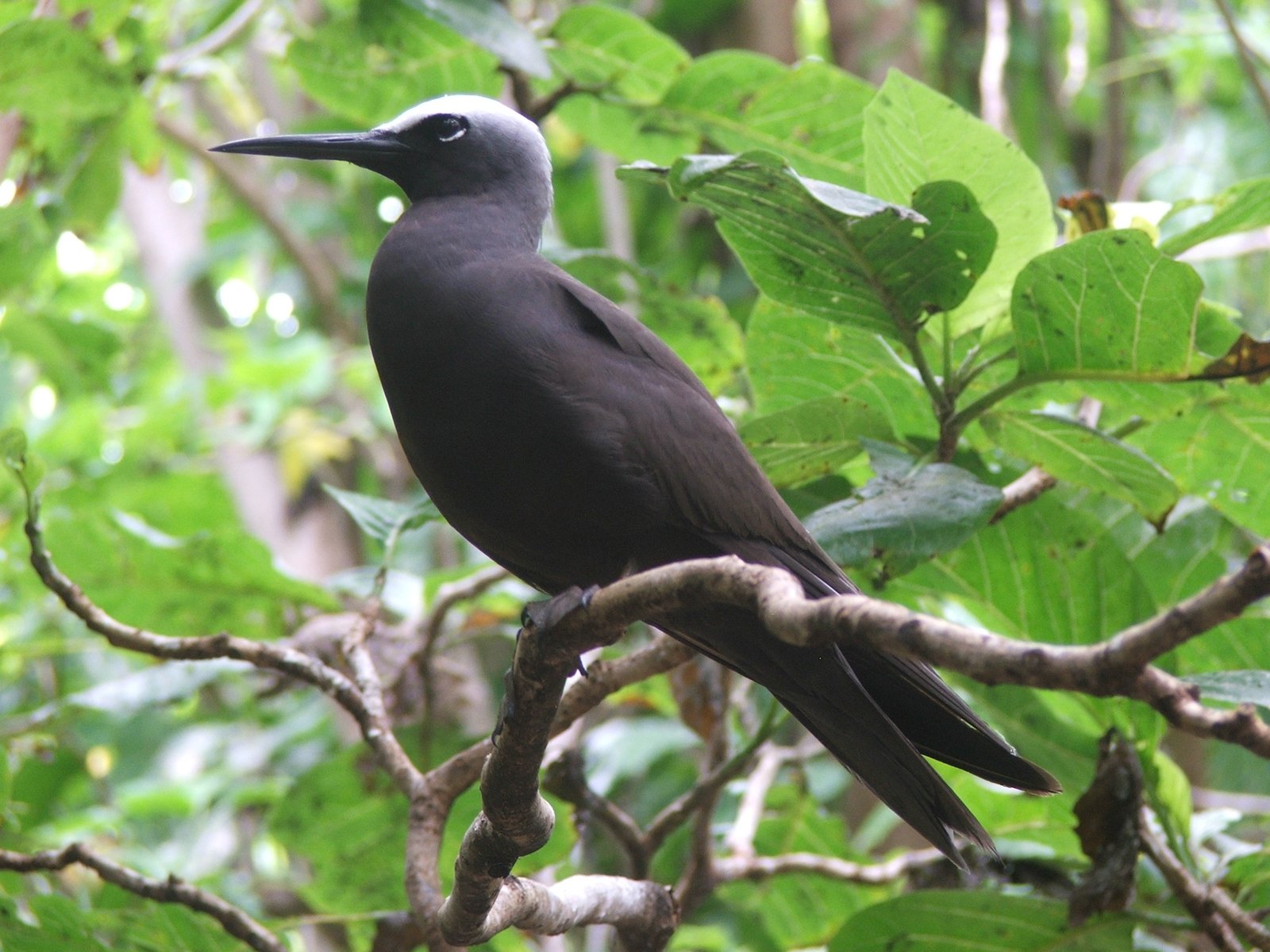
The Black Noddy is a small, sooty-black tern with a bright white cap and a long, thin bill. In the guide area it breeds in large numbers on Isla del Coco, where nests are built in trees. Elsewhere it is a scarce sight at sea, usually among flocks of Brown Noddies.
Voice
A dry, rattling krrr and chattering calls, higher and less raw than those of Brown Noddy; mostly silent away from the colony.
Recording: Sreekar — CC BY-NC-SA 4.0 · converted to mono · xeno-canto
Identification
35–37 cm, slender, sooty black with a brownish tinge, and a bright white cap that contrasts sharply with the dark lores and nape. A narrow white crescent below the eye. The bill is black, long and thin, longer than the head. The tail is wedge-shaped and relatively short, with a greyish tone. The sexes are alike. Juveniles have an even more sharply defined white cap and pale fringes to the upperparts.
Confusion species
Brown Noddy Anous stolidus is larger and warmer brown, with a shorter, thicker bill, a less sharply defined greyish crown, a paler underwing and a longer tail. Among Brown Noddies a Black Noddy stands out by its smaller size, faster wingbeats and striking white cap. Juvenile Sooty Terns Onychoprion fuscatus have white spots on the upperparts and a forked tail.
Habitat
Open tropical sea around islands, especially over deep water and reefs. It breeds in colonies in trees and shrubs on oceanic islands, sometimes on cliff ledges; the nest is a platform of leaves, seaweed and droppings. It often feeds close to the breeding site.
Where the bird is most at home, classified by the vegetation units of Mexico and Central America.




Range and movements
In the guide area it breeds on Isla del Coco (Costa Rica). On the Caribbean side scarce off Quintana Roo, Belize and the Bay Islands of Honduras, and a few times off Panama; its breeding status on this side is uncertain. Outside the guide area in the tropical Pacific, locally in the Indian Ocean and in the Atlantic, including islands off Venezuela and in the Gulf of Guinea.
- Summer visitor (c. Apr–Sep)
- Passage (Mar–Apr, Oct–Nov)
- dark = core range, pale = thinly spread
How and when to look
On Isla del Coco the colonies in the trees along the bays are clearly visible. On the Caribbean side it is worth checking flocks of Brown Noddies at reefs and headlands for a smaller, blacker bird with a white cap.
Conservation status
Not threatened. The world population is large. On the breeding islands introduced rats and the loss of nest trees are the main threats.
Scientific name
Anous minutus | Boie, 1844
Boie described the species in 1844 and placed it straight away in the genus where it still stands. The genus Anous was introduced in 1826 by Stephens. Anous is Greek for 'stupid, silly' — for the tameness with which noddies allowed sailors to approach and catch them. minutus is Latin for 'small', as it is smaller than the Brown Noddy (Anous stolidus). The specimen the first description was based on came from Raine Island, Australia.