All species › Passerines › Wrens › Song Wren
Position in the tree Birds Aves › Birds with a flexible palate Neognathae › All other modern birds Neoaves › Landbirds Telluraves › Falcons, parrots and passerines Australaves › Falcons and passerines Eufalconimorphae › Parrots and passerines Psittacopasserae
Song Wren | Cyphorhinus phaeocephalus
Pacifische orpheuswinterkoning | Cucarachero canoro
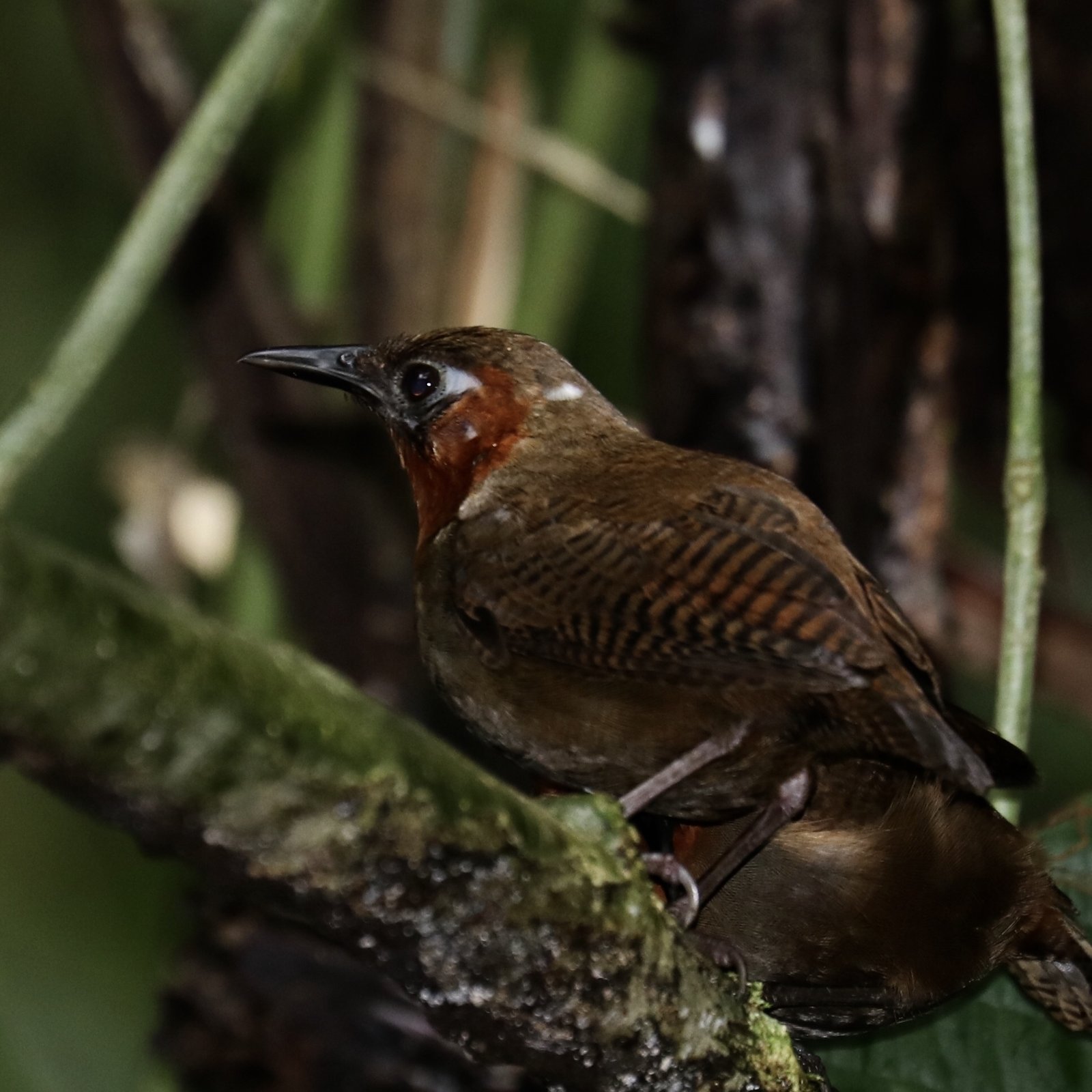
The Song Wren is a stocky, dark brown wren with a rufous throat and breast and bare, pale blue skin around the eye. Small groups forage over the floor of humid lowland forest, giving a remarkable mix of clear whistles and guttural sounds.
Voice
A series of clear whistled notes at varying pitch, interspersed with low, harsh clucks and rattles; the combination is distinctive. Foraging groups also give harsh, grating calls.
Recording: William Adsett — CC BY-NC-SA 4.0 · converted to mono · xeno-canto
Identification
12–13 cm. Upperparts dark rufous-brown, crown darker brown; wings and short tail barred black. Bare pale blue skin around the eye. Throat, cheeks and breast bright rufous, belly and flanks dark brown. Bill fairly heavy, with a distinct ridge on the upper mandible. Sexes alike.
Confusion species
White-breasted Wood Wren Henicorhina leucosticta is smaller, with a streaked head and a white breast. Bay Wren Cantorchilus nigricapillus has a black head with white on the face and forages higher in the undergrowth. The nightingale-wrens Microcerculus lack the blue eye-ring and the rufous breast.
Habitat
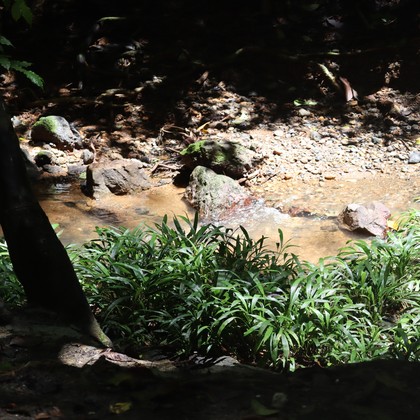
Floor and low undergrowth of humid evergreen lowland and foothill forest, mainly in the forest interior, sometimes in mature secondary forest. Groups or pairs flick over leaves in search of insects and other invertebrates and sometimes follow army ant swarms.
Where the bird is most at home, classified by the vegetation units of Mexico and Central America.


Range and movements
Caribbean slope of Honduras, Nicaragua and Costa Rica and much of Panama. Outside the guide area in western Colombia and Ecuador.
- Resident
- dark = core range, pale = thinly spread
How and when to look
Regularly heard at La Selva in Costa Rica and along Pipeline Road (Camino del Oleoducto) in Panama. Listen for the mix of whistles and guttural notes from the undergrowth; groups move slowly across the forest floor.
Conservation status
Not threatened. Depends on closed forest and is sensitive to deforestation, but is common in larger forest areas.
Scientific name
Cyphorhinus phaeocephalus | Sclater, 1860
Sclater described the species in 1860 and placed it straight away in the genus where it still stands. The genus Cyphorhinus was introduced in 1844 by Cabanis. Cyphorhinus is Greek, from kuphos 'hump' and rhis 'nose', after the arched, humped ridge of the bill. phaeocephalus is Greek, from phaios 'dusky' and kephalē 'head', after the dark brown head. The specimen the first description was based on came from Esmeraldas, Ecuador.