All species › Owls › Owls › Short-eared Owl
Position in the tree Birds Aves › Birds with a flexible palate Neognathae › All other modern birds Neoaves › Landbirds Telluraves › Raptors, owls, kingfishers and woodpeckers Afroaves › Hawks and owls Hieraves
Short-eared Owl | Asio flammeus
Velduil | Búho campestre
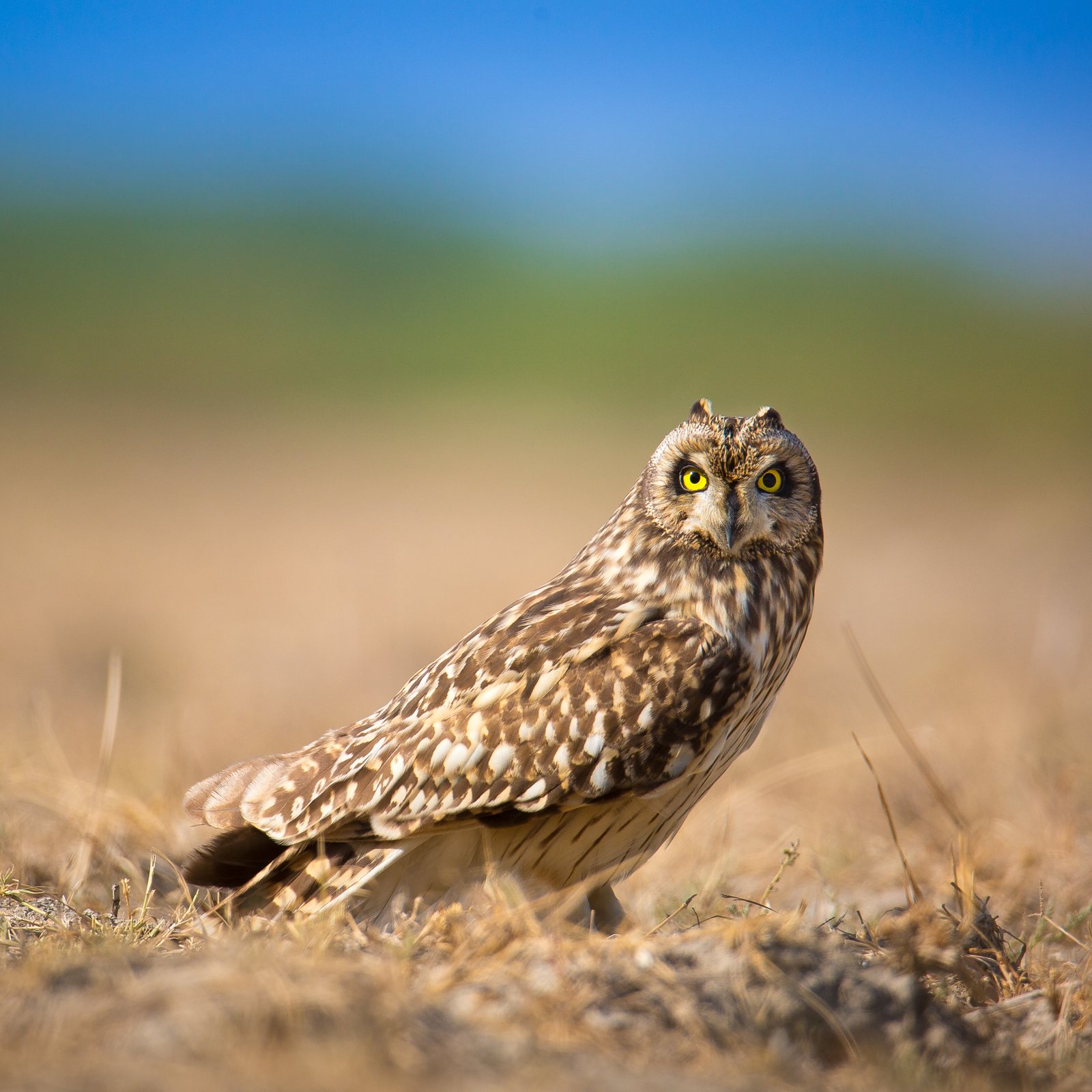
The Short-eared Owl is an owl of open country with one of the largest ranges of any bird. In the guide area it is a scarce winter visitor from North America that winters mainly in northern and central Mexico; there are no known breeding records from the guide area. It often hunts at dusk and sometimes in the middle of the day, with a low, fluttering and gliding flight over grass and rough vegetation.
Voice
Usually silent in winter. When disturbed a hoarse, barking kyeff or kee-aw. On the breeding grounds the male gives a series of low boo-boo-boo notes in display flight and claps its wings.
Recording: Kevin Guille — CC0 · converted to mono · xeno-canto
Identification
34–43 cm, medium-sized, with a large round head, very short ear tufts that are usually invisible, and yellow-orange eyes set in black surrounds. The facial disc is pale. The upperparts are buff with dark spots and streaks; the breast is heavily streaked dark, the belly paler and more finely streaked. In flight the long, narrow wings stand out, with a buff patch at the base of the primaries above, a dark carpal patch below and a dark wingtip with narrow bars.
Confusion species
The Long-eared Owl Asio otus has long ear tufts, a rufous face and a more finely marked belly with crossbars, and hunts mainly at night from thickets and scrub. The American Barn Owl Tyto furcata also hunts over open ground but has dark eyes in a white, heart-shaped facial disc and unstreaked pale underparts. The Striped Owl Asio clamator has long ear tufts, a white face with a black rim and dark eyes. The Burrowing Owl Athene cunicularia is much smaller and often stands on the ground.
Habitat
Open landscapes with tall grass or rough vegetation: grassland and semi-desert grassland, wet grassland and marsh edges, fields, pastures and fallow land, also coastal salt flats and grassland on the plateau. By day it roosts on the ground in grass, sometimes several birds together. It hunts low over the ground for mice and other small mammals, sometimes birds.
Where the bird is most at home, classified by the vegetation units of Mexico and Central America.







Range and movements
Winter visitor, roughly from November to March and in small numbers into April, mainly in Baja California and Baja California Sur, in the grasslands of Chihuahua and elsewhere in northern Mexico, and south on the plateau to the State of México and the Valley of Mexico; also on the coastal plain of Veracruz. Further south in the guide area rare to vagrant, with a few records in Guatemala, Belize, Honduras and Costa Rica. Almost absent in summer; no breeding is known from the guide area. Outside the guide area in North and South America, on Cuba, Hispaniola and Puerto Rico, in Europe, Asia and on Hawaii and the Galápagos.
- Winter visitor (c. Oct–Mar)
- dark = core range, pale = thinly spread
How and when to look
Best looked for in winter at dusk over large, open grasslands and fields, for example in the Janos grasslands in Chihuahua, in northern Baja California and in the marshes and grasslands of the upper Lerma in the State of México. A bird fluttering low over the grass with deep, irregular wingbeats and then dropping down is typical.
Conservation status
Not threatened as a species. In North America numbers have declined sharply through the loss of grasslands; in the Mexican wintering areas, too, grassland is being lost to arable farming and development.
Scientific name
Asio flammeus | (Pontoppidan, 1763)
Pontoppidan described the species in 1763 as Strix Flammea; because it was later moved to another genus, the author and year stand in brackets. The genus Asio was introduced in 1760 by Brisson. Asio is the Latin name of a horned or eared owl. flammeus is Latin for 'flame-coloured'. The specimen the first description was based on came from Sweden.