All species › Owls › Owls › Ferruginous Pygmy Owl
Position in the tree Birds Aves › Birds with a flexible palate Neognathae › All other modern birds Neoaves › Landbirds Telluraves › Raptors, owls, kingfishers and woodpeckers Afroaves › Hawks and owls Hieraves
Ferruginous Pygmy Owl | Glaucidium brasilianum
Braziliaanse dwerguil | Tecolote bajeño
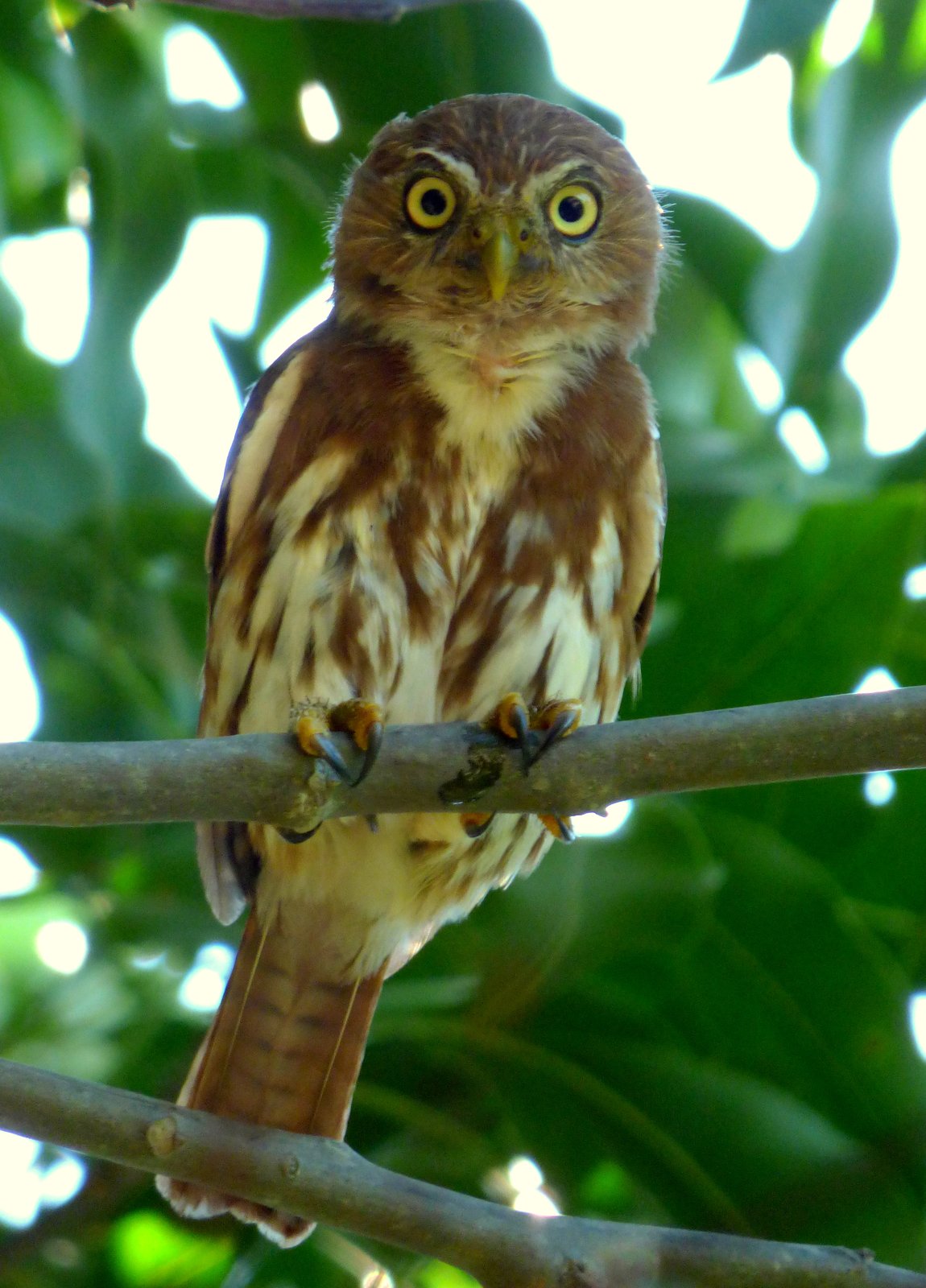
The Ferruginous Pygmy Owl is the most widespread and most common pygmy owl in the guide area and occurs from the southern United States to Argentina. It is also active by day and often sings in the middle of the day. Small songbirds and hummingbirds react strongly to it and so often reveal where it is perched. The birds of Mexico and Central America are sometimes treated as a separate species, Glaucidium ridgwayi.
Voice
A long series of even, whistled toots, poip-poip-poip-poip, about two to three per second, which can run to dozens of notes; given both by day and at night. Also a high, twittering chirr. The song is widely imitated throughout the range to attract songbirds.
Recording: Juan Freile — CC BY-NC-SA 4.0 · converted to mono · xeno-canto
Identification
15–17 cm, compact, with a round head without ear tufts, yellow eyes, short white eyebrows and a fairly long tail. The colour varies from grey-brown to warm rufous. The crown is finely streaked pale, not dotted; on the nape two black spots with a pale border act as false eyes. In grey-brown birds the tail is dark with narrow pale bars, in rufous birds rufous with dark bars. The underparts are white with rufous or brown streaks. It often cocks and wags its tail.
Confusion species
The Colima Pygmy Owl Glaucidium palmarum, the Tamaulipas Pygmy Owl Glaucidium sanchezi, the Central American Pygmy Owl Glaucidium griseiceps and the Northern Pygmy Owl Glaucidium gnoma have pale dots instead of streaks on the crown and fewer, broken white tail bars; their song is a short series of toots. The Tropical Screech Owl Megascops choliba and other screech owls have ear tufts and are active only at night. The Elf Owl Micrathene whitneyi has a short tail and no false eyes.
Habitat
Dry and semi-evergreen forest, thorn scrub, forest edges, secondary forest, gallery forest, farmland and pasture with scattered trees, plantations, gardens and villages; in Sonora also cactus desert and riparian woodland. Mainly in the lowlands and on the lower slopes, locally up to about 1,500 metres. It hunts from a perch, by day and at dusk, for large insects, lizards, small birds and mice, sometimes prey larger than itself. It nests in tree cavities, old woodpecker holes and cavities in columnar cacti.
Where the bird is most at home, classified by the vegetation units of Mexico and Central America.







Range and movements
Resident in the lowlands of much of the guide area: on the Pacific side from Sonora south and on the Gulf side from Nuevo León and Tamaulipas south, across the Yucatán Peninsula and through Belize, Guatemala, El Salvador, Honduras, Nicaragua and Costa Rica into Panama, where it is more local. In Costa Rica mainly in the dry northwest. Absent from the high mountains and the wettest rainforests. Outside the guide area in Arizona and Texas and in South America south to Argentina.
- Resident
- dark = core range, pale = thinly spread
How and when to look
Found almost everywhere in dry forest and open country with trees in the lowlands, also in gardens and hotel grounds, for example in Yucatán and in Guanacaste in Costa Rica. A group of agitated songbirds and hummingbirds around one spot in a tree often points to a pygmy owl; the series of toots is often heard in the middle of the day too.
Conservation status
Not threatened. The species adapts well to man-made landscapes as long as trees with cavities remain. At the northern edge of its range, in Arizona, it has become rare.
Scientific name
Glaucidium brasilianum | (Gmelin, 1788)
Gmelin described the species in 1788 as Strix brasiliana; because it was later moved to another genus, the author and year stand in brackets. The genus Glaucidium was introduced in 1826 by Boie. Glaucidium is Greek glaukidion 'little owl' or 'owlet', a diminutive of glaux 'owl'. brasilianum means 'Brazilian', after Brazil, where the species was described. The specimen the first description was based on came from Brazil (Ceará suggested).