All species › Swifts › Hummingbirds › Short-crested Coquette
Position in the tree Birds Aves › Birds with a flexible palate Neognathae › All other modern birds Neoaves › Birds of the elements Elementaves › Nightjars and swifts Strisores
Short-crested Coquette | Lophornis brachylophus
Kortkuifkoketkolibrie | Coqueta cresticorta
The Short-crested Coquette occurs only in a small area in the Sierra de Atoyac in Guerrero and is one of the rarest birds in Mexico. For a long time it was known from only a few specimens; today it is mainly seen in and near shade coffee plantations on the Pacific slope.
Voice
Poorly known. Soft, short tsip calls; the wings produce a soft hum.
No recording with a suitable Creative Commons licence is available for this species yet.
Identification
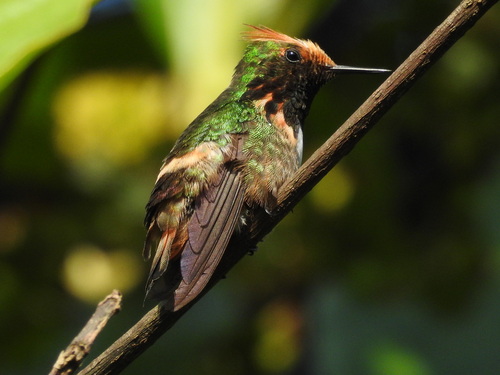
7 cm, with a short, straight red bill with a black tip. The male has a short rufous crest whose feathers have green tips, a glittering green throat, rufous cheek tufts with green tips, a green back with a white to pale buff band across the lower back and a rufous tail with dark edges. The female lacks crest and cheek tufts; she has a rufous forehead, a pale buff throat, pale underparts, the same pale rump band and a rufous tail with a dark band.
Confusion species
No other coquette occurs in the area. Black-crested Coquette Lophornis helenae lives far away, on the Gulf slope and in south-eastern Mexico, and has a long black crest. Sparkling-tailed Woodstar Tilmatura dupontii is just as small and also has pale spots on the lower back, but the male has a long forked tail and the female has cinnamon underparts without a rufous forehead. Female Canivet's Emerald Cynanthus canivetii has a white stripe behind the eye and no pale rump band.
Habitat
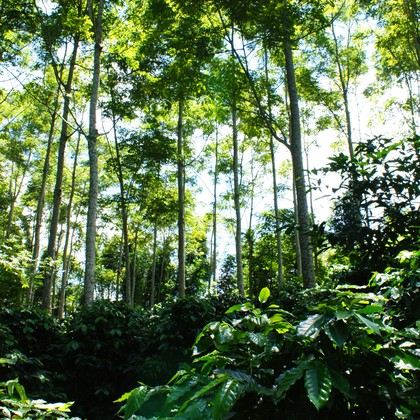
Humid semi-deciduous and evergreen forest on the Pacific slope, cloud-forest edges and especially shade coffee plantations with flowering shade trees and shrubs, roughly between 900 and 1800 m. It feeds at flowers in the lower and middle strata and along edges and roads.
Where the bird is most at home, classified by the vegetation units of Mexico and Central America.



Range and movements
Endemic to Mexico. Known only from a small area in the Sierra de Atoyac, on the Pacific slope of the Sierra Madre del Sur in Guerrero, north of Atoyac de Álvarez, around the villages of El Paraíso and La Pintada. There are no reliable reports from elsewhere.
- Resident
- dark = core range, pale = thinly spread
How and when to look
Only found in the shade coffee around La Pintada and along the road from El Paraíso to Puerto del Gallo; local guides know the sites. Security in the region varies, so it is worth obtaining current local information in advance.
Conservation status
Critically Endangered. The world population is very small and confined to a single mountain area. Threats are forest loss through logging, fires and agricultural expansion, and the conversion of shade coffee into open crops. The area is poorly studied and the population size is uncertain.
Scientific name
Lophornis brachylophus | Moore, 1949
Moore described the species in 1949 and placed it straight away in the genus where it still stands. The genus Lophornis was introduced in 1829 by Lesson. Lophornis is Greek, from lophos 'crest' and ornis 'bird', after the males' crests. brachylophus is Greek, from brakhus 'short' and lophos 'crest', after the male's short crest. The specimen the first description was based on came from San Vicente de Benitez, Guerrero, Mexico.