All species › Swifts › Hummingbirds › Rufous-crested Coquette
Position in the tree Birds Aves › Birds with a flexible palate Neognathae › All other modern birds Neoaves › Birds of the elements Elementaves › Nightjars and swifts Strisores
Rufous-crested Coquette | Lophornis delattrei
Vuurkuifkoketkolibrie | Coqueta crestirrufa
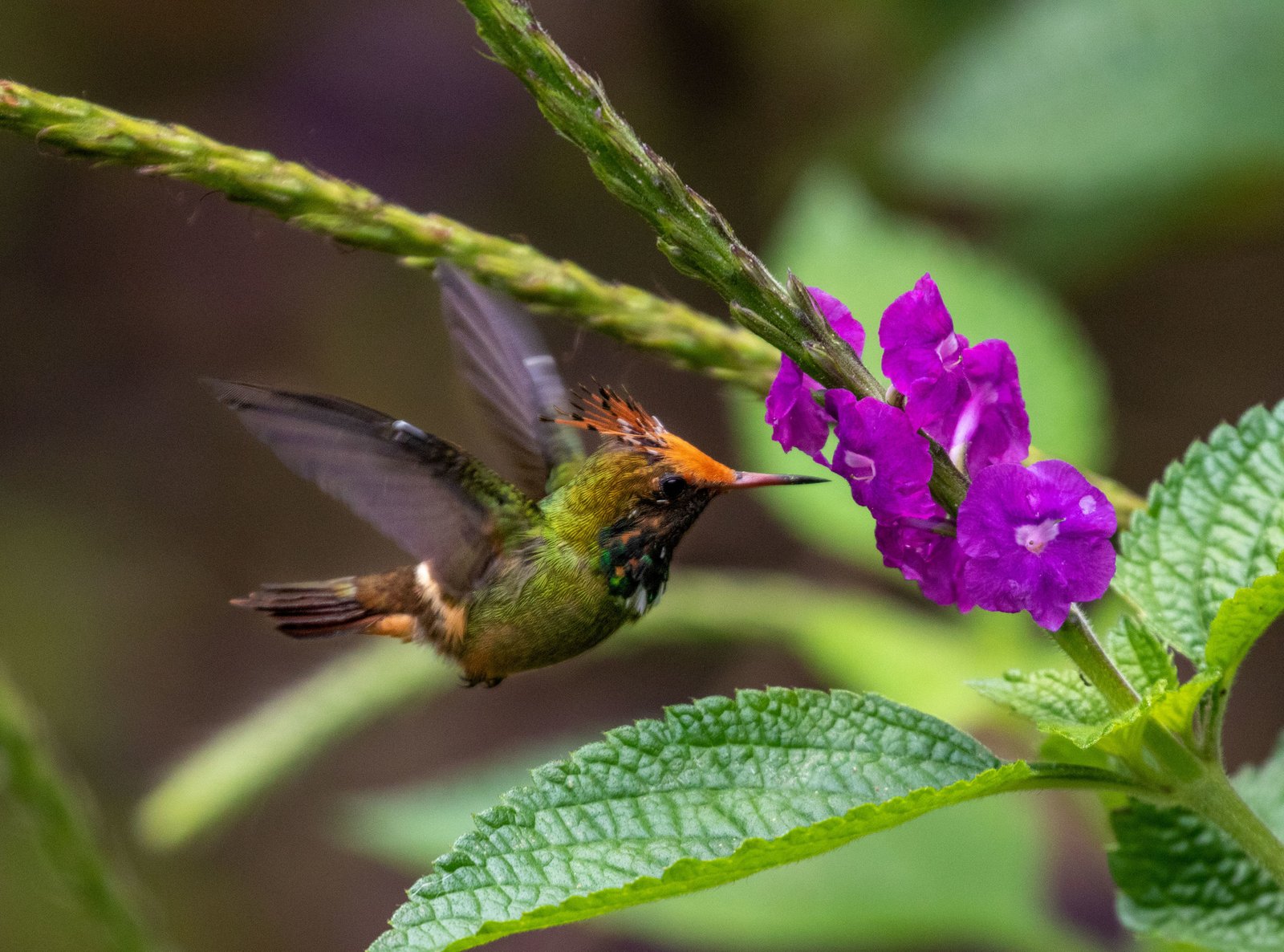
The Rufous-crested Coquette is one of the smallest birds in the guide area. The male has an erect, rufous crest. In the guide area the species lives only in Panama and, rarely, in Costa Rica; most of its range lies along the eastern slope of the Andes. Coquettes fly slowly with a humming sound, the tail slightly raised, and look more like a large bee or a hawk-moth than a bird.
Voice
Rather silent. A soft, dry tsip or tik, sometimes in short series. In flight the wings produce a low, insect-like hum.
Recording: Jerome Fischer — CC BY-NC-SA 4.0 · shortened to the first 60 s, mono · xeno-canto
Identification
7 cm, with a short, straight bill that is red with a black tip in the male. Both sexes have bronze-green upperparts and a narrow whitish band across the rump, which is clearly visible in flight; the tail is largely rufous. The male has a long crest of narrow rufous feathers, some with a dark green spot at the tip, a glittering green throat and bronze-green underparts. The female lacks the crest and has a rufous forehead, a pale, rufous-tinged throat and paler, greyish bronze-green underparts.
Confusion species
The male White-crested Coquette Lophornis adorabilis of Costa Rica and western Panama has a white crest and a rufous belly; the female of that species has rufous underparts. Black-crested Coquette Lophornis helenae has a black crest and spotted underparts and lives mainly further north. Green Thorntail Discosura conversii also has a white rump band, but the male has long, wire-like tail feathers and no crest. Short-crested Coquette Lophornis brachylophus of Guerrero in Mexico was formerly treated as a subspecies of this species and has a shorter crest.
Habitat
Edges of humid foothill and montane forest, clearings, old secondary forest, roadside forest edges and gardens with flowering shrubs, in the guide area mainly between about 500 and 1300 m. It takes nectar high in flowering trees and at low flowering shrubs along edges, and catches small insects.
Where the bird is most at home, classified by the vegetation units of Mexico and Central America.




Range and movements
In the guide area in central Panama, mainly in the hills and mountains of Coclé, Panamá and Colón, with scattered records further west and in southern Costa Rica, where the species is rare and irregular. Outside the guide area along the Andes from Colombia through Ecuador and Peru to Bolivia.
- Resident
- Winter visitor (c. Oct–Mar)
- dark = core range, pale = thinly spread
How and when to look
In Panama around El Valle de Antón and Cerro Gaital and on Cerro Azul, at flowering shrubs along forest edges and in gardens. The species often appears temporarily where many flowers are in bloom and is gone again a few weeks later; during flowering, birds regularly return to the same shrub.
Conservation status
Not threatened. Scarce and local in the guide area, with marked fluctuations in numbers from place to place. The species uses forest edges and semi-open country with flowering shrubs.
Scientific name
Lophornis delattrei | (Lesson, 1839)
Lesson described the species in 1839 as Ornismya (Lophorinus) DeLattrei; because it was later moved to another genus, the author and year stand in brackets. The genus Lophornis was introduced in 1829 by Lesson. Lophornis is Greek, from lophos 'crest' and ornis 'bird', after the males' crests. delattrei honours the French naturalist and collector Adolphe Delattre (1805–1854), who collected in Mexico and Colombia. The specimen the first description was based on came from not designated; probably Peru.