All species › Swifts › Hummingbirds › Green Thorntail
Position in the tree Birds Aves › Birds with a flexible palate Neognathae › All other modern birds Neoaves › Birds of the elements Elementaves › Nightjars and swifts Strisores
Green Thorntail | Discosura conversii
Groene draadkolibrie | Colibrí colicerda verde
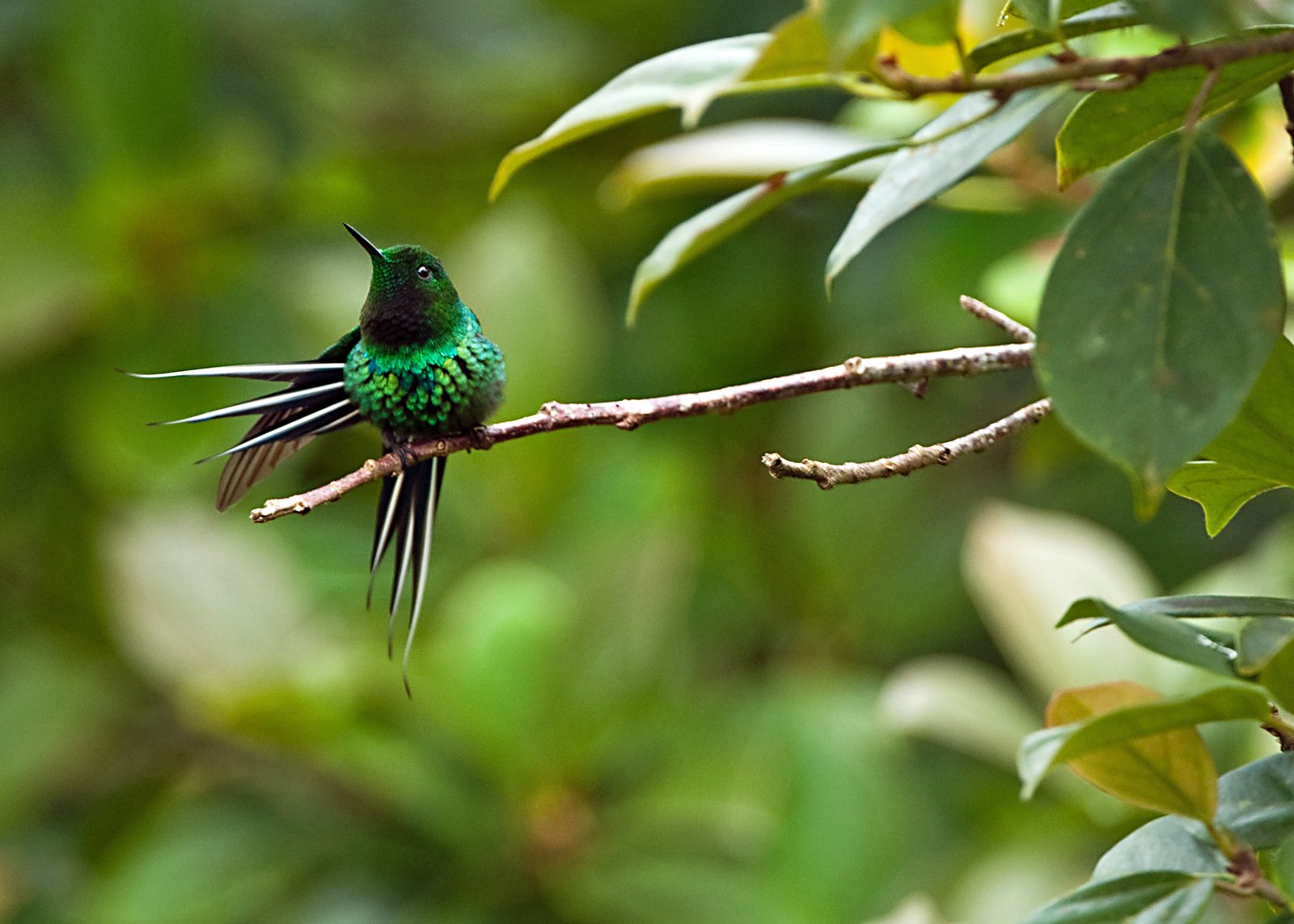
The Green Thorntail is a very small hummingbird of the humid foothills of Costa Rica and Panama. The male has wire-like, pointed tail feathers that project far beyond the body. Because of its slow, humming flight and the white band across the lower back, a feeding bird looks more like a large butterfly or hawk-moth than a hummingbird.
Voice
Rather quiet. A soft, dry chit and a fine twitter; in flight a low humming of the wings.
Recording: Jerome Fischer — CC BY-NC-SA 4.0 · converted to mono · xeno-canto
Identification
7–8 cm excluding the long tail feathers, which add about 3 cm in the male. The bill is short, straight and black. The male is glittering green, with a narrow white band across the lower back, small white tufts on the flanks and a blue-black tail with stiff, wire-like tips. The female has a short, slightly forked tail with white tips; she is green above with the same white rump band, and dark blackish below with a white malar stripe and a white flank patch.
Confusion species
Coquettes, such as White-crested Coquette Lophornis adorabilis and Rufous-crested Coquette Lophornis delattrei, also have a pale band across the lower back, but the male has a crest and a rufous tail; females have rufous on the face or in the tail. Snowcap Microchera albocoronata lacks the rump band and the male has a white crown.
Habitat
Humid hill and foothill forest, mainly in the canopy and along forest edges and clearings, and in gardens with flowering shrubs near forest. It often feeds high at flowering trees and comes low to shrubs such as porterweed; it hovers slowly at the flowers with its tail cocked.
Where the bird is most at home, classified by the vegetation units of Mexico and Central America.





Range and movements
In Costa Rica mainly on the Caribbean slope of the mountains, locally also just across the divide on the Pacific slope, and in Panama in the foothills of both slopes from the west to Coclé and Panamá province and in Darién. Outside the guide area in western Colombia and western Ecuador.
- Resident
- dark = core range, pale = thinly spread
How and when to look
In Costa Rica regularly at porterweed hedges and flowering shrubs in lodge gardens on the Caribbean slope, such as around Cinchona, Rancho Naturalista and the Sarapiquí area; in Panama for example at El Valle de Antón and Cerro Azul.
Conservation status
Not threatened. The species is locally common and also occurs in gardens and at the edges of farmland, but depends on foothill forest, which has disappeared in many places.
Scientific name
Discosura conversii | (Bourcier & Mulsant, 1846)
Bourcier & Mulsant described the species in 1846 as Trochilus Conversii; because it was later moved to another genus, the author and year stand in brackets. The genus Discosura was introduced in 1850 by Bonaparte. Discosura is Greek, from diskos 'disc, plate' and oura 'tail', after the disc-tipped tail feathers of some species. conversii honours M. Convers (fl. 1845), French naturalist and collector resident in Bogotá (Colombia). The specimen the first description was based on came from Bogotá, Colombia.