All species › Birds of prey › Kites, Old World vultures, eagles and hawks › Savanna Hawk
Position in the tree Birds Aves › Birds with a flexible palate Neognathae › All other modern birds Neoaves › Landbirds Telluraves › Raptors, owls, kingfishers and woodpeckers Afroaves › Hawks and owls Hieraves
Savanna Hawk | Buteogallus meridionalis
Savannebuizerd | Gavilán sabanero
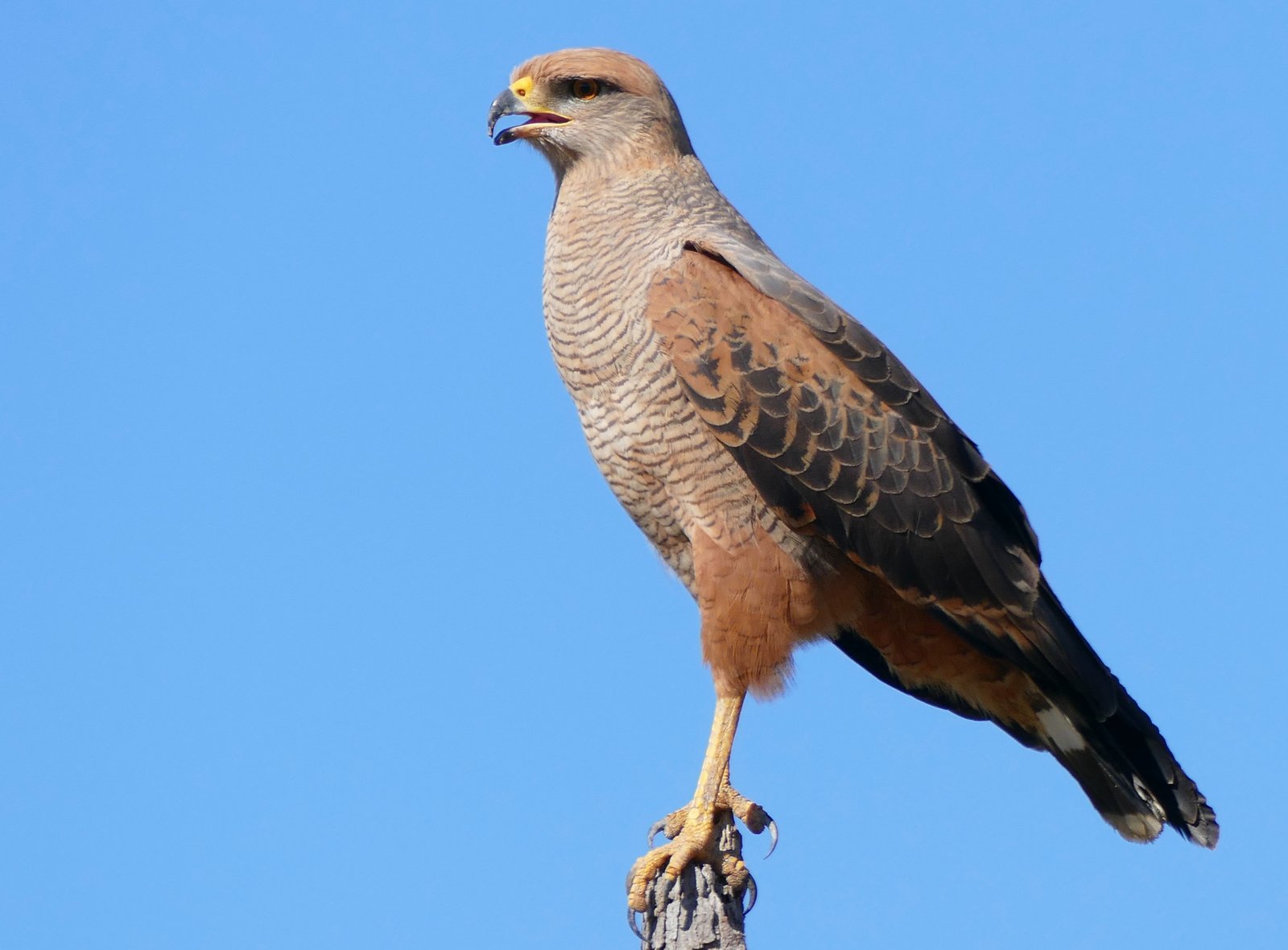
The Savanna Hawk is a large, rufous hawk with very long, broad wings, long yellow legs and a short black tail with one white band. It often perches on posts, low trees or the ground in open grassland and hunts large insects, frogs, snakes, crabs and small mammals, also following grass fires and ploughs. In the guide area it is a resident of the lowlands of Panama that has also become established in southwestern Costa Rica since the beginning of this century.
Voice
A hoarse, drawn-out, descending scream, keeeeerr, especially around the nest and during disputes.
Recording: JAYRSON ARAUJO DE OLIVEIRA — CC BY-NC-SA 4.0 · converted to mono · xeno-canto
Identification
46–61 cm, with very long, broad wings, long yellow legs and a short tail. Adults are cinnamon-red to rufous, with fine dark barring on the underparts and a greyish-mottled mantle. The flight feathers are rufous with a broad black trailing edge and black wingtips. The tail is black with one broad white band in the middle and a narrow white tip. The eye is brown to orange, the cere yellow. In flight the wings look long and rectangular, and when perched they reach beyond the tail tip. Young birds are duller and browner, with a pale supercilium, buff underparts with dark streaks and a tail with several narrow bands. Male and female are alike; the female is larger.
Confusion species
The rufous colour, long legs and long wings make it almost unmistakable. The Black-collared Hawk Busarellus nigricollis is also rufous, but has a white head, a black neck patch and shorter, broader wings, and lives by water. Harris’s Hawk Parabuteo unicinctus is dark brown with rufous shoulders and thighs and a white tail base. The Roadside Hawk Rupornis magnirostris is much smaller and greyish-brown.
Habitat
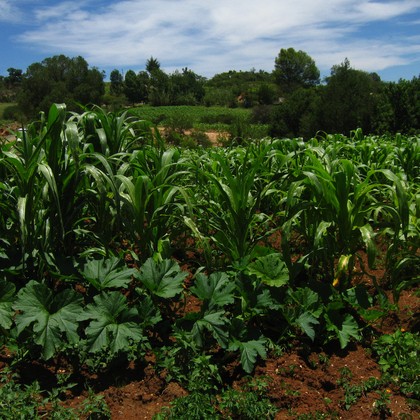
Open lowland savanna, grassland and pasture with scattered trees and posts, wet grassland, marsh edges and rice fields; mainly in the lowlands up to about 600 m. It often sits motionless for long periods on a post or low in a tree, or walks on the ground. It appears at grass fires and ploughing tractors to take flushed prey.
Where the bird is most at home, classified by the vegetation units of Mexico and Central America.



Range and movements
Resident in Panama, mainly in the lowlands of the Pacific slope, from Chiriquí through Veraguas, Herrera, Los Santos and Coclé to Panamá province and east into Darién; locally also on the Caribbean side in Colón. Since the beginning of this century it has spread into southwestern Costa Rica, where it is now an established breeder in Puntarenas province; a few records further north, as far as Nicaragua. Outside the guide area in South America, from Colombia and Venezuela to northern Argentina.
- Resident
- dark = core range, pale = thinly spread
How and when to look
Along the Pan-American Highway in the lowlands of Coclé and Herrera in Panama, birds often perch on fence posts and in isolated trees in pastures; in Costa Rica it can be seen in the open farmland of southern Puntarenas.
Conservation status
Not threatened. It benefits from the conversion of forest to pasture and is expanding in the guide area.
Scientific name
Buteogallus meridionalis | (Latham, 1790)
Latham described the species in 1790 as Falco meridionalis; because it was later moved to another genus, the author and year stand in brackets. The genus Buteogallus was introduced in 1830 by Lesson. Buteogallus is Latin, from buteo 'buzzard' and gallus 'cock, fowl'; the reason for the second part is unclear. meridionalis is Latin for 'southern', after its range in South America. The specimen the first description was based on came from Cayenne, French Guiana.