All species › Birds of prey › Kites, Old World vultures, eagles and hawks › Great Black Hawk
Position in the tree Birds Aves › Birds with a flexible palate Neognathae › All other modern birds Neoaves › Landbirds Telluraves › Raptors, owls, kingfishers and woodpeckers Afroaves › Hawks and owls Hieraves
Great Black Hawk | Buteogallus urubitinga
Zwarte arendbuizerd | Aguililla-negra mayor
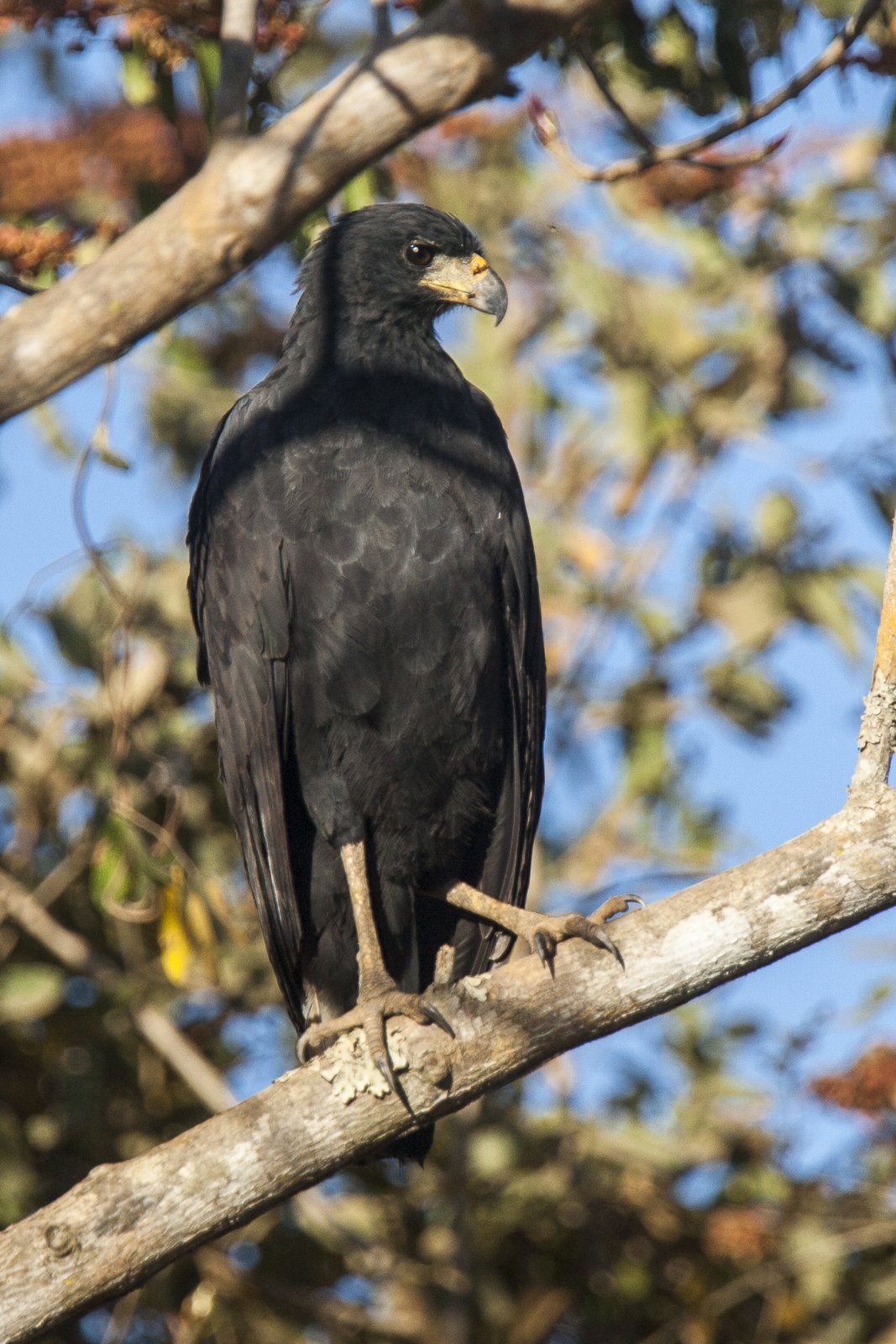
The Great Black Hawk is a large black hawk with broad wings, long yellow legs and a tail that is largely white. It hunts from a perch or by walking on the ground for a wide range of prey, from snakes, lizards and frogs to crabs, fish, birds and small mammals. In the guide area it is a widespread lowland resident from Mexico to Panama, mainly near water.
Voice
A long, rising, whistled scream, ooo-weeeeeee, often high in flight or from a perch, sometimes alternating with short, shrill calls.
Recording: Guillermo Menéndez (gmmv80) — CC BY-NC-SA 4.0 · shortened to the first 60 s, mono · xeno-canto
Identification
51–64 cm, with broad, rounded wings, a fairly long tail and long yellow legs. Adults are black, with fine white barring on the thighs, a white rump and yellow cere and lores. The tail is white with a broad black terminal band and a narrow white tip; in Mexico and northern Central America the white is more extensive, while in eastern Panama the tail base is blacker and there are sometimes two white bands. In flight the wings are uniformly black from below, without a pale patch in the primaries. Young birds are dark brown above and buff with dark streaks below, with a pale head and a tail with numerous narrow dark bands; adult plumage is reached only after several years. Male and female are alike; the female is larger.
Confusion species
The Common Black Hawk Buteogallus anthracinus is smaller and stockier, with shorter legs, a black tail base with one broad white band in the middle, no white rump and a small pale patch at the base of the outer primaries. The Solitary Eagle Buteogallus solitarius is larger and slate-grey, with even broader wings and a very short tail, and lives in montane forest. The Black Hawk-Eagle Spizaetus tyrannus has a small crest, feathered legs and a long tail with several grey bands. Young birds closely resemble young Common Black Hawks, but have longer legs and a longer tail with more and narrower bands.
Habitat
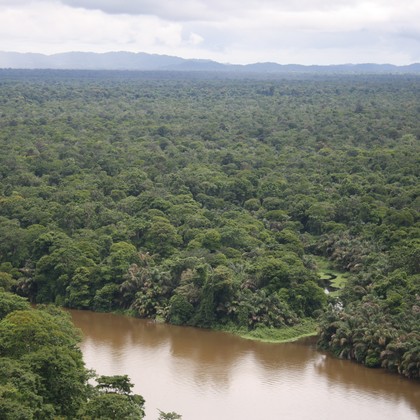
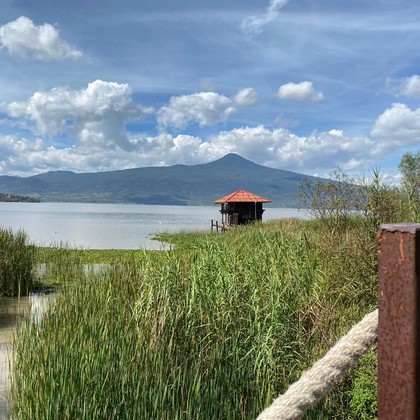
Floodplain and gallery forest, mangroves, swamp forest and marshes, forest edges and clearings in lowland forest, and pasture with scattered trees, usually near rivers or lakes; mainly in the lowlands, locally up to about 1500 m. It perches on a branch at the forest edge or walks over banks, mudflats and pasture in search of prey.
Where the bird is most at home, classified by the vegetation units of Mexico and Central America.





Range and movements
Resident in the lowlands of Mexico, on the Pacific slope from southern Sonora and Sinaloa and on the Gulf slope from southern Tamaulipas, south through Oaxaca, Chiapas, Tabasco and the Yucatán Peninsula, and on through Belize, Guatemala, El Salvador, Honduras, Nicaragua and Costa Rica to Panama. Absent from the arid north and the plateaus of Mexico and from the higher mountains of Central America. Outside the guide area in tropical South America, east of the Andes to northern Argentina.
- Resident
- dark = core range, pale = thinly spread
How and when to look
Along rivers, lagoons and marshes in the lowlands, for example at Palo Verde and Caño Negro in Costa Rica and around the Panama Canal, it often perches on a dead branch at the forest edge or walks over banks and pasture. Birds circling high over the forest can be recognized by the white tail with its broad black terminal band.
Conservation status
Not threatened. Declining locally through the clearing of forest and riparian woodland and through shooting, but still widespread in the lowlands of the guide area.
Scientific name
Buteogallus urubitinga | (Gmelin, 1788)
Gmelin described the species in 1788 as Falco Urubitinga; because it was later moved to another genus, the author and year stand in brackets. The genus Buteogallus was introduced in 1830 by Lesson. Buteogallus is Latin, from buteo 'buzzard' and gallus 'cock, fowl'; the reason for the second part is unclear. urubitinga is a Tupi name for a bird of prey, via Georg Marcgrave's Brazilian descriptions (1648). The specimen the first description was based on came from northeastern Brazil.