All species › Cuckoos › Cuckoos › Rufous-vented Ground Cuckoo
Position in the tree Birds Aves › Birds with a flexible palate Neognathae › All other modern birds Neoaves › Doves, turacos and allies Columbaves › Bustards, turacos and cuckoos Otidimorphae
Rufous-vented Ground Cuckoo | Neomorphus geoffroyi
Roodbuikgrondkoekoek | Cuco hormiguero ventrirrufo
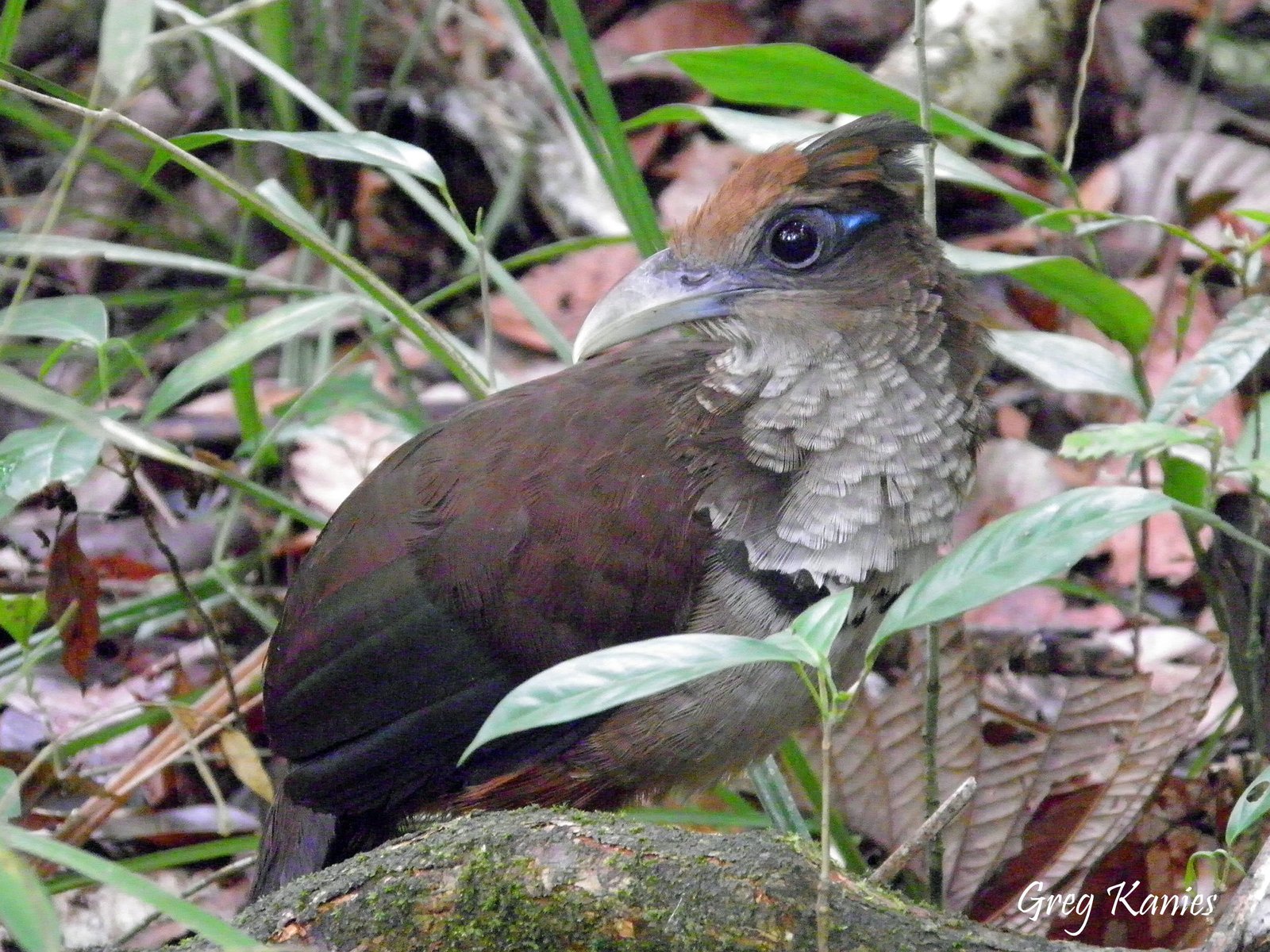
The Rufous-vented Ground Cuckoo is a large, ground-dwelling cuckoo of undisturbed humid lowland forest that follows army-ant swarms and herds of peccaries to catch flushed animals. In the guide area it lives from eastern Nicaragua to Panama. It is scarce, shy and has declined in much of its range through forest loss.
Voice
A loud, dry bill-clacking, often the first sign, especially when the bird is excited. Also a low, hollow, dove-like moan, a drawn-out whooo-oop that carries far through the forest.
Recording: Odirlei Vieira da Fonseca — CC BY-NC-SA 4.0 · shortened to the first 60 s, mono · xeno-canto
Identification
46–51 cm; a robust cuckoo with long legs, a long, broad tail and a heavy, curved, pale greenish-yellow bill. The head carries a dark, blue-black crest; bare blue skin surrounds the eye. The neck and upperparts are olive-brown to bronze-brown, the wings and tail glossy purplish-blue to greenish-black. The underparts are pale grey-brown to ochre, with a narrow black band across the breast; the belly and undertail coverts are rufous-brown. The sexes are alike; young birds are darker and lack the breast band. The subspecies in the guide area is N. g. salvini.
Confusion species
In the guide area there is no species that closely resembles it. Common Squirrel Cuckoo Piaya cayana is rufous, lives in trees and is much more slender. Great Tinamou Tinamus major also walks on the forest floor, but has a small head, a thin bill and almost no tail. Guans such as Crested Guan Penelope purpurascens have a red dewlap and live mainly in trees.
Habitat
Humid lowland rainforest and foothill forest with a tall, closed canopy and an open understorey, from sea level to about 1200 m; it avoids clearings and young secondary growth. It walks over the forest floor behind army-ant swarms and herds of peccaries and catches the insects, scorpions, frogs and lizards they flush. It builds its own stick nest in a tree and incubates its own eggs.
Where the bird is most at home, classified by the vegetation units of Mexico and Central America.



Range and movements
In the guide area on the Caribbean slope of Nicaragua (mainly the north-east and the south) and Costa Rica, locally also in the volcanic ranges of Guanacaste and Tilarán, and in Panama on both slopes in Veraguas, Coclé, Colón, Panamá, Guna Yala and Darién. Outside the guide area in north-western Colombia, with other subspecies in parts of the Amazon basin and eastern Brazil.
- Resident
- dark = core range, pale = thinly spread
How and when to look
Most often found at army-ant swarms in large, old forest, such as along Pipeline Road in Soberanía National Park in Panama and in the forests on the Caribbean slope of the northern volcanoes of Costa Rica. The clacking of the bill and the calls of antbirds around a swarm are the best clues. A bird following a swarm sometimes allows a remarkably close approach.
Conservation status
Vulnerable. The species needs large, intact forests and disappears where forest is fragmented or where peccaries are hunted out. In the guide area it is scarce everywhere and has declined sharply in much of Nicaragua and Costa Rica.
Scientific name
Neomorphus geoffroyi | (Temminck, 1820)
Temminck described the species in 1820 as Coccyzus geoffroyi; because it was later moved to another genus, the author and year stand in brackets. The genus Neomorphus was introduced in 1827 by Gloger. Neomorphus is Greek, from neos 'new' and morphē 'form, shape': 'new form'. geoffroyi honours the French zoologist Étienne Geoffroy Saint-Hilaire (1772–1844). The specimen the first description was based on came from vicinity of Belém (Pará), Brazil.