All species › Cuckoos › Cuckoos › Lesser Roadrunner
Position in the tree Birds Aves › Birds with a flexible palate Neognathae › All other modern birds Neoaves › Doves, turacos and allies Columbaves › Bustards, turacos and cuckoos Otidimorphae
Lesser Roadrunner | Geococcyx velox
Kleine renkoekoek | Correcaminos tropical
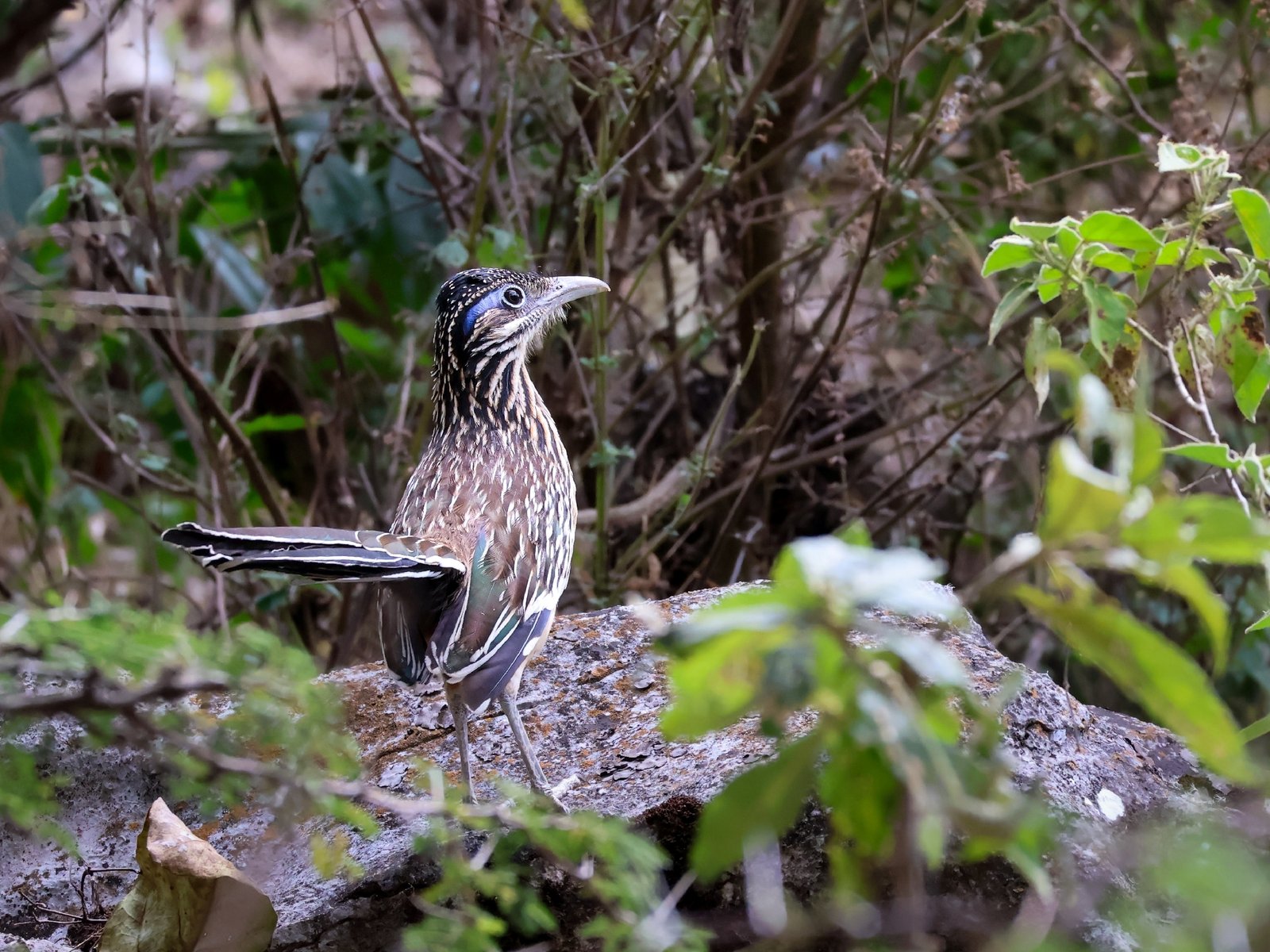
The Lesser Roadrunner is a slender, long-tailed ground cuckoo of dry forest and thorn scrub that hunts by running over the ground. It lives from north-western Mexico to northern Nicaragua and does not occur outside the guide area. Unlike the Greater Roadrunner of the northern deserts, it also often perches in bushes and low trees.
Voice
A series of descending, dove-like cooing notes, coo coo coo-oo, often given from a raised perch. Also a dry bill-clattering and soft, moaning sounds near the nest.
Recording: Sasha Robinson — CC BY-NC-SA 4.0 · converted to mono · xeno-canto
Identification
46–51 cm, more than half of it tail. The upperparts are streaked brown and black with pale feather edges, with a green to bronze gloss on the wings and tail. The head carries a dark, erectile crest; behind the eye is a patch of bare skin coloured blue and orange-red. The throat and foreneck are pale ochre and unstreaked; dark streaks run only along the sides of the neck. The belly is pale ochre-brown. The long, graduated tail has white tips to the outer feathers. The bill is fairly short and dark, the legs blue-grey and long. The sexes are alike.
Confusion species
Greater Roadrunner Geococcyx californianus is larger, with a clearly longer bill and a white foreneck and breast with heavy dark streaks; it lives mainly in the deserts and highlands of northern and central Mexico and overlaps only locally. Pheasant Cuckoo Dromococcyx phasianellus and Lesser Ground Cuckoo Morococcyx erythropygus are much smaller and keep hidden in vegetation; Lesser Ground Cuckoo has rufous underparts and a short tail.
Habitat
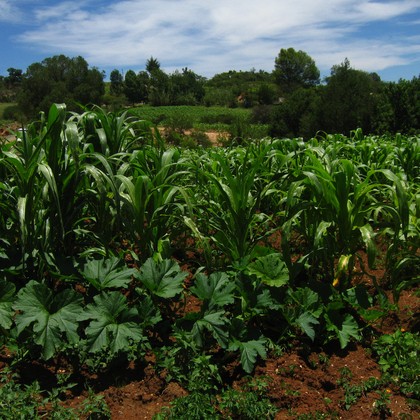
Dry deciduous forest, thorn scrub, cactus scrub, overgrown field edges and pasture with hedges and bushes, from sea level to about 2500 m. It hunts by running and jumping after large insects, lizards, small snakes and nestling birds, and also searches low branches for prey. The nest is a flat platform of twigs in a dense bush or low tree.
Where the bird is most at home, classified by the vegetation units of Mexico and Central America.




Range and movements
In Mexico along the Pacific slope and in the dry interior valleys from southern Sonora and Sinaloa through Nayarit, Jalisco, Colima, Michoacán, Guerrero, Morelos, Puebla and Oaxaca to Chiapas, locally in central Veracruz, and on the Yucatán Peninsula (Yucatán, Campeche, Quintana Roo). Further south in the dry regions of Guatemala, El Salvador, Honduras and northern and central Nicaragua. Absent from the wet Caribbean lowlands. The species does not occur outside the guide area.
- Resident
- dark = core range, pale = thinly spread
How and when to look
Early in the morning along dirt roads and field edges in dry scrub, where birds sit in the sun or run across the track. Good areas are northern Yucatán, the dry valleys of Oaxaca and Chiapas, the Motagua valley in Guatemala and the dry interior valleys of Honduras. The cooing call often gives away a bird sitting quietly in a bush.
Conservation status
Not threatened. Locally fairly common in dry scrub and farmland with hedges; the species sometimes benefits from open, overgrown ground, but disappears where scrub gives way to bare fields.
Scientific name
Geococcyx velox | (Wagner, 1836)
Wagner described the species in 1836 as Cuculus velox; because it was later moved to another genus, the author and year stand in brackets. The genus Geococcyx was introduced in 1831 by Wagler. Geococcyx is Greek, from gē 'earth, ground' and kokkux 'cuckoo': 'ground cuckoo', after its running, terrestrial habits. velox is Latin for 'swift', after its fast running on the ground. The specimen the first description was based on came from outskirts of Mexico City.