All species › Cuckoos › Cuckoos › Little Cuckoo
Position in the tree Birds Aves › Birds with a flexible palate Neognathae › All other modern birds Neoaves › Doves, turacos and allies Columbaves › Bustards, turacos and cuckoos Otidimorphae
Little Cuckoo | Coccycua minuta
Kleine eekhoornkoekoek | Cuco menudo
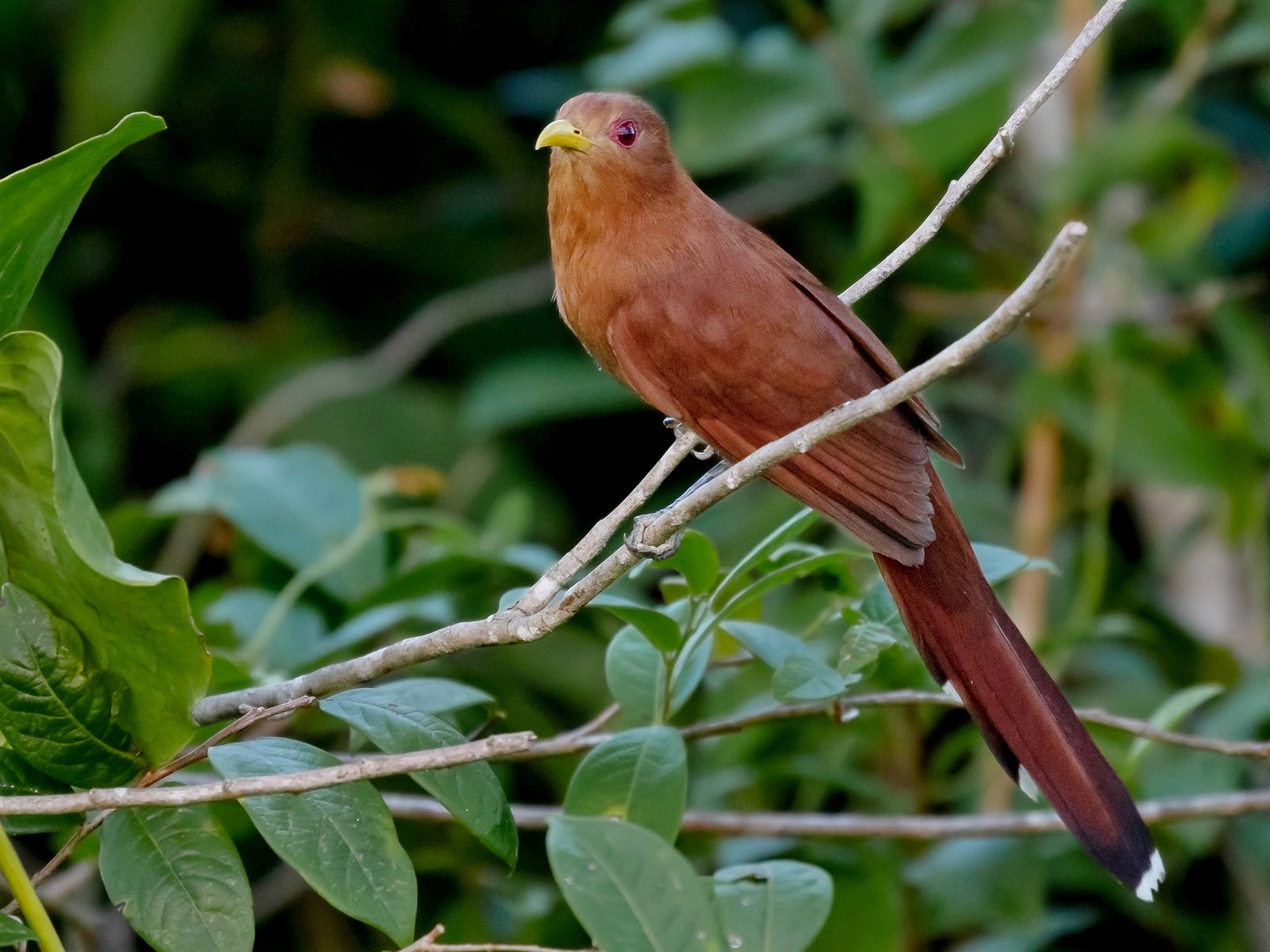
The Little Cuckoo is a small, rufous cuckoo of dense thickets along rivers and marshes. In colour it looks like a scaled-down Common Squirrel Cuckoo, but its tail is much shorter. In the guide area it occurs only in eastern Panama, where it reaches the north-western edge of its large South American range.
Voice
Less noisy than Common Squirrel Cuckoo. A dry, rasping chek and a nasal kweh, sometimes repeated in a short, descending series, usually from dense cover.
Recording: José María Loaiza B. — CC BY-NC-SA 4.0 · converted to mono · xeno-canto
Identification
25–28 cm, with a fairly long, graduated tail. Head, upperparts, throat and breast are warm chestnut to rufous; towards the rear the belly becomes greyish to dark grey-brown. The tail is darker rufous-brown and the feathers have white tips, which show from below as a row of white spots. The bill is short, curved and yellowish; the eye is red, with a red bare eye-ring. The sexes are alike; young birds are duller, with a dark bill.
Confusion species
Common Squirrel Cuckoo Piaya cayana is very similar in colour, but almost twice as long, with a much longer tail with black, white-tipped feathers below, a grey lower breast and a greenish-yellow bill; it lives mainly higher in the trees. Dwarf Cuckoo Coccycua pumila is smaller, grey-brown above, with rufous only on the throat and breast.
Habitat
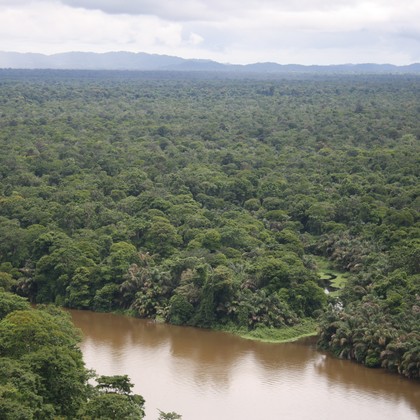
Dense thickets and low vegetation along rivers, oxbows, marshes and lagoons, also overgrown forest edges and secondary forest in wet lowlands. It forages hidden among low branches for insects and other invertebrates, which it snatches from leaves and twigs with a short lunge. It incubates its own eggs, in a cup of twigs in a bush or low tree.
Where the bird is most at home, classified by the vegetation units of Mexico and Central America.


Range and movements
In the guide area only in eastern Panama: in the lowlands of Darién and the Emberá comarca, in the east of Panamá province (including the Bayano area) and scarce west to the area around the Panama Canal and Colón. Outside the guide area from Colombia and Venezuela through the Guianas and the Amazon basin to Bolivia and Brazil, and on Trinidad.
- Resident
- dark = core range, pale = thinly spread
How and when to look
Along the edges of rivers and marshes in Darién and eastern Panamá province, such as along the Chucunaque river and the marshes around Yaviza. The dry chek from a bush is often the first sign; with patience the bird shows itself as it hops from branch to branch.
Conservation status
Not threatened. The species has a very large range in South America. In Panama it is locally fairly common in suitable thickets along water, but inconspicuous.
Scientific name
Coccycua minuta | (Vieillot, 1817) (GBIF: Piaya minuta)
Vieillot described the species in 1817 as Coccyzus minutus; because it was later moved to another genus, the author and year stand in brackets. The genus Coccycua was introduced in 1830 by Lesson. Coccycua is a blend of the genus names Coccyzus (cuckoo) and Coua (coua). minuta is Latin for 'small', after the small size. The specimen the first description was based on came from Cayenne, French Guiana.