All species › Kingfishers, bee-eaters and rollers › Motmots › Rufous Motmot
Position in the tree Birds Aves › Birds with a flexible palate Neognathae › All other modern birds Neoaves › Landbirds Telluraves › Raptors, owls, kingfishers and woodpeckers Afroaves › Mousebirds, rollers and woodpeckers Coraciimorphae › Trogons and cavity nesters Cavitaves › Hornbills, kingfishers and woodpeckers Picocoraciae › Kingfishers, bee-eaters and woodpeckers Picodynastornithes
Rufous Motmot | Baryphthengus martii
Rosse motmot | Momoto canelo mayor
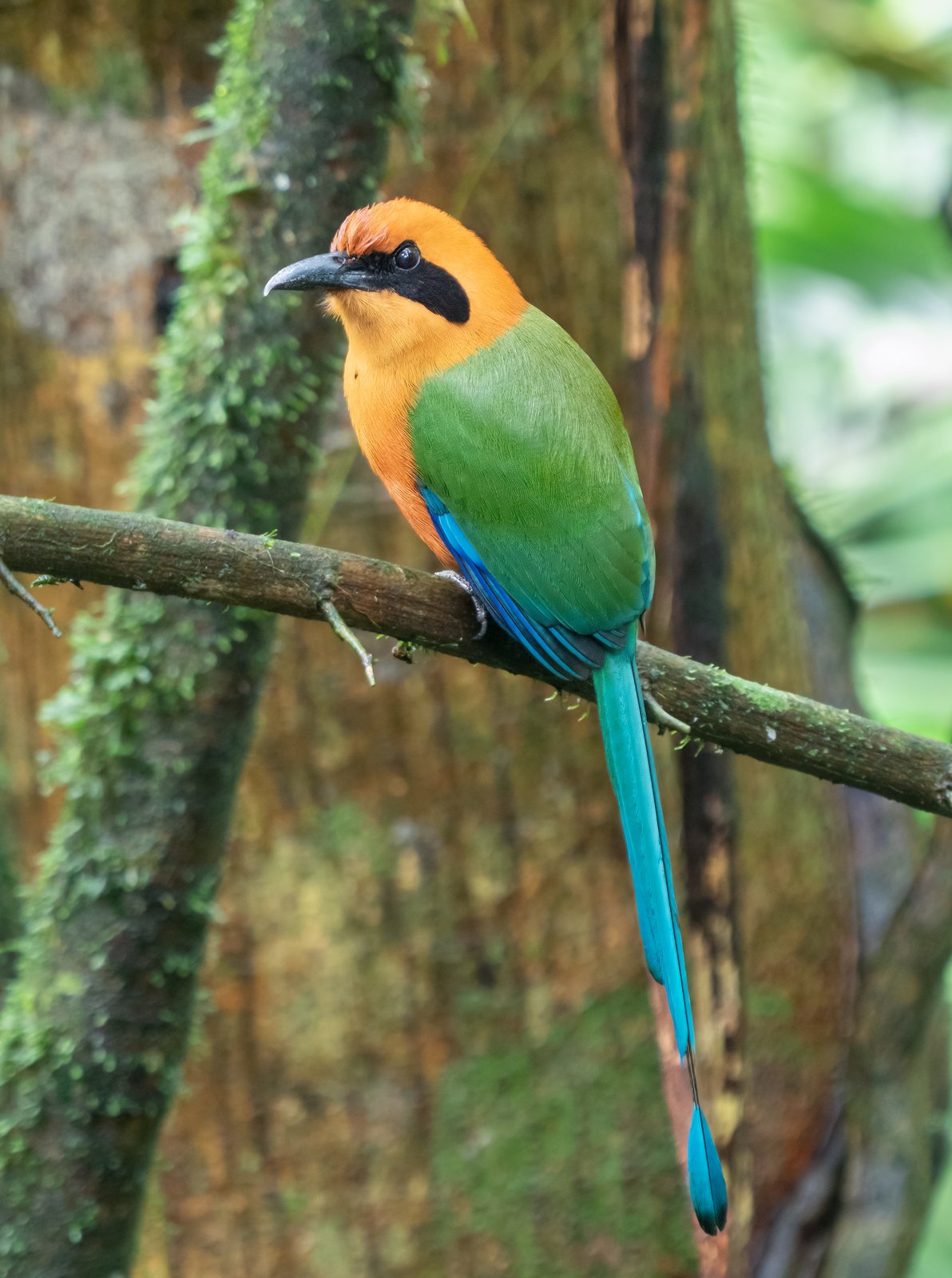
The Rufous Motmot is the largest motmot of the guide area, a rufous forest bird with a long, racket-tipped tail. It lives in humid lowland forest from Honduras to Panama and beyond in South America. Its scientific name honours the German naturalist Carl Friedrich Philipp von Martius.
Voice
A deep, hollow hoo-doo-doo or a rapid, rolling series of low hoo notes, often in duet or in a chorus of several birds, mainly in the twilight before dawn. Lower and faster than the calls of Momotus species.
Recording: Juan Freile — CC BY-NC-SA 4.0 · converted to mono · xeno-canto
Identification
42–47 cm, including the tail rackets. The head, neck and underparts are warm cinnamon-rufous, with a broad black mask through the eye and a small black breast spot; the lower belly is greenish. The back and wings are green, the primaries bluish. The tail is long and green to blue-green, and the two central tail feathers end in large rackets on a short stretch of bare shaft. The bill is black, stout and slightly curved. The sexes are alike.
Confusion species
Broad-billed Motmot Electron platyrhynchum has a similar colour pattern but is much smaller (30–35 cm), with a turquoise chin, a green belly and a broad, flat bill. Whooping Motmot Momotus subrufescens and Lesson's Motmot Momotus lessonii have a black crown ringed blue and are greener or duller brown below.
Habitat
Humid lowland and foothill forest up to about 1300 m, especially closed forest with a tall canopy, also tall secondary forest. It perches in the middle tree layer and eats large insects, small vertebrates and fruit; it sometimes follows army-ant swarms. It nests in a long, self-dug tunnel in a bank.
Where the bird is most at home, classified by the vegetation units of Mexico and Central America.




Range and movements
Caribbean side of eastern Honduras, Nicaragua and Costa Rica, in Costa Rica locally also in the south-west, and Panama on both slopes east to Darién. Outside the guide area in Colombia, Ecuador, Peru, western Brazil and Bolivia.
- Resident
- dark = core range, pale = thinly spread
How and when to look
At La Selva in Costa Rica and along Pipeline Road (Camino del Oleoducto) in Soberanía in Panama the low duet is regularly heard in the early morning. The bird often sits higher in the forest than other motmots and is therefore mainly detected by the duet.
Conservation status
Least Concern. It depends on closed forest and is therefore sensitive to clearance, but it is present over a large area.
Scientific name
Baryphthengus martii | (Spix, 1824)
Spix described the species in 1824 as Prionites martii; because it was later moved to another genus, the author and year stand in brackets. The genus Baryphthengus was introduced in 1860 by Cabanis & Heine. Baryphthengus is Greek, from barus 'heavy, deep' and phthengomai 'to speak': 'deep-voiced', after the low hooting call. martii honours the German botanist Carl Friedrich Philipp von Martius (1794–1868), who collected in Brazil from 1817 to 1820. The specimen the first description was based on came from near Belém (Pará), Brazil.