All species › Swifts › Hummingbirds › Black-crested Coquette
Position in the tree Birds Aves › Birds with a flexible palate Neognathae › All other modern birds Neoaves › Birds of the elements Elementaves › Nightjars and swifts Strisores
Black-crested Coquette | Lophornis helenae
Zwartkuifkoketkolibrie | Coqueta crestinegra
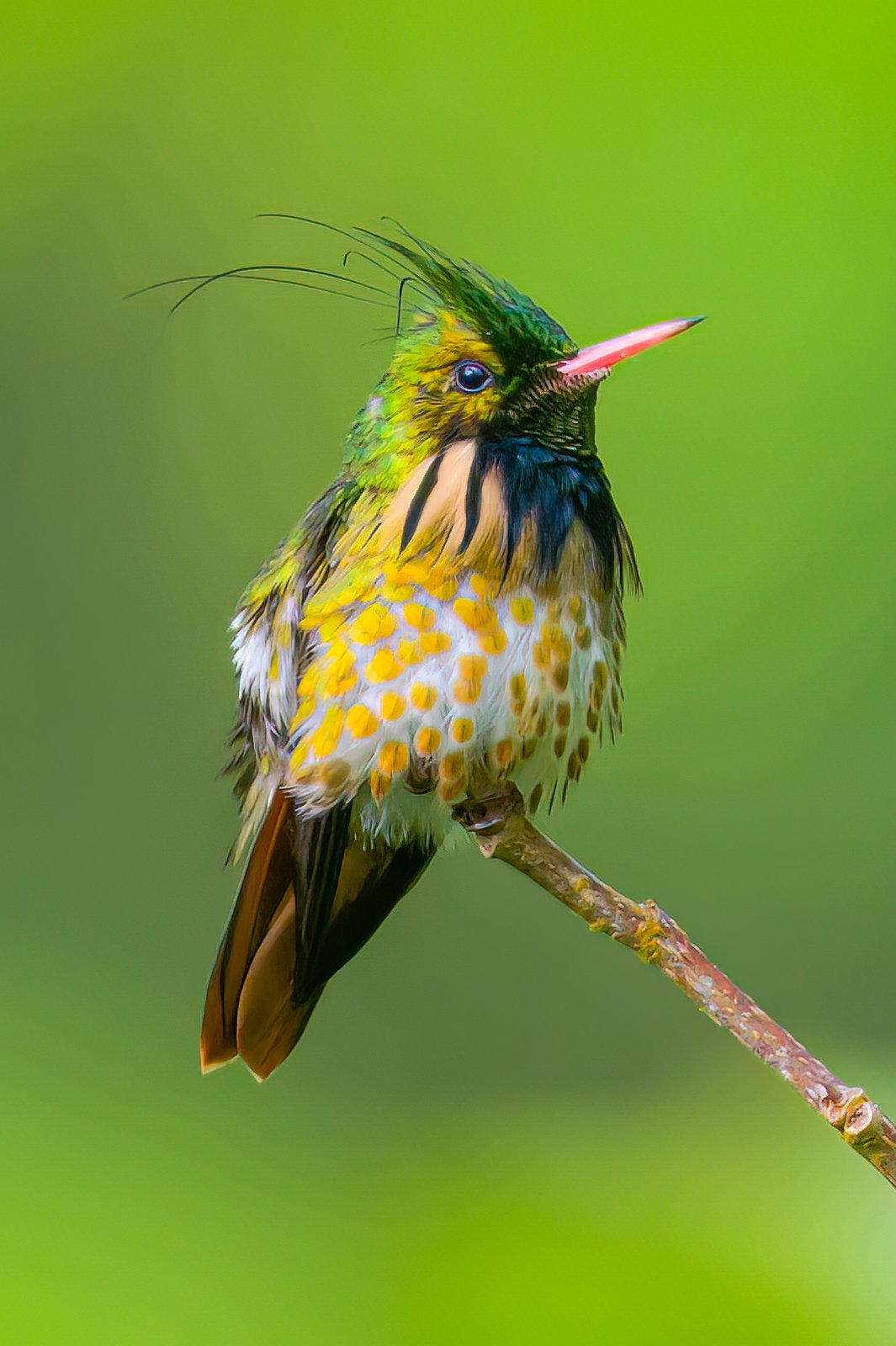
The Black-crested Coquette is the only coquette in the northern part of the guide area. The male has a crest of a few long, thin black feathers and a tuft of elongated feathers on each side of the throat. The species lives in the humid lowlands and foothills of the Caribbean slope, from southern Mexico to Costa Rica, and often goes unnoticed because it often feeds high in flowering trees.
Voice
A soft, dry tsip, often repeated. The wing sound is a low hum, like that of a large bee.
Recording: Andrew Spencer — CC BY-NC-SA 3.0 · converted to mono · xeno-canto
Identification
7 cm, with a short, straight, reddish bill with a dark tip. The upperparts are bronze-green, with a whitish band across the rump; the tail is rufous with dark markings. The male has a glittering green crown and throat, a crest of thin black feathers projecting far back, a tuft of long, pale cinnamon feathers with dark spots on each side of the throat, and pale underparts with large bronze-green and rufous spots. The female lacks crest and throat tufts; she has a pale throat with dark speckling and pale underparts with bronze-green spots on breast and flanks.
Confusion species
No other coquettes occur in the north of the guide area. In Costa Rica, White-crested Coquette Lophornis adorabilis lives on the Pacific slope; its male has a white crest and a plain rufous belly, and its female has unspotted rufous underparts. Female Green Thorntails Discosura conversii also have a white rump band, but a dark throat with a white malar stripe and a dark, forked tail.
Habitat
Edges and clearings of humid lowland and foothill forest, old secondary forest, riverside forest edges, shade coffee and gardens with flowering trees, mainly between about 300 and 1200 m, locally lower. It takes nectar in the canopy of flowering trees such as Inga and at low flowering shrubs along edges, and catches small insects.
Where the bird is most at home, classified by the vegetation units of Mexico and Central America.





Range and movements
Endemic to the guide area. On the Caribbean slope from southern Mexico, in southern Veracruz, northern Oaxaca and Chiapas, through Guatemala, Belize, Honduras and Nicaragua to Costa Rica, where it is most often seen. In Panama only a few records in the west.
- Resident
- dark = core range, pale = thinly spread
How and when to look
In Costa Rica at flowering trees and shrubs in the Caribbean foothills, for example around Lake Arenal and at Rancho Naturalista. Birds often return to the same flowering shrub, so waiting at such a shrub produces more than walking around.
Conservation status
Not threatened. Scarce and local, rare in the north of its range; fairly common at suitable sites in Costa Rica. The species also uses secondary forest and gardens, but remains dependent on forested foothills.
Scientific name
Lophornis helenae | (Delattre, 1843)
Delattre described the species in 1843 as Ornismya Helenae; because it was later moved to another genus, the author and year stand in brackets. The genus Lophornis was introduced in 1829 by Lesson. Lophornis is Greek, from lophos 'crest' and ornis 'bird', after the males' crests. helenae honours Helene of Mecklenburg-Schwerin (1814–1858), Duchess of Orléans and wife of Ferdinand Philippe d'Orléans. The specimen the first description was based on came from Verapaz, Guatemala.