All species › Pigeons and doves › Doves and pigeons › Ruddy Quail-Dove
Position in the tree Birds Aves › Birds with a flexible palate Neognathae › All other modern birds Neoaves › Doves, turacos and allies Columbaves › Doves and sandgrouse Columbimorphae
Ruddy Quail-Dove | Geotrygon montana
Rosse kwartelduif | Paloma perdiz rojiza
The Ruddy Quail-Dove is the most widespread quail-dove in the guide area, a stocky, rufous dove that almost always walks on the forest floor. It lives in humid and semi-humid forest from western and eastern Mexico to Panama. Outside the guide area it occurs in the West Indies and over much of tropical South America.
Voice
A low, hollow, ventriloquial whooo, falling and fading, repeated at intervals of a few seconds for long periods. The sound gives little clue to its source and seems to come from far away. On take-off the wings make a loud clattering sound.
Recording: Richard E. Webster — CC BY-NC-SA 4.0 · shortened to the first 60 s, mono · xeno-canto
Identification
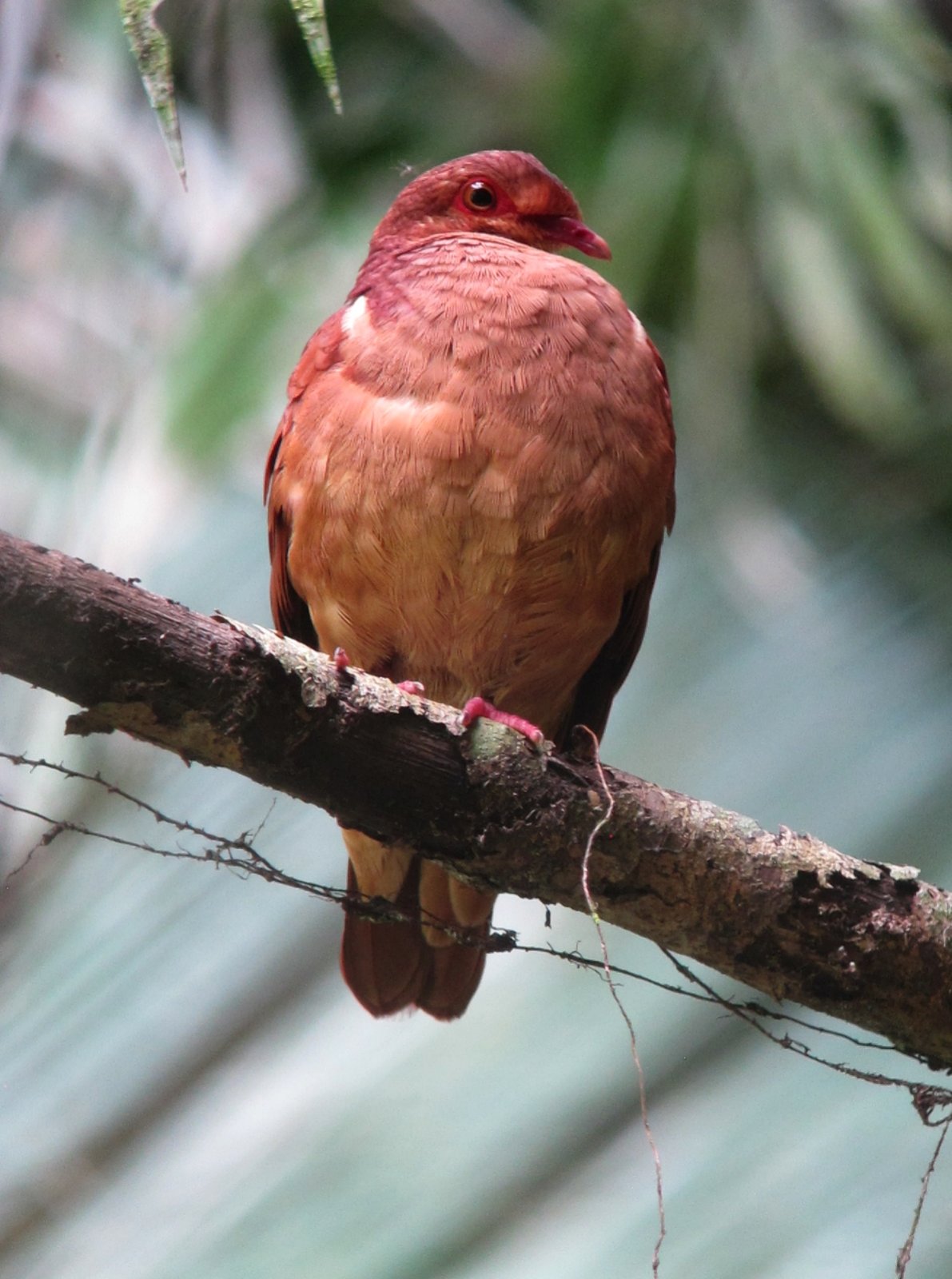
21–28 cm, stocky and short-tailed, with a round head and fairly long legs. The male is rufous to chestnut above with a purplish gloss on the nape and mantle; the underparts are warm ochre-brown to pinkish buff. A pale ochre stripe runs below the eye, bordered by a rufous malar stripe. Bill, orbital ring and legs are pinkish red. The female is olive-brown above, with a fainter face pattern and grey-brown to buff underparts. Juveniles are darker, with rufous feather edges.
Confusion species
Violaceous Quail-Dove Geotrygon violacea has a pale grey to whitish face without a malar stripe, a violet-glossed nape and mantle and a whitish belly. Olive-backed Quail-Dove Leptotrygon veraguensis is dark olive-brown with a broad white stripe below the eye. White-tipped Dove Leptotila verreauxi and Grey-chested Dove Leptotila cassinii are greyer and longer-tailed, with white tail corners. Quail-doves of the genus Zentrygon, such as Chiriqui Quail-Dove Zentrygon chiriquensis, live mainly higher in the mountains and have a grey crown or a striking face pattern.
Habitat
The floor of humid lowland forest, foothill forest and secondary forest, also semi-evergreen forest on the Yucatán Peninsula, the lower parts of cloud forest and shaded coffee and cacao plantations; from sea level to about 1500 m. It lives singly or in pairs and walks with a bobbing head over the leaf litter in search of fallen fruit, seeds and small invertebrates. When disturbed it usually walks away or flies low and fast between the trunks. The nest is a loose platform of twigs low in a shrub or sapling.
Where the bird is most at home, classified by the vegetation units of Mexico and Central America.






Range and movements
In Mexico on the Pacific side from Jalisco south to Chiapas and on the Gulf side from San Luis Potosí and Veracruz through Tabasco to the Yucatán Peninsula. Further in Belize, Guatemala, Honduras, El Salvador, Nicaragua, Costa Rica and Panama, mainly in the humid Caribbean lowlands and foothills and in the southern part of the Pacific side. Outside the guide area in the West Indies and in South America south to northern Argentina.
- Resident
- dark = core range, pale = thinly spread
How and when to look
Best seen early in the morning, when birds walk along quiet forest trails; standing still pays off more than walking on. In Costa Rica and Panama quail-doves sometimes come to feeding stations with fruit or rice at lodges. The low, hollow whooo often reveals its presence before the bird itself.
Conservation status
Not threatened. The species is widespread and tolerates secondary forest and plantations with shade trees, but disappears where forest is cleared completely.
Scientific name
Geotrygon montana | (Linnaeus, 1758)
Linnaeus described the species in 1758 as Columba montana; because it was later moved to another genus, the author and year stand in brackets. The genus Geotrygon was introduced in 1847 by Gosse. Geotrygon is Greek, from gē 'earth, ground' and trugōn 'turtle dove': 'ground dove'. montana is Latin for 'of the mountains', although the species lives mostly in lowland forest. The specimen the first description was based on came from Jamaica.