All species › Pigeons and doves › Doves and pigeons › Violaceous Quail-Dove
Position in the tree Birds Aves › Birds with a flexible palate Neognathae › All other modern birds Neoaves › Doves, turacos and allies Columbaves › Doves and sandgrouse Columbimorphae
Violaceous Quail-Dove | Geotrygon violacea
Bisschopskwartelduif | Paloma perdiz violácea
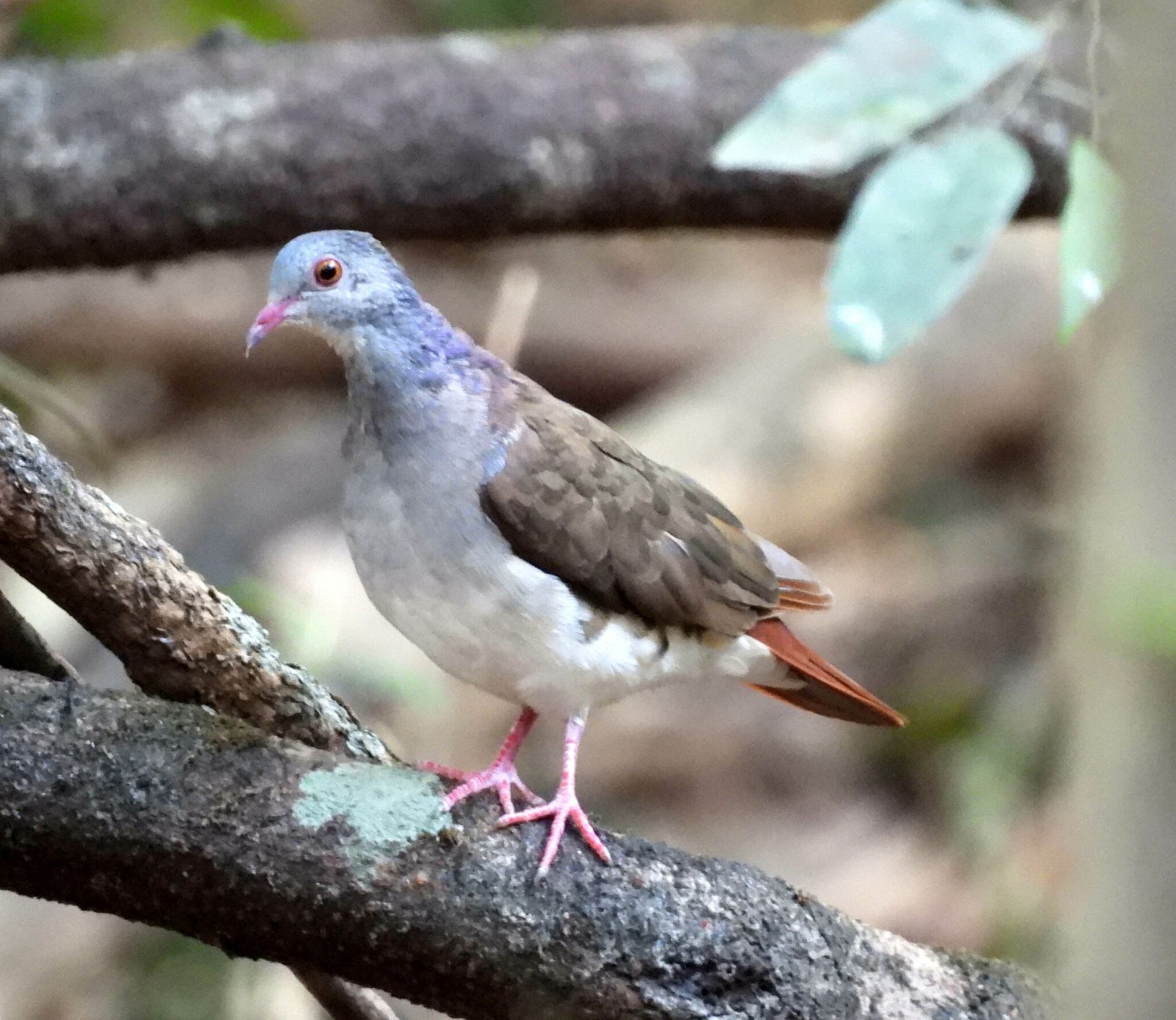
The Violaceous Quail-Dove is a scarce, shy quail-dove of humid lowland and foothill forest in the south-east of the guide area, from Nicaragua to Panama. The male stands out with a pale face and a violet-glossed nape and mantle, which give the species its name. Outside the guide area it occurs patchily in South America.
Voice
A short, soft, low hoo or woo, repeated at short intervals for long periods, often from a low branch. The sound is weak and does not carry far.
Recording: Fernando Igor de Godoy — CC BY-NC-SA 4.0 · converted to mono · xeno-canto
Identification
21–25 cm, stocky and short-tailed. The male has a whitish forehead and face without a stripe or malar stripe, a grey crown and a nape and mantle with a strong violet to amethyst gloss. Back and wings are rufous-brown, the breast is pale greyish-vinaceous, the belly and undertail coverts whitish. Bill and legs are red. The female is duller, with less gloss on the nape and mantle, a browner back and a greyer breast. In flight the underwing is rufous.
Confusion species
Ruddy Quail-Dove Geotrygon montana has a pale stripe below the eye with a rufous malar stripe, rufous to ochre underparts and no whitish belly. Olive-backed Quail-Dove Leptotrygon veraguensis is dark olive-brown with a broad white stripe below the eye and a black bill. Doves of the genus Leptotila, such as Grey-headed Dove Leptotila plumbeiceps, are longer-tailed, with white tail corners and a dark bill.
Habitat
The floor and understorey of humid lowland forest, foothill forest and gallery forest, also semi-evergreen forest and old secondary forest; from sea level to about 1000 m. It lives singly or in pairs, usually in dense, shady parts of the forest, where it searches for fallen seeds and fruit. The nest is a loose platform of twigs in a shrub or sapling.
Where the bird is most at home, classified by the vegetation units of Mexico and Central America.



Range and movements
Scarce and local on the Caribbean side of Nicaragua and Costa Rica, and patchily in Panama, where it occurs on both sides of the country, including the Canal area and Darién. Outside the guide area patchily in South America, from Colombia and Venezuela to Bolivia, Paraguay, south-eastern Brazil and north-eastern Argentina.
- Resident
- Summer visitor (c. Apr–Sep)
- Winter visitor (c. Oct–Mar)
- Passage (Mar–Apr, Oct–Nov)
- dark = core range, pale = thinly spread
How and when to look
Rarely seen, usually by chance when a bird flushes from a forest trail or sits quietly on a low branch. Chances are best in the Panama Canal area early in the morning, when standing still and listening for the soft hoo pays off more than walking on.
Conservation status
Not threatened, but rare and poorly known in the guide area. The species depends on undisturbed lowland forest and is declining locally through deforestation.
Scientific name
Geotrygon violacea | (Temminck, 1809)
Temminck described the species in 1809 as Columba Violacea; because it was later moved to another genus, the author and year stand in brackets. The genus Geotrygon was introduced in 1847 by Gosse. Geotrygon is Greek, from gē 'earth, ground' and trugōn 'turtle dove': 'ground dove'. violacea is Latin for 'violet', after the purple gloss on the mantle and back. The specimen the first description was based on came from probably the Americas (not specified further).