All species › Passerines › Cardinals and allies › Rose-bellied Bunting
Position in the tree Birds Aves › Birds with a flexible palate Neognathae › All other modern birds Neoaves › Landbirds Telluraves › Falcons, parrots and passerines Australaves › Falcons and passerines Eufalconimorphae › Parrots and passerines Psittacopasserae
Rose-bellied Bunting | Passerina rositae
Rozebuikgors | Colorín azulrosa
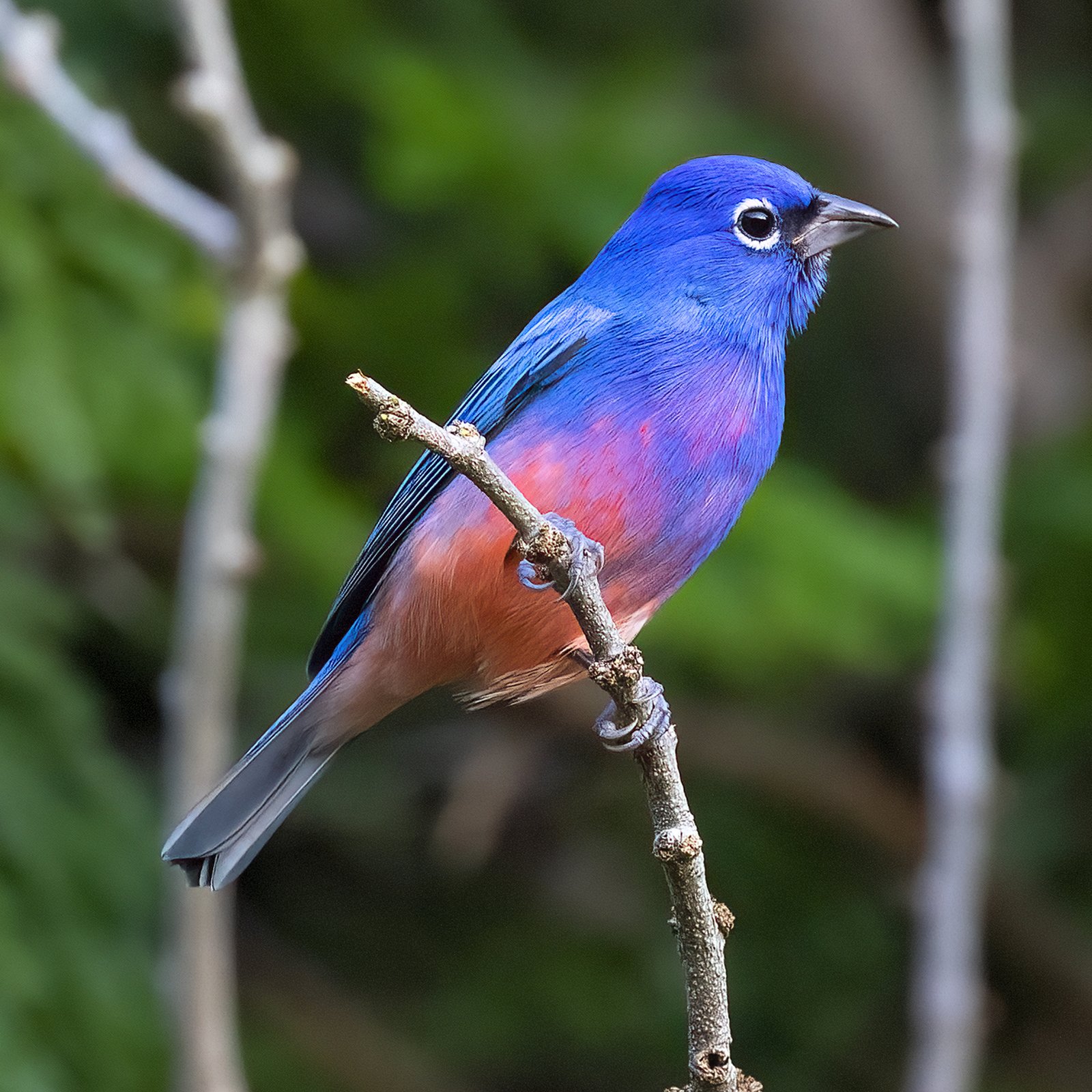
The Rose-bellied Bunting is a bunting with a very small range: it lives only in dry forest on the hills of the Pacific slope of the Isthmus of Tehuantepec in southern Mexico. The male is dark blue with a pink belly. The species is shy and keeps to dense undergrowth.
Voice
The song is a sweet, warbling series of clear notes, similar to that of related buntings. The call is a sharp chik.
Recording: Manuel Grosselet — CC BY-NC-SA 4.0 · converted to mono · xeno-canto
Identification
13–14 cm. Conical grey bill. Both sexes have a broken white eye-ring. The male is dark purplish blue on the head, back, throat and breast, with brighter blue on the forehead, shoulder and rump, and a pink to rose-red lower breast and belly. The female is grey-brown above with a blue tinge to the wings, rump and tail, buffy brown on the breast and tinged pink on the belly.
Confusion species
The male Orange-breasted Bunting Passerina leclancherii, found on the same coast, is turquoise and green above with yellow to orange underparts; the female is olive-green with yellowish underparts. The male Varied Bunting Passerina versicolor is dark purplish with a red nape; the female is plain grey-brown without a white eye-ring and without a pink tinge. The female Painted Bunting Passerina ciris is green. The male Blue Bunting Cyanocompsa parellina is blue-black without pink.
Habitat
Undergrowth of dry and semi-humid forest on hill slopes and in ravines, also thorn forest and dense thickets at forest edges; mostly between 100 and 900 m. Lives hidden in dense vegetation.
Where the bird is most at home, classified by the vegetation units of Mexico and Central America.



Range and movements
Endemic to the guide area, and indeed to a small part of it: only on the Pacific slope of the Isthmus of Tehuantepec, in south-eastern Oaxaca and extreme western Chiapas.
- Resident
- dark = core range, pale = thinly spread
How and when to look
Early in the morning in dry hill forest near the Isthmus of Tehuantepec, where males sing from the undergrowth or a low branch; often together with Orange-breasted Bunting.
Conservation status
Near Threatened (NT). Very small range; the dry forest on which the species depends is being cleared and burned for cattle and agriculture.
Scientific name
Passerina rositae | (Lawrence, 1874)
Lawrence described the species in 1874 as Cyanospiza rositae; because it was later moved to another genus, the author and year stand in brackets. The genus Passerina was introduced in 1816 by Vieillot. Passerina comes from the Latin passerinus 'sparrow-like', from passer 'sparrow'. rositae honours a certain Rosita; Lawrence did not explain the name and who she was is unknown. The specimen the first description was based on came from Cacoprieto, Isthmus of Tehuantepec, Oaxaca, Mexico.