All species › Passerines › Cardinals and allies › Orange-breasted Bunting
Position in the tree Birds Aves › Birds with a flexible palate Neognathae › All other modern birds Neoaves › Landbirds Telluraves › Falcons, parrots and passerines Australaves › Falcons and passerines Eufalconimorphae › Parrots and passerines Psittacopasserae
Orange-breasted Bunting | Passerina leclancherii
Regenbooggors | Colorín pecho naranja
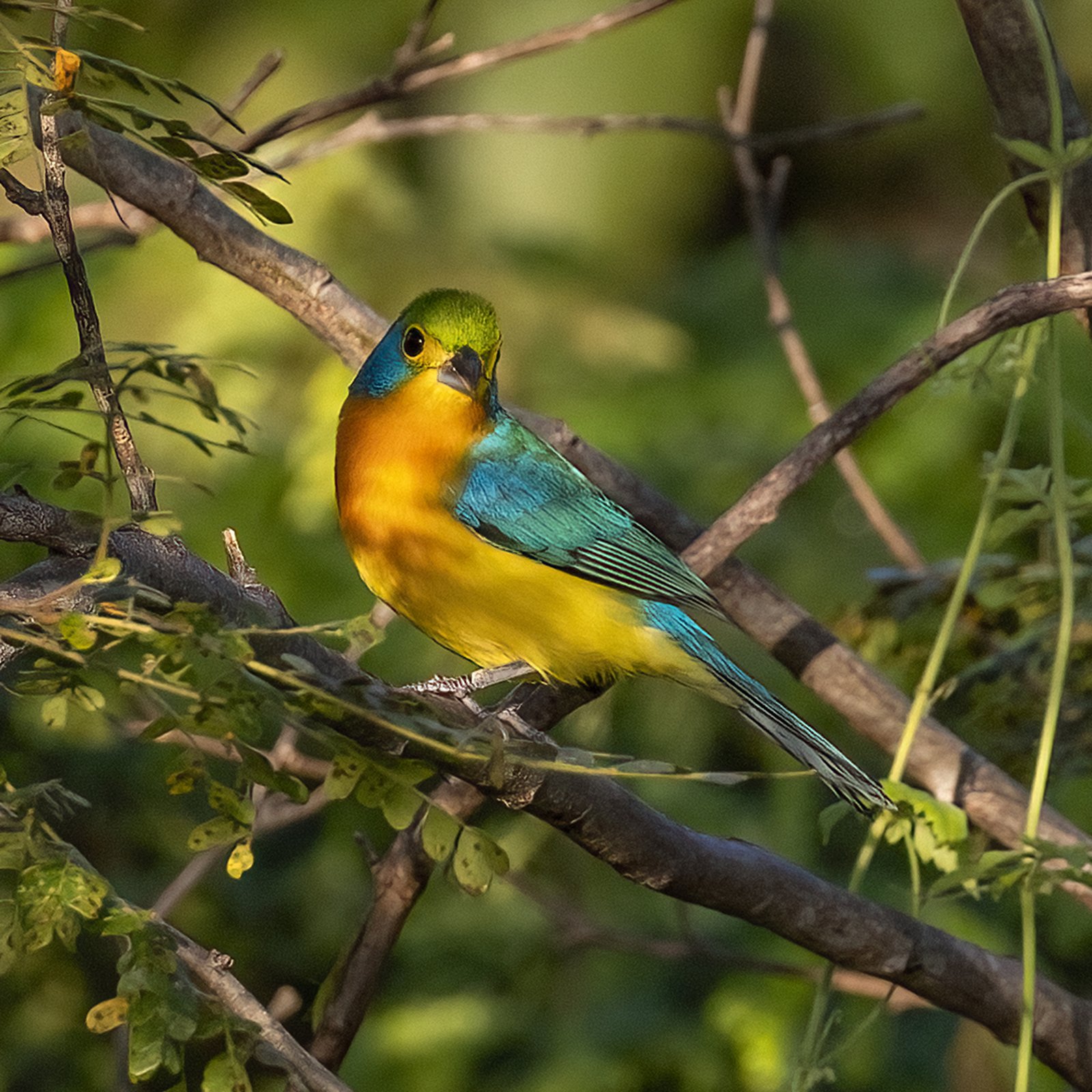
The Orange-breasted Bunting is a small Passerina bunting found only in western and southern Mexico. The male has turquoise and green upperparts and yellow-orange underparts; the female is greenish with yellow underparts. It lives in dry forest and scrub on the Pacific slope, from Jalisco to Chiapas.
Voice
The song is a short, rapid series of twittering and whistled notes, more jumbled than that of Indigo Bunting. The call is a dry, short tsik.
Recording: Richard E. Webster — CC BY-NC-SA 4.0 · shortened to the first 60 s, mono · xeno-canto
Identification
12–13 cm. A small bunting with a short, conical bill. The male has a yellow-green forehead and crown, turquoise-blue cheeks, nape, back and rump, and blue edges to the wings and tail. The underparts are bright yellow with an orange wash across the breast; a narrow yellow ring surrounds the eye. The female is olive-green above with a bluish tinge on the rump, wings and tail, and yellow below, slightly olive on the breast. Young males resemble the female with patches of blue.
Confusion species
The female Painted Bunting Passerina ciris (winter visitor) is more uniform bright green above, lacks blue on the rump and tail and is greenish yellow rather than pure yellow below. Females of Indigo Bunting Passerina cyanea, Varied Bunting Passerina versicolor and Rose-bellied Bunting Passerina rositae are brown or greyish brown, without yellow underparts. With its blue upperparts and yellow-orange underparts, the male cannot be confused with any other species.
Habitat
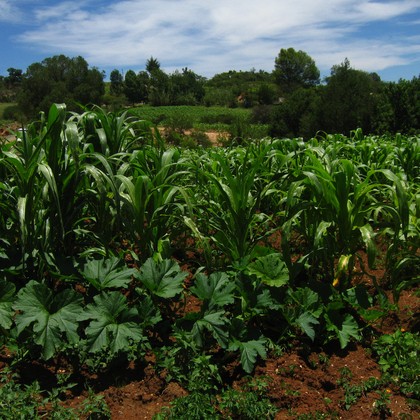
Tropical dry forest, thorn scrub, forest edges, overgrown fields and scrubby pastures with seeding grasses, from sea level to about 1300 m. It feeds in pairs or small groups low in bushes and on the ground on seeds and insects; outside the breeding season sometimes in mixed flocks with other seedeaters.
Where the bird is most at home, classified by the vegetation units of Mexico and Central America.


Range and movements
Endemic to Mexico: the Pacific slope and adjacent interior from southern Jalisco and Colima through Michoacán, Guerrero and southern Puebla to Oaxaca and western Chiapas, east to the Isthmus of Tehuantepec.
- Resident
- dark = core range, pale = thinly spread
How and when to look
Regularly seen in dry forest and scrub in the lowlands of Colima and Jalisco and on the Oaxaca coast, for example around Huatulco. Males sing from an exposed branch in the rainy season.
Conservation status
Not threatened (LC). Locally fairly common within a restricted range; it is trapped for the cage-bird trade and loses habitat where dry forest is cleared.
Scientific name
Passerina leclancherii | de Lafresnaye, 1840
De Lafresnaye described the species in 1840 and placed it straight away in the genus where it still stands. The genus Passerina was introduced in 1816 by Vieillot. Passerina comes from the Latin passerinus 'sparrow-like', from passer 'sparrow'. leclancherii honours the French naval surgeon and naturalist Charles René Augustin Léclancher (1804–1857). The specimen the first description was based on came from Acapulco, Guerrero, Mexico.