All species › Passerines › New World warblers › Red Warbler
Position in the tree Birds Aves › Birds with a flexible palate Neognathae › All other modern birds Neoaves › Landbirds Telluraves › Falcons, parrots and passerines Australaves › Falcons and passerines Eufalconimorphae › Parrots and passerines Psittacopasserae
Red Warbler | Cardellina rubra
Rode zanger | Chipe rojo
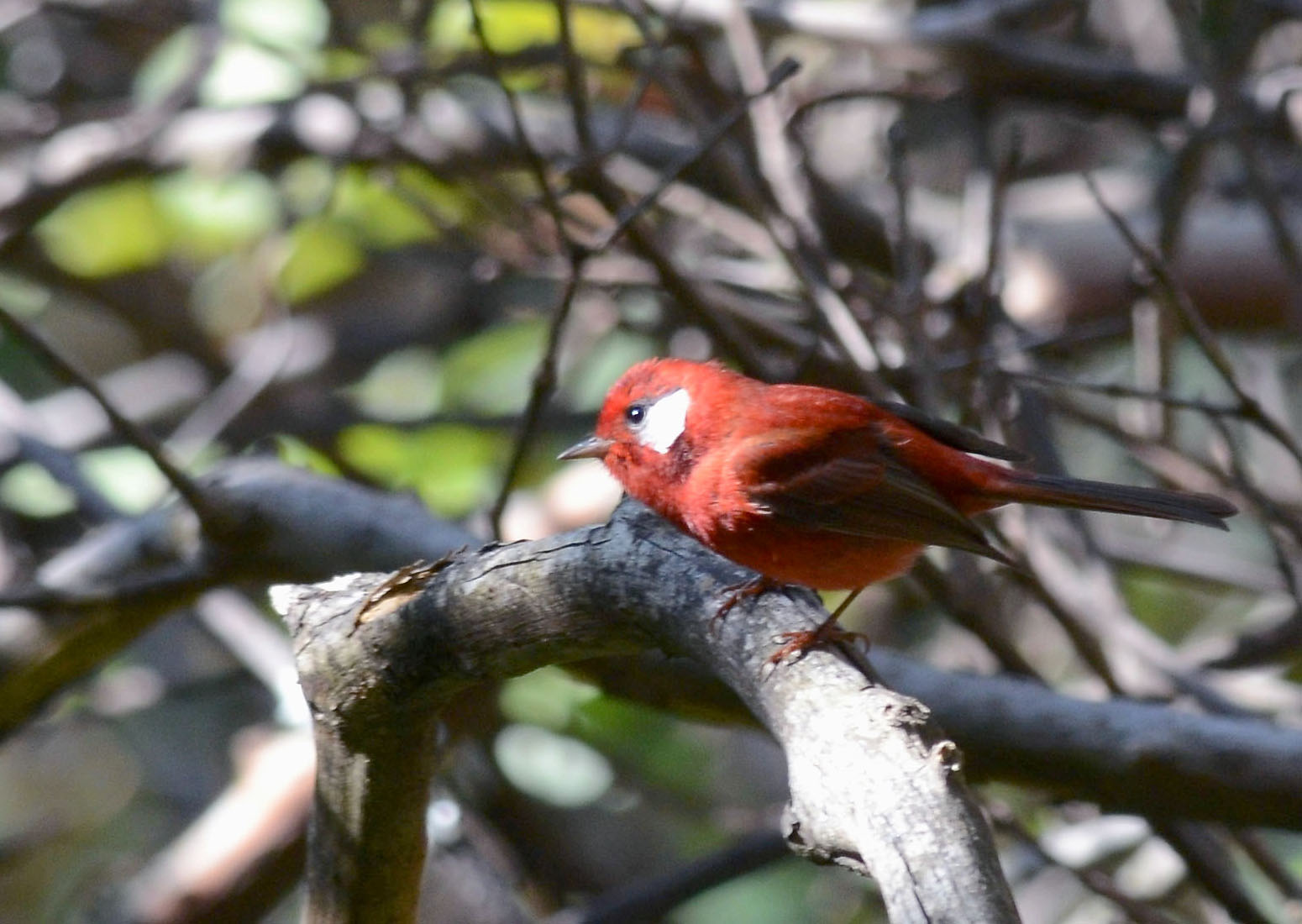
The Red Warbler is an almost entirely red New World warbler of conifer and pine-oak forest in the Mexican mountains. It occurs only in Mexico. With its closest relative in Chiapas and Guatemala, Pink-headed Warbler, it forms a pair of two species that replace each other geographically.
Voice
The song is a varied series of short trills and fuller, twittering phrases, with high notes in between. The call is a high, thin tsee and a stronger pseet.
Recording: Matthew L. Brady — CC BY-NC-SA 4.0 · converted to mono · xeno-canto
Identification
12–13 cm, with a short, fine bill. The head and body are bright red, the wings and tail browner red with paler feather edges. A key feature is an ear patch that varies by region: silvery white in birds of the central part of the range (C. r. rubra) and in the Sierra Madre del Sur (C. r. rowleyi, the deepest red form), dark grey in the Sierra Madre Occidental (C. r. melanauris). The sexes are almost alike; the female is slightly duller. Juveniles are brown with two pale wing bars.
Confusion species
Pink-headed Warbler Cardellina versicolor has a silvery-pink head and lives only in Chiapas and Guatemala, so not alongside Red Warbler. Painted Whitestart Myioborus pictus is black with a red belly and white wing patches. Hepatic Tanager Piranga flava is larger and a greyer red, with a stout bill and a grey cheek.
Habitat
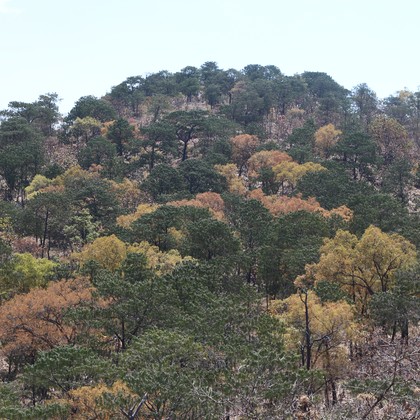
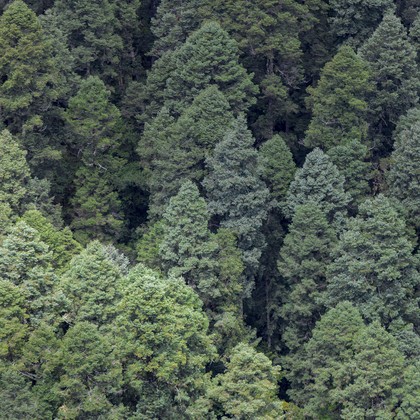
Humid conifer forest, pine forest, pine-oak forest and sacred fir (oyamel) forest in the mountains, in the breeding season between about 1800 and 3900 m; in winter birds partly move down into lower oak forest. It searches for insects in the lower and middle storeys, and outside the breeding season often joins mixed flocks with other warblers. It builds a domed, oven-shaped nest of pine needles and grass on the ground, against a bank or under a grass tussock.
Where the bird is most at home, classified by the vegetation units of Mexico and Central America.

Range and movements
Only in Mexico: the Sierra Madre Occidental from south-western Chihuahua and Durango to northern Nayarit, the Trans-Mexican Volcanic Belt from southern Jalisco and Michoacán through the State of México and Morelos to southern Hidalgo, and the Sierra Madre del Sur in Guerrero and Oaxaca.
- Resident
- dark = core range, pale = thinly spread
How and when to look
In mixed flocks in pine-oak forest, for example around the high volcanoes south of Mexico City and in the mountains of Guerrero and Oaxaca. The call often gives the flock away first.
Conservation status
Least Concern. The species is common in suitable montane forest, but is locally vulnerable to logging and forest fires in pine-oak forest.
Scientific name
Cardellina rubra | (Swainson, 1827)
Swainson described the species in 1827 as Setophaga rubra; because it was later moved to another genus, the author and year stand in brackets. The genus Cardellina was introduced in 1850 by Bonaparte. Cardellina is a diminutive of the Italian dialect word cardella 'goldfinch'. rubra is Latin for 'red', after the all-red plumage. The specimen the first description was based on came from Morelia, Michoacán, Mexico.