All species › Falcons › Falcons and caracaras › Red-throated Caracara
Position in the tree Birds Aves › Birds with a flexible palate Neognathae › All other modern birds Neoaves › Landbirds Telluraves › Falcons, parrots and passerines Australaves › Falcons and passerines Eufalconimorphae
Red-throated Caracara | Ibycter americanus
Roodkeelcaracara | Caracara comecacao
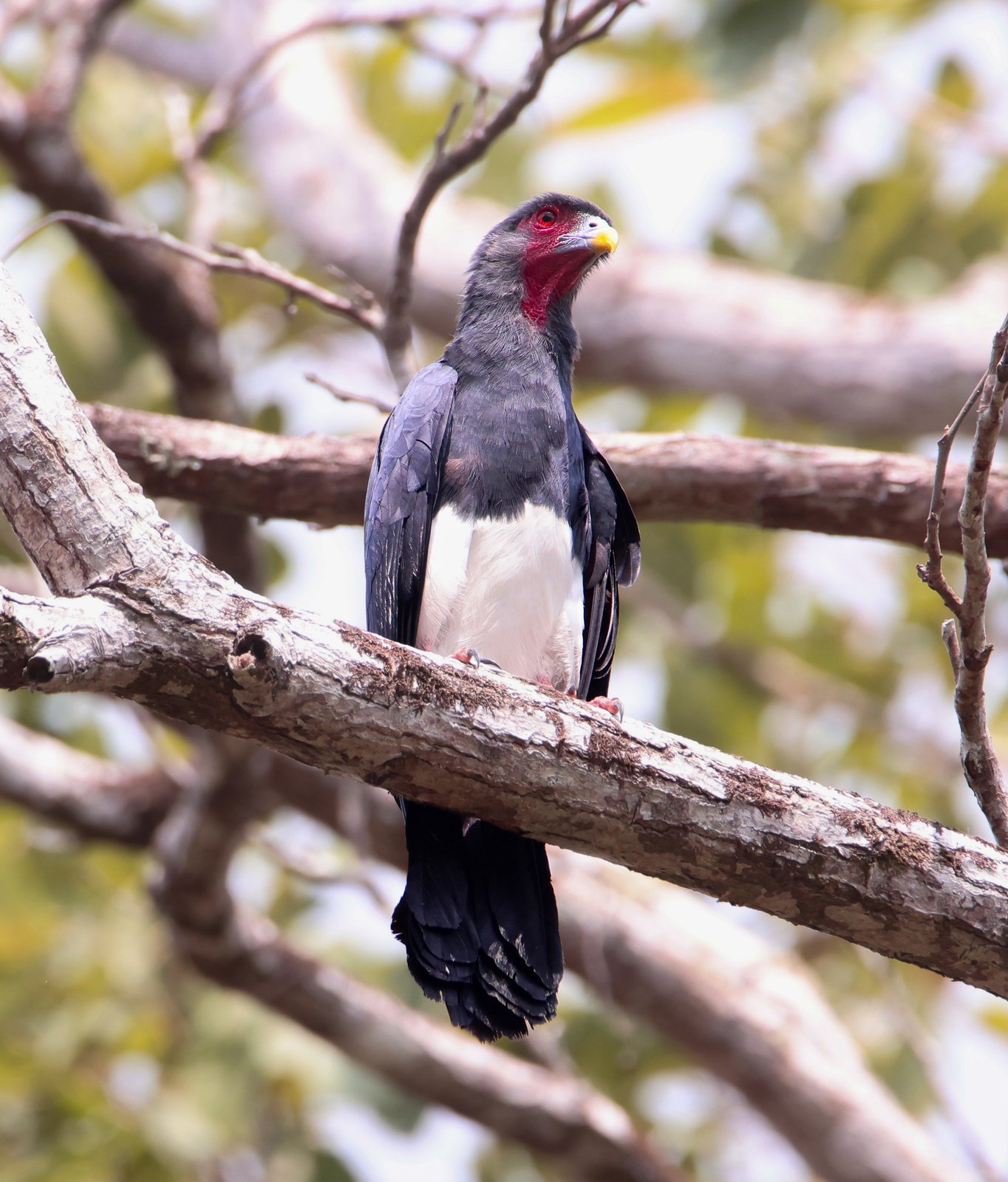
The Red-throated Caracara is a glossy black caracara with a white belly and a bare red throat and face, which moves through the canopy in noisy groups. It feeds mainly on the larvae of wasps and bees, for which it breaks open nests, and also on fruit and seeds. In the guide area it was formerly widespread from southern Mexico to Panama, but it has disappeared from the northern part and now occurs mainly in Panama.
Voice
Very loud and hoarse, a repeated ka-ka-ka-kaw or ka-ka-ka-ka-kao recalling the word cacao, often given by the whole group at once, especially in flight and when leaving a perch.
Recording: Jacob Wijpkema — CC BY-NC-SA 4.0 · shortened to the first 60 s, mono · xeno-canto
Identification
48–56 cm. Glossy black, with a white belly, white thighs and white undertail coverts. Face and throat bare and red to pinkish red. Bill yellowish to greyish yellow, legs red to orange-red. The tail is long and black, the wings broad and rounded. Juveniles are duller, with a less red, more yellowish throat. Male and female are alike.
Confusion species
The Crested Caracara Caracara plancus has a black cap, a white neck, a barred breast and a white tail, and lives in open country. The Common Black Hawk Buteogallus anthracinus and the Great Black Hawk Buteogallus urubitinga are entirely black without a white belly, and have white bands in the tail and yellow legs.
Habitat
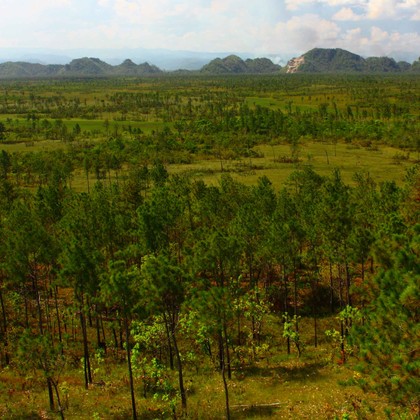
Tall humid lowland and foothill forest, forest edges and riverine forest; in Honduras and Nicaragua also woodland patches and gallery forest in pine savanna. Mostly below 1200 m. It lives in the canopy and flies in groups from tree to tree.
Where the bird is most at home, classified by the vegetation units of Mexico and Central America.





Range and movements
Resident. It formerly occurred from southern Mexico (Veracruz, Oaxaca and Chiapas) and Guatemala to Panama, but has disappeared from Mexico and Guatemala and from most of Costa Rica, where a small population remains on the Osa Peninsula. Small, scattered populations in eastern Honduras (Mosquitia and Olancho) and in the Caribbean lowlands of Nicaragua. In Panama still widespread in forest on both slopes, especially in the centre and east of the country. Outside the guide area in northern South America to Bolivia and southern Brazil.
- Resident
- dark = core range, pale = thinly spread
How and when to look
In Panama it is often recorded in Soberanía National Park along the Panama Canal and in Darién, where groups call loudly in the canopy. In Costa Rica regular in Corcovado National Park on the Osa Peninsula.
Conservation status
Not globally threatened, but in the guide area it has declined steeply through deforestation and hunting, disappearing from Mexico, Guatemala and most of Costa Rica.
Scientific name
Ibycter americanus | (Boddaert, 1783)
Boddaert described the species in 1783 as Falco americanus; because it was later moved to another genus, the author and year stand in brackets. The genus Ibycter was introduced in 1816 by Vieillot. Ibycter is Greek, from ibuktēr 'singer of war-songs' (ibuō 'to shout'), after the loud, raucous calls. americanus is Modern Latin for 'American', 'of the Americas'. The specimen the first description was based on came from Cayenne, French Guiana.