All species › Passerines › Cardinals and allies › Red-throated Ant Tanager
Position in the tree Birds Aves › Birds with a flexible palate Neognathae › All other modern birds Neoaves › Landbirds Telluraves › Falcons, parrots and passerines Australaves › Falcons and passerines Eufalconimorphae › Parrots and passerines Psittacopasserae
Red-throated Ant Tanager | Driophlox fuscicauda
Roodkeelmiertangare | Tangara hormiguera garganta roja
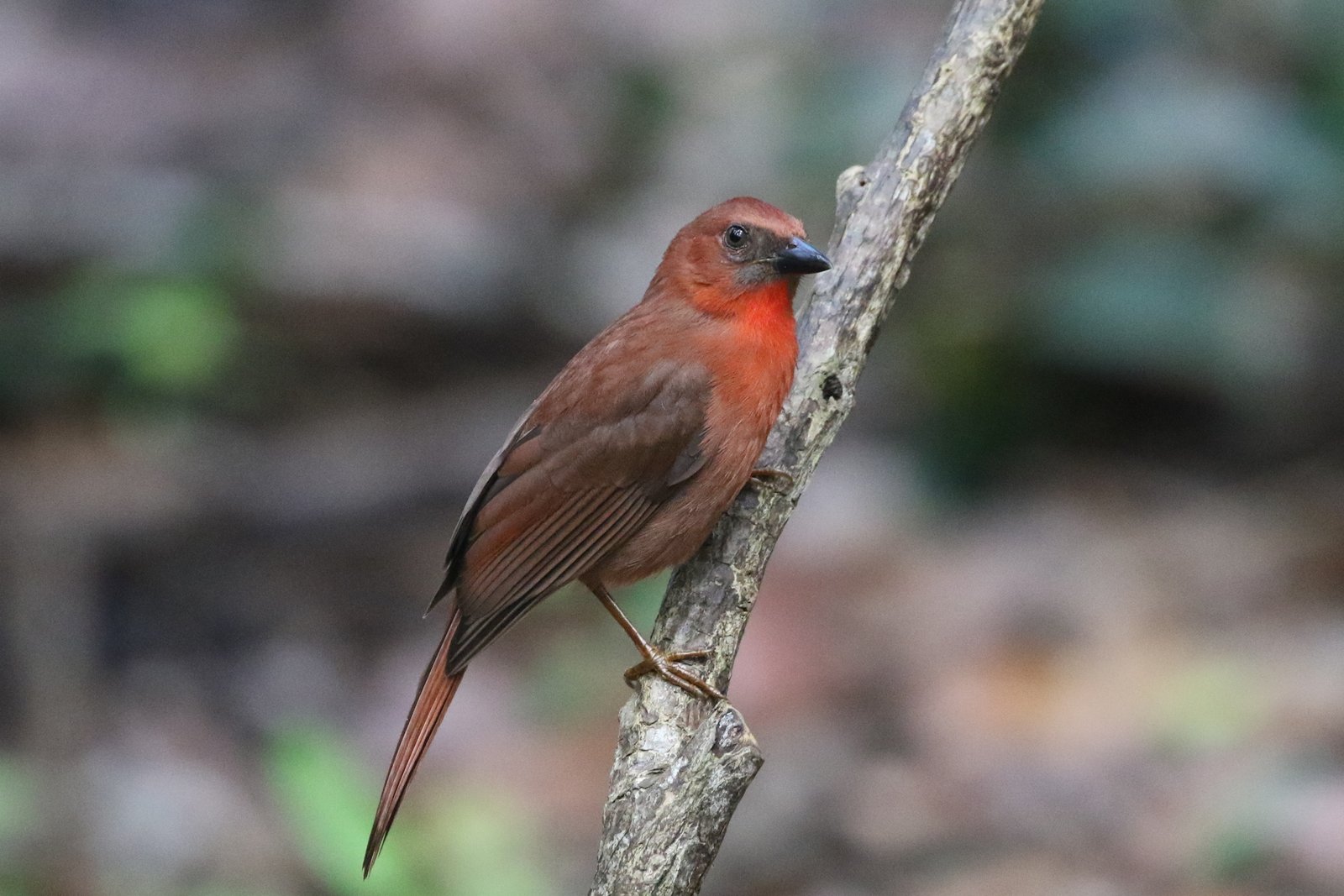
The Red-throated Ant Tanager is a sturdy, dull-coloured songbird of the understorey of humid lowland forest. The male is dark dull red with a rosy-red throat, the female brown with a yellow throat. It moves through the undergrowth in noisy family groups and sometimes follows army-ant swarms. In the guide area it lives from south-eastern Mexico to Panama.
Voice
Groups keep in contact with harsh, grating chak and chet calls and a rasping rattle. The song is a series of short, clear whistled notes, often answered by the mate. In alarm a fast, sharp chatter.
Recording: maicol gonzalez guzman — CC BY-NC-SA 4.0 · shortened to the first 60 s, mono · xeno-canto
Identification
18–20 cm. A sturdy, long-tailed songbird with a stout dark bill. The male is dark dull red, browner on the back and wings, with a brighter rosy-red throat and a thin red crown stripe without a black border. The female is olive-brown, slightly paler below, with a contrasting ochre-yellow throat and no or only a faint yellow crown stripe. Legs pinkish-brown.
Confusion species
Red-crowned Ant Tanager Habia rubica is smaller and paler, with a crown stripe bordered with black on each side and a throat that barely contrasts with the breast; it lives more often in drier forest. Black-cheeked Ant Tanager Driophlox atrimaxillaris (only in south-western Costa Rica) is dark grey with black cheeks and a salmon-pink throat. Female Summer Tanagers Piranga rubra are yellower and live higher in the trees.
Habitat
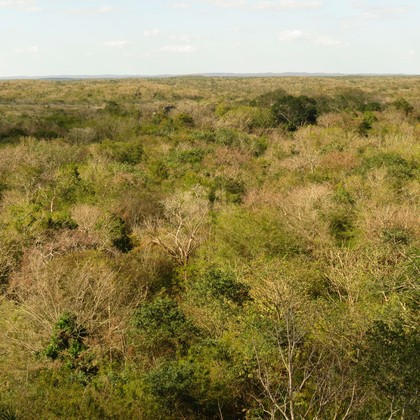
Understorey and dense edges of humid lowland forest, foothill forest and semi-evergreen seasonal forest, also tall secondary forest, wooded ravines and shade plantations; mainly below 800 m, locally to about 1200 m. It feeds low in the vegetation on insects and fruit and sometimes follows army-ant swarms.
Where the bird is most at home, classified by the vegetation units of Mexico and Central America.




Range and movements
Caribbean slope of south-eastern Mexico (from southern Veracruz and northern Oaxaca through Tabasco and Chiapas to the Yucatán Peninsula) through Belize, Guatemala, Honduras and Nicaragua to Costa Rica and Panama; locally also on the Pacific slope. Outside the guide area in northern Colombia.
- Resident
- dark = core range, pale = thinly spread
How and when to look
Groups are often heard first by their harsh, grating calls in the understorey, for example at Tikal and Calakmul or at La Selva in Costa Rica. They respond strongly to each other's alarm calls and stay close to the ground.
Conservation status
Not threatened (LC). Common in humid forest and forest edges; tolerates some disturbance but disappears where forest is cleared entirely.
Scientific name
Driophlox fuscicauda | (Cabanis, 1861)
Cabanis described the species in 1861 as Phoenicothraupis fuscicauda; because it was later moved to another genus, the author and year stand in brackets. The genus Driophlox was introduced in 2024 by Scott, Chesser, Unitt & Burns. Driophlox is Greek, from drios 'thicket, copse' and phlox 'flame': a 'flame in the thicket', after the red of these undergrowth dwellers. fuscicauda is Latin, from fuscus 'dusky' and cauda 'tail', after the dark tail. The specimen the first description was based on came from Costa Rica.