All species › Passerines › Cardinals and allies › Black-cheeked Ant Tanager
Position in the tree Birds Aves › Birds with a flexible palate Neognathae › All other modern birds Neoaves › Landbirds Telluraves › Falcons, parrots and passerines Australaves › Falcons and passerines Eufalconimorphae › Parrots and passerines Psittacopasserae
Black-cheeked Ant Tanager | Driophlox atrimaxillaris
Zwartwangmiertangare | Tangara hormiguera carinegra
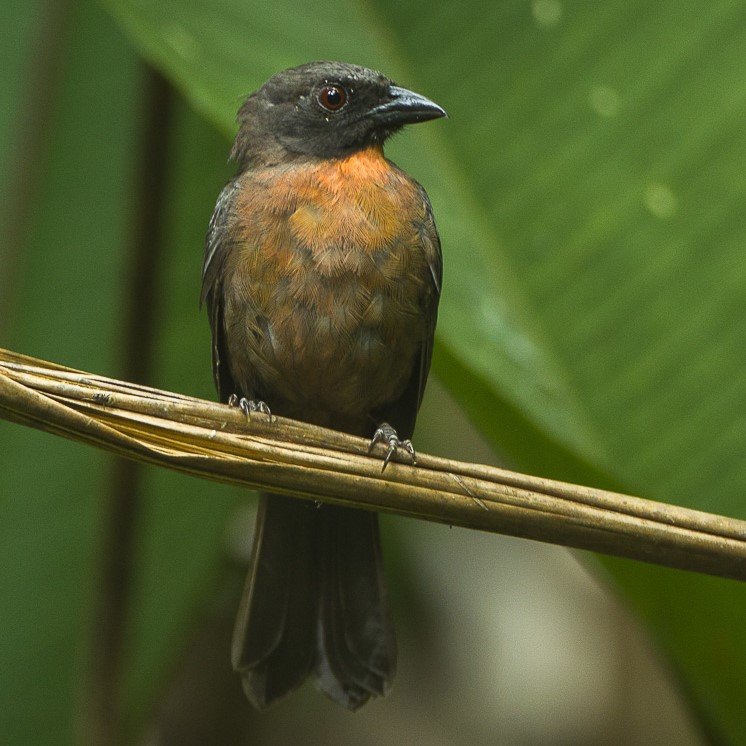
The Black-cheeked Ant Tanager is a dark ant tanager with black cheeks and a salmon-pink throat, found only in south-western Costa Rica, around the Golfo Dulce and on the Osa Peninsula. It lives in pairs or small groups in the understorey of humid lowland forest and often joins mixed flocks.
Voice
The song is a series of clear whistled notes, sometimes followed by a short chatter. Groups keep in contact with harsh chak calls and a rasping rattle, similar to those of other ant tanagers.
Recording: Arllet Quirós-Calvo — CC BY-NC-SA 4.0 · converted to mono · xeno-canto
Identification
17–19 cm. A sturdy, long-tailed songbird with a stout blackish bill. The male is dark slate-grey to olive-grey, with black cheeks and ear coverts and a salmon-pink to orange-pink throat and upper breast; lower breast and belly grey. The female resembles the male but is slightly duller and browner, with a paler, orange-yellow throat.
Confusion species
Red-throated Ant Tanager Driophlox fuscicauda does not occur in south-western Costa Rica; the male is dark dull red without black cheeks and the female olive-brown with a yellow throat. Within its small range no other bird shows the same combination of a dark body, black cheeks and a pink throat.
Habitat
Understorey of humid evergreen lowland forest, especially old forest with a dense understorey, also tall secondary forest and wooded ravines; from sea level to about 300 m, locally higher. It feeds low in the vegetation on insects and fruit, often with mixed flocks, and sometimes follows army-ant swarms.
Where the bird is most at home, classified by the vegetation units of Mexico and Central America.


Range and movements
Endemic to south-western Costa Rica: the Osa Peninsula and the lowlands around the Golfo Dulce, north to about the area of the Río Térraba. Records from adjacent western Panama are unconfirmed.
- Resident
- Winter visitor (c. Oct–Mar)
- dark = core range, pale = thinly spread
How and when to look
The best chance is in Corcovado National Park, for example around Sirena station, and in the Piedras Blancas forest near Golfito. Groups often give themselves away with their harsh calls in the understorey.
Conservation status
Near Threatened (NT). The small range and dependence on lowland forest make the species vulnerable; much of the population lives inside protected areas, but forest outside them is still being cleared.
Scientific name
Driophlox atrimaxillaris | (Dwight & Griscom, 1924)
Dwight & Griscom described the species in 1924 as Phoenicothraupis atrimaxillaris; because it was later moved to another genus, the author and year stand in brackets. The genus Driophlox was introduced in 2024 by Scott, Chesser, Unitt & Burns. Driophlox is Greek, from drios 'thicket, copse' and phlox 'flame': a 'flame in the thicket', after the red of these undergrowth dwellers. atrimaxillaris is Latin, from ater 'black' and maxilla 'jaw', after the black cheeks. The specimen the first description was based on came from Puerto Jiménez, Golfo Dulce, Costa Rica.