All species › Passerines › Cardinals and allies › Pyrrhuloxia
Position in the tree Birds Aves › Birds with a flexible palate Neognathae › All other modern birds Neoaves › Landbirds Telluraves › Falcons, parrots and passerines Australaves › Falcons and passerines Eufalconimorphae › Parrots and passerines Psittacopasserae
Pyrrhuloxia | Cardinalis sinuatus
Grijze kardinaal | Cardenal pardo
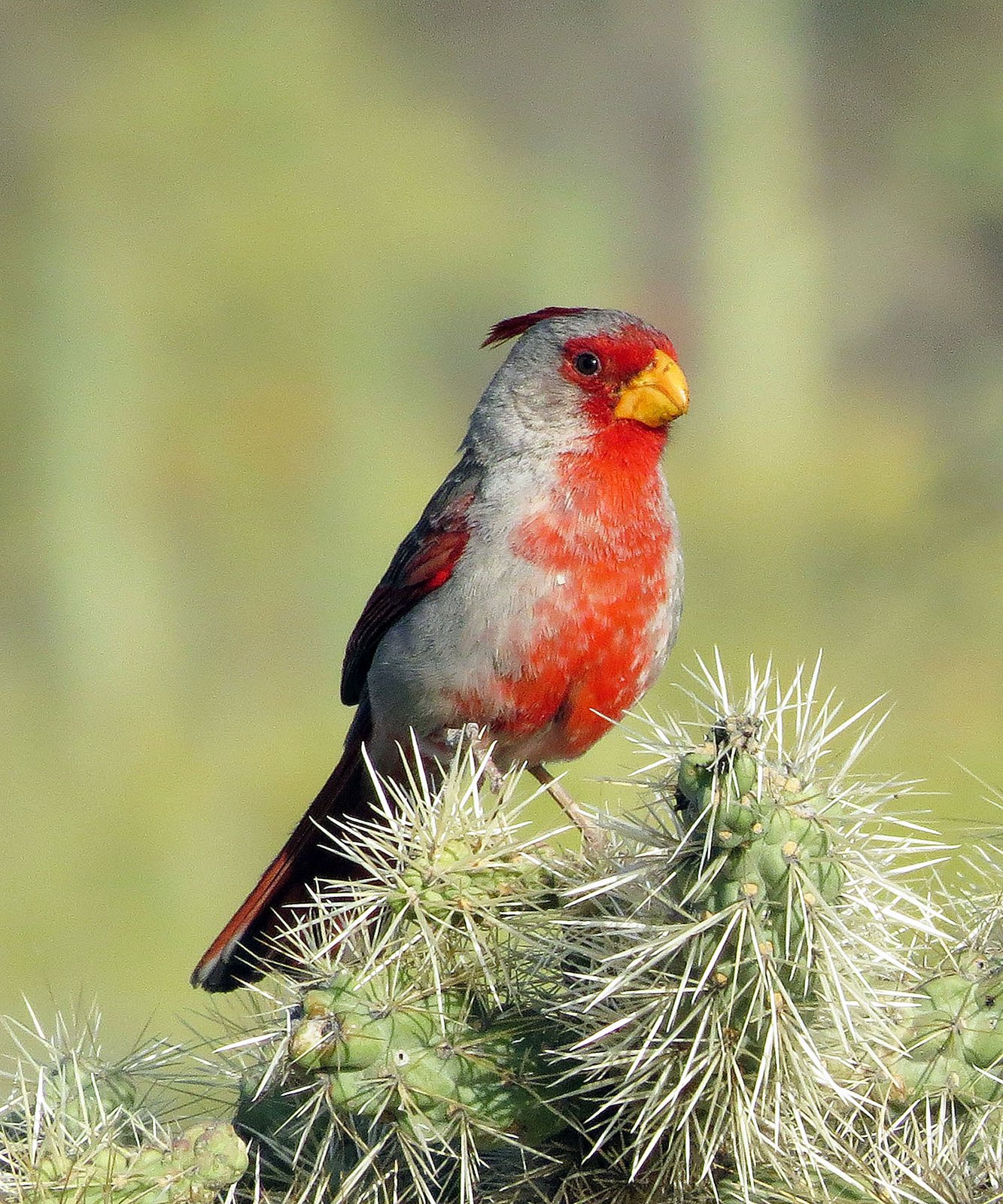
The Pyrrhuloxia is a grey relative of the Northern Cardinal with a long, pointed crest and a short, strongly curved yellow bill. The male has red on the face, the crest and the breast and belly. It lives in desert scrub and thorn scrub in northern Mexico.
Voice
The song is a series of clear whistled notes, thinner and sharper than that of the Northern Cardinal, such as kweet kweet kweet or a fast chew-chew-chew. The call is a sharp, metallic chink.
Recording: Scott Crabtree — CC BY-NC-SA 4.0 · converted to mono · xeno-canto
Identification
19–21 cm. A grey, long-tailed songbird with a long, thin, red-tipped crest and a short, thick, parrot-like curved yellowish bill. The male is grey with a red face around the bill, a red crest tip and a red stripe from throat over breast to belly; wings and tail with red. The female is greyish-brown, paler and browner below, with only some red in the crest, wings and tail. Young birds have a darker bill.
Confusion species
The female Northern Cardinal Cardinalis cardinalis is warmer brown and has a red to orange-red, less strongly curved bill and a dark face. Male Northern Cardinals are entirely red.
Habitat
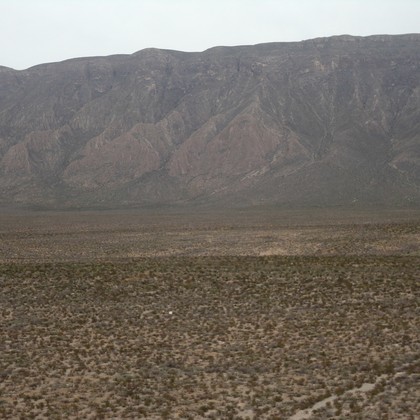
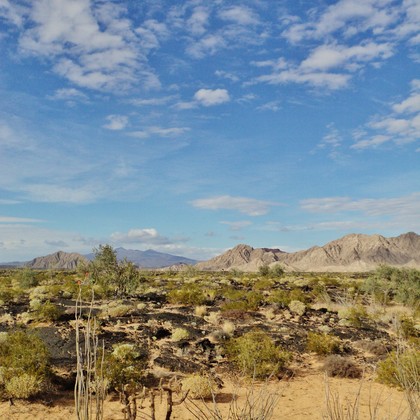
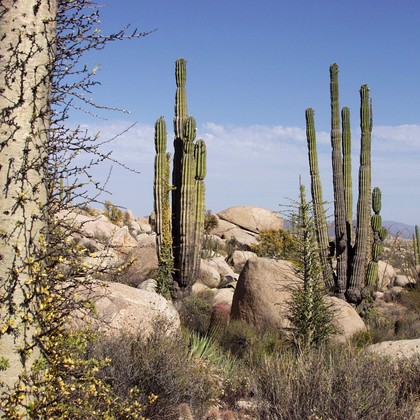
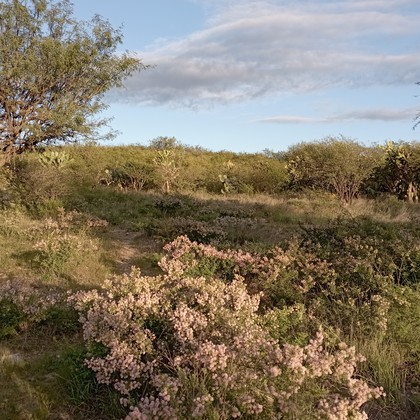
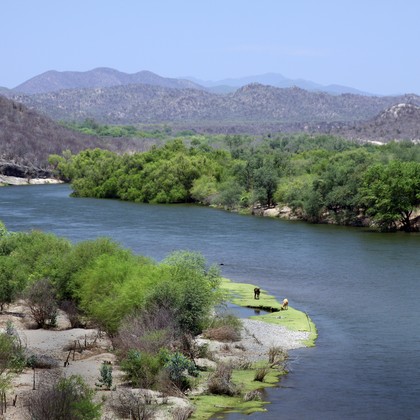
Dry thorn scrub, mesquite and acacia thickets, desert washes with shrubs, semi-desert with scattered bushes and riparian scrub; mainly below 1800 m. Outside the breeding season sometimes in flocks, also at field margins and feeding stations. It eats mainly seeds, also insects and fruit.
Where the bird is most at home, classified by the vegetation units of Mexico and Central America.

Range and movements
In Mexico in southern Baja California, in Sonora and Sinaloa south to about Nayarit, and on the central plateau and in the north-east from Chihuahua, Coahuila, Nuevo León and Tamaulipas south to Zacatecas, San Luis Potosí and Guanajuato. Outside the guide area in the south-western United States, from Arizona and New Mexico to Texas.
- Resident
- dark = core range, pale = thinly spread
How and when to look
Found in thorn scrub of the Chihuahuan Desert, for example around Cuatro Ciénegas in Coahuila, and in desert scrub near La Paz in Baja California Sur. Early in the morning it often sings from the top of a bush.
Conservation status
Not threatened (LC). Locally fairly common; declines where scrub is converted to cropland or lost to overgrazing.
Scientific name
Cardinalis sinuatus | Bonaparte, 1838
Bonaparte described the species in 1838 and placed it straight away in the genus where it still stands. He introduced the genus Cardinalis in that same work. Cardinalis is Latin for 'cardinal', after the red plumage recalling a cardinal's scarlet robes. sinuatus is Latin for 'curved, bent', after the short, strongly curved bill. The specimen the first description was based on came from western Mexico (not further specified).