All species › Woodpeckers and allies › Woodpeckers › Red-rumped Woodpecker
Position in the tree Birds Aves › Birds with a flexible palate Neognathae › All other modern birds Neoaves › Landbirds Telluraves › Raptors, owls, kingfishers and woodpeckers Afroaves › Mousebirds, rollers and woodpeckers Coraciimorphae › Trogons and cavity nesters Cavitaves › Hornbills, kingfishers and woodpeckers Picocoraciae › Kingfishers, bee-eaters and woodpeckers Picodynastornithes
Red-rumped Woodpecker | Veniliornis kirkii
Roodstuitspecht | Carpintero lomirrojo
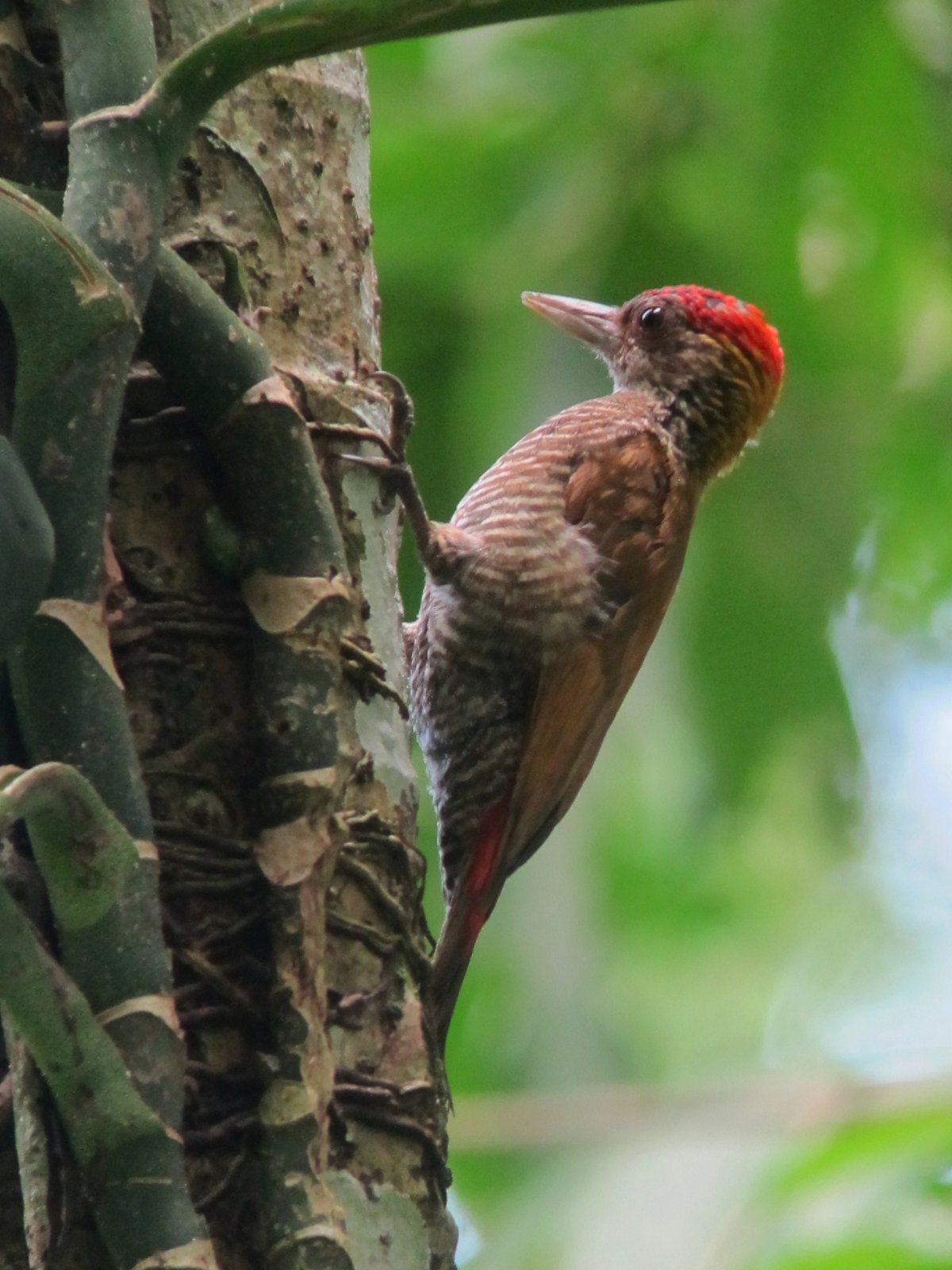
The Red-rumped Woodpecker is a small olive-brown woodpecker of forest edges, light woodland and mangroves, which in the guide area occurs only in Panama and south-western Costa Rica. The red rump is often covered by the wings and is mainly visible in flight.
Voice
A high, sharp keek and series of high, somewhat nasal notes. Drums in short rolls.
Recording: Jerome Fischer — CC BY-NC-SA 4.0 · converted to mono · xeno-canto
Identification
15–16 cm. Upperparts golden olive-brown, rump and uppertail coverts red. Head olive-brown with a dark crown; the male has red on the crown and nape, the female does not. Underparts finely and evenly barred dark olive-brown and off-white. Tail dark.
Confusion species
Smoky-brown Woodpecker Leuconotopicus fumigatus is plain brown, without barring below and without a red rump. Golden-olive Woodpecker Colaptes rubiginosus is larger, with a grey crown and a pale cheek. Red-crowned Woodpecker Melanerpes rubricapillus has a black-and-white barred back and almost plain greyish-buff underparts.
Habitat
Forest edges, light and young woodland, gallery forest, mangroves and semi-open country with trees, also plantations and gardens, mainly in the lowlands and foothills. It searches for insects and larvae on branches and trunks in the middle and upper levels.
Where the bird is most at home, classified by the vegetation units of Mexico and Central America.






Range and movements
In Panama mainly on the Pacific side, from Chiriquí through Veraguas and the area around Panama City to Darién. In Costa Rica in the south-west, in the Coto Colorado valley, around Golfito and on the Osa Peninsula, with a growing number of records in recent years. Outside the guide area in Colombia, Venezuela, western Ecuador and on Trinidad and Tobago.
- Resident
- dark = core range, pale = thinly spread
How and when to look
In Costa Rica at forest edges along the rivers and rice fields around Coto and at the bridge over the Río Rincón on Osa; in Panama in Darién and in woodland and mangroves on the Pacific side around Panama City.
Conservation status
Not threatened. It tolerates forest edges and young woodland; in Costa Rica it is being seen more and more often.
Scientific name
Veniliornis kirkii | (Malherbe, 1845)
Malherbe described the species in 1845 as Picus (Chloropicus) Kirkii; because it was later moved to another genus, the author and year stand in brackets. The genus Veniliornis was introduced in 1854 by Bonaparte. Veniliornis combines Venilia, a Roman nymph from the myth of the woodpecker-king Picus, with Greek ornis 'bird'. kirkii probably honours John Kirk, who collected birds on Tobago around 1845, where the type came from. The specimen the first description was based on came from Tobago.