All species › Falcons › Falcons and caracaras › Laughing Falcon
Position in the tree Birds Aves › Birds with a flexible palate Neognathae › All other modern birds Neoaves › Landbirds Telluraves › Falcons, parrots and passerines Australaves › Falcons and passerines Eufalconimorphae
Laughing Falcon | Herpetotheres cachinnans
Lachvalk | Halcón guaco
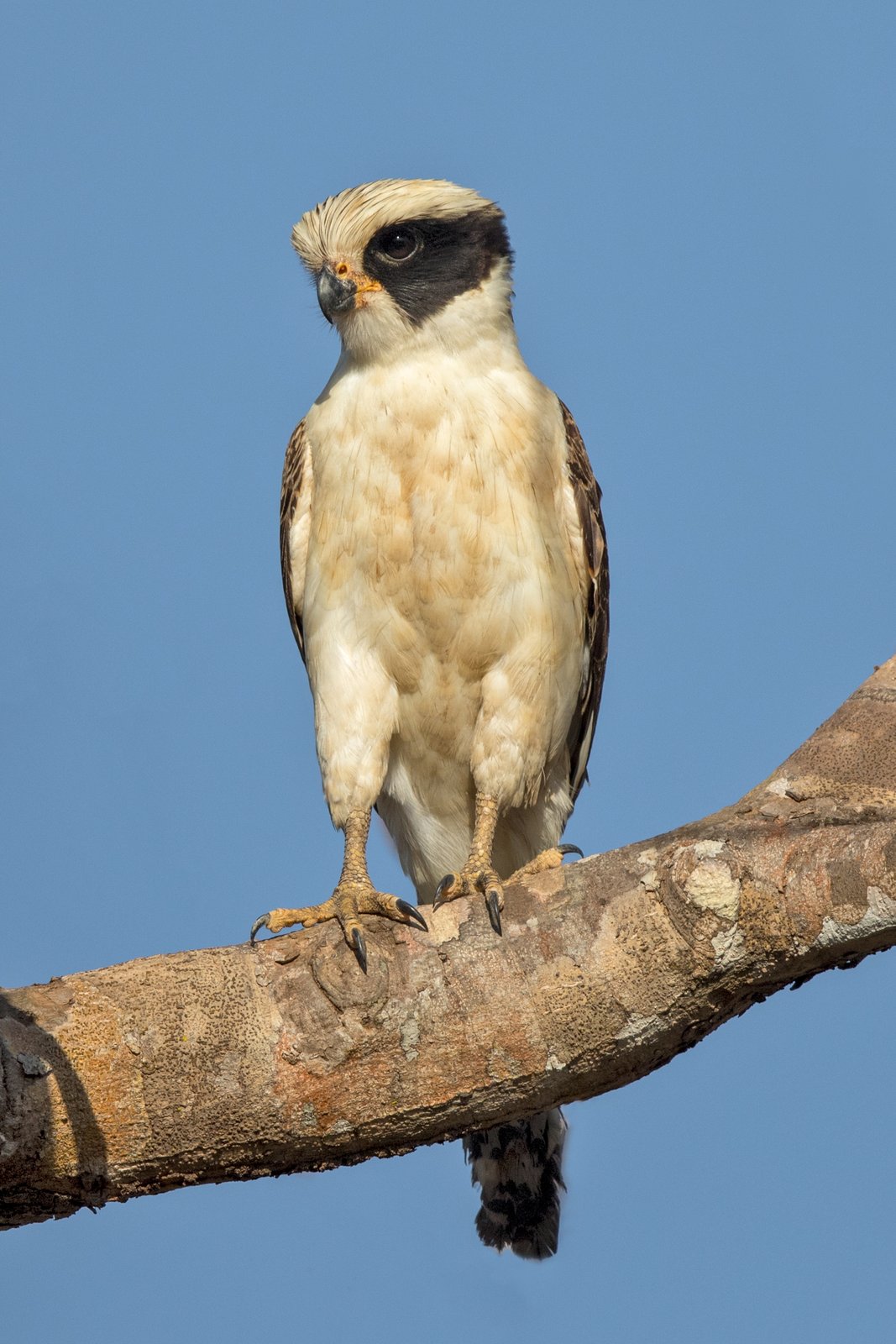
The Laughing Falcon is a large falcon with a pale head and a broad black mask that extends round the nape. It often sits upright for long periods on a bare branch or a post at the forest edge and feeds mainly on snakes, including venomous ones, which it takes from the ground or from a tree. In the guide area it is a common resident of the lowlands, from northwestern and northeastern Mexico to Panama. The name comes from its loud, laughing call, heard especially at dawn and dusk.
Voice
A long series of loud, nasal calls that become faster and higher, wah-co, wah-co, wah-co, often a duet between male and female and sometimes lasting several minutes. Also a laughing ha-ha-ha-ha. Heard mainly at dawn, at dusk and on moonlit nights.
Recording: JAYRSON ARAUJO DE OLIVEIRA — CC BY-NC-SA 4.0 · shortened to the first 60 s, mono · xeno-canto
Identification
46–56 cm. Large head with a creamy-white to pale buff crown with fine dark shaft streaks, and a broad black mask from the eye round the back of the neck. Back and wings dark brown; underparts plain cream to warm buff. The tail is long and rounded, black with narrow whitish bars and a pale tip. In flight the wings are short and rounded, with a rufous to buff patch at the base of the primaries. Bill short and black, legs yellowish. Male and female are alike; juveniles resemble adults.
Confusion species
Its pale head with the black mask makes it almost unmistakable. The Collared Forest Falcon Micrastur semitorquatus has a dark crown, a black crescent on the cheek and a white collar, and stays hidden in the forest. The Yellow-headed Caracara Daptrius chimachima (Costa Rica and Panama) also has a pale head, but only a narrow black line behind the eye, and forages on the ground in open country, often near cattle.
Habitat
Forest edges, clearings in humid and dry forest, gallery forest, seasonal forest, savanna with scattered trees and pasture with tall trees; mostly below 1500 m. It avoids the interior of closed forest. It hunts from a high, open perch and drops onto its prey.
Where the bird is most at home, classified by the vegetation units of Mexico and Central America.







Range and movements
Resident. In Mexico on the Pacific side from southern Sonora and on the Gulf side from southern Tamaulipas, south through the lowlands to Chiapas and the Yucatán Peninsula. Further through Belize, Guatemala, El Salvador, Honduras, Nicaragua and Costa Rica to Panama, on both slopes. Outside the guide area in tropical South America to northern Argentina.
- Resident
- dark = core range, pale = thinly spread
How and when to look
It is found mainly by listening at dawn. In Guanacaste in Costa Rica, at Tikal in Guatemala and in the forests along the Panama Canal it regularly sits in full view on a bare tree by the road or at the forest edge.
Conservation status
Not threatened. Common, and tolerates partly cleared landscapes with scattered tall trees.
Scientific name
Herpetotheres cachinnans | (Linnaeus, 1758)
Linnaeus described the species in 1758 as Falco cachinnans; because it was later moved to another genus, the author and year stand in brackets. The genus Herpetotheres was introduced in 1817 by Vieillot. Herpetotheres is Greek, from herpeton 'creeping animal, reptile' and thēras 'hunter': 'snake-hunter', after the Laughing Falcon's diet. cachinnans is Latin for 'laughing aloud', after the loud, laughing call. The specimen the first description was based on came from Suriname (restricted later; originally South America).