All species › Passerines › New World warblers › Red-faced Warbler
Position in the tree Birds Aves › Birds with a flexible palate Neognathae › All other modern birds Neoaves › Landbirds Telluraves › Falcons, parrots and passerines Australaves › Falcons and passerines Eufalconimorphae › Parrots and passerines Psittacopasserae
Red-faced Warbler | Cardellina rubrifrons
Roodmaskerzanger | Chipe cara roja
The Red-faced Warbler is a small grey warbler of mountain forest with a bright red face and a black cap. It breeds in coniferous and pine-oak forest in the south-western United States and north-western Mexico. In winter it moves to the highlands of southern Mexico and northern Central America.

Voice
The song is a series of clear, sweet notes that speeds up and ends in an emphatic, downslurred note, recalling the song of Yellow Warbler. The call is a sharp chip.
Recording: David A. Brinkman — CC BY-NC-SA 4.0 · converted to mono · xeno-canto
Identification
13–14 cm. Forehead, face, throat and upper breast bright red. A black cap extends from the crown down over the ear coverts, with a small white spot on the nape. Back and wings grey, rump white, underparts greyish white. The sexes are nearly alike; the female is slightly duller. Young birds have a brownish-pink face and a browner cap. Bill short, fine and grey. It often flicks its tail.
Confusion species
No other warbler in the guide area combines a red face, a black cap and a grey back. Red Warbler Cardellina rubra (Mexico only) is almost entirely red, without a black cap. Painted Whitestart Myioborus pictus is black with a red belly and a large white wing patch.
Habitat
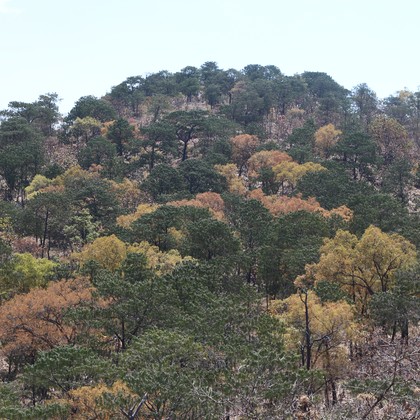
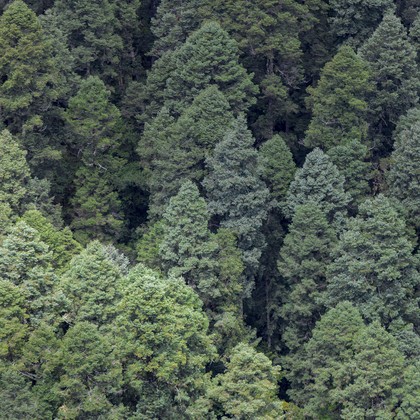
Breeds in coniferous, fir and pine-oak forest in the mountains, mostly between 2000 and 3000 m. In winter in pine-oak forest and humid montane forest, mostly between 1500 and 3500 m, often in mixed flocks with other warblers. It searches for insects at the outer ends of branches and in the foliage. The nest is built on the ground, hidden under a grass tussock or against a slope.
Where the bird is most at home, classified by the vegetation units of Mexico and Central America.


Range and movements
Breeds from the south-western United States (Arizona and New Mexico) south along the Sierra Madre Occidental to Durango. Winters in the mountains of southern Mexico (from Jalisco and Michoacán through Guerrero and Oaxaca to Chiapas) and on through Guatemala, El Salvador and Honduras.
- Resident
- Summer visitor (c. Apr–Sep)
- Winter visitor (c. Oct–Mar)
- Passage (Mar–Apr, Oct–Nov)
- dark = core range, pale = thinly spread
How and when to look
In winter often found in mixed flocks in the pine-oak forest of Chiapas and western Guatemala. The red face shows well even in foliage.
Conservation status
Not threatened (LC). Common in suitable mountain forest; locally sensitive to logging of coniferous and pine-oak forest.
Scientific name
Cardellina rubrifrons | (Giraud, 1841)
Giraud described the species in 1841 as Muscicapa rubrifrons; because it was later moved to another genus, the author and year stand in brackets. The genus Cardellina was introduced in 1850 by Bonaparte. Cardellina is a diminutive of the Italian dialect word cardella 'goldfinch'. rubrifrons is Latin, from ruber 'red' and frons 'forehead', after the red face. The specimen the first description was based on came from Mexico (unspecified; originally given wrongly as 'Texas').