All species › Swifts › Hummingbirds › Purple-throated Woodstar
Position in the tree Birds Aves › Birds with a flexible palate Neognathae › All other modern birds Neoaves › Birds of the elements Elementaves › Nightjars and swifts Strisores
Purple-throated Woodstar | Philodice mitchellii
Paarskeelboself | Estrellita gorgipúrpura
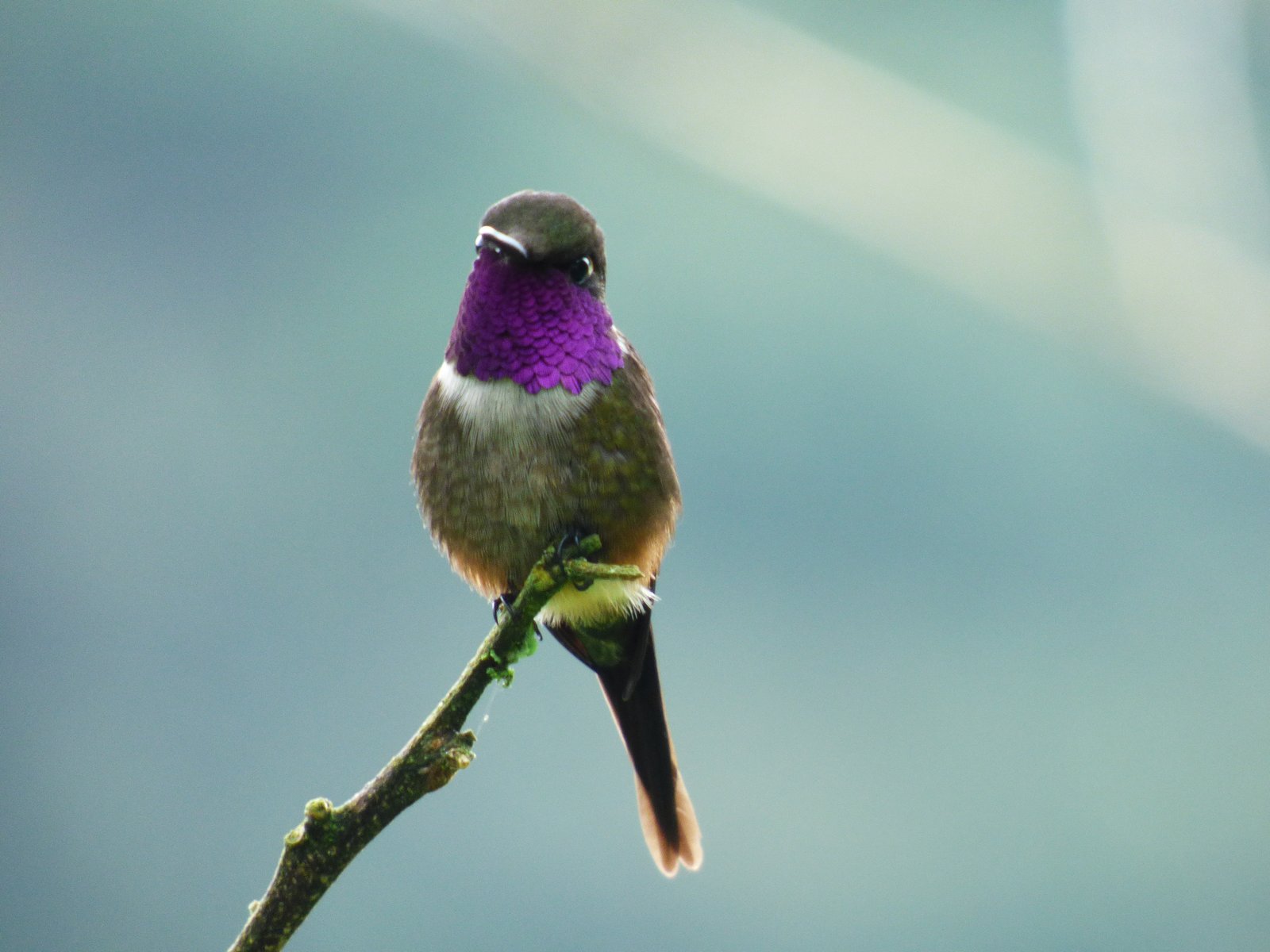
The Purple-throated Woodstar is a small hummingbird of the Andes of Colombia and Ecuador, which in the guide area occurs only in the mountains of Darién in eastern Panama. It was formerly placed with the Magenta-throated Woodstar in the genus Calliphlox; the two species do not overlap in Panama. Woodstars fly slowly with a bee-like buzz and often perch high on bare twigs.
Voice
A dry, soft tsit or chip; the wings give a low, bee-like buzz in flight.
Recording: Nick Athanas — CC BY-NC-SA 3.0 · converted to mono · xeno-canto
Identification
7–8 cm, with a short, straight black bill. Both sexes have a white spot behind the eye and a white patch on each side of the rump. The male is dark bronzy green above, with a glittering purple throat, a white band below the throat, dark green underparts with rufous on the flanks and a forked, dark tail. The female has a whitish throat with dark spots, a pale breast band, cinnamon belly and flanks and a rounded tail with a rufous base, a black band and rufous tips.
Confusion species
Magenta-throated Woodstar Philodice bryantae occurs only in western Panama and Costa Rica, is slightly larger, and the male has a magenta-red throat and a longer tail. Female Rufous-crested Coquette Lophornis delattrei has a rufous forehead and a pale band across the rump instead of two white patches. Females of other small hummingbirds in Darién lack the white rump patches.
Habitat
Edges of humid foothill and montane forest, clearings, scrub and flowering gardens, in Darién mainly on the mountain slopes. It feeds from the understorey to the canopy at small flowers and often sits for long periods on a lookout high in a tree.
Where the bird is most at home, classified by the vegetation units of Mexico and Central America.



Range and movements
In the guide area only in the mountains of Darién in eastern Panama, such as Cerro Pirre and Cerro Tacarcuna; scarce and local there. Most of the world population lives outside the guide area, on the slopes of the Andes of Colombia and Ecuador.
- Resident
- dark = core range, pale = thinly spread
How and when to look
Seldom seen in the guide area; the best chance is at flowering trees and shrubs along forest edges and clearings in the mountains of Darién. Look for a small hummingbird that flies slowly with a buzz and returns to a bare twig.
Conservation status
Least Concern. The range in the Andes is large. In Panama the species is rare and known from only a few sites.
Scientific name
Philodice mitchellii | (Bourcier, 1847) (GBIF: Calliphlox mitchellii)
Bourcier described the species in 1847 as Trochilus Mitchellii; because it was later moved to another genus, the author and year stand in brackets. The genus Philodice was introduced in 1866 by Mulsant, Verreaux & Verreaux. Philodice refers to Philodice of Greek mythology, daughter of Inachus and wife of Leucippus. mitchellii honours the English zoologist and artist David William Mitchell (1813–1859), secretary of the Zoological Society of London. The specimen the first description was based on came from Zimapán, Mexico (per the description).