All species › Swifts › Hummingbirds › Sparkling-tailed Woodstar
Position in the tree Birds Aves › Birds with a flexible palate Neognathae › All other modern birds Neoaves › Birds of the elements Elementaves › Nightjars and swifts Strisores
Sparkling-tailed Woodstar | Tilmatura dupontii
Duponts kolibrie | Colibrí cola pinta
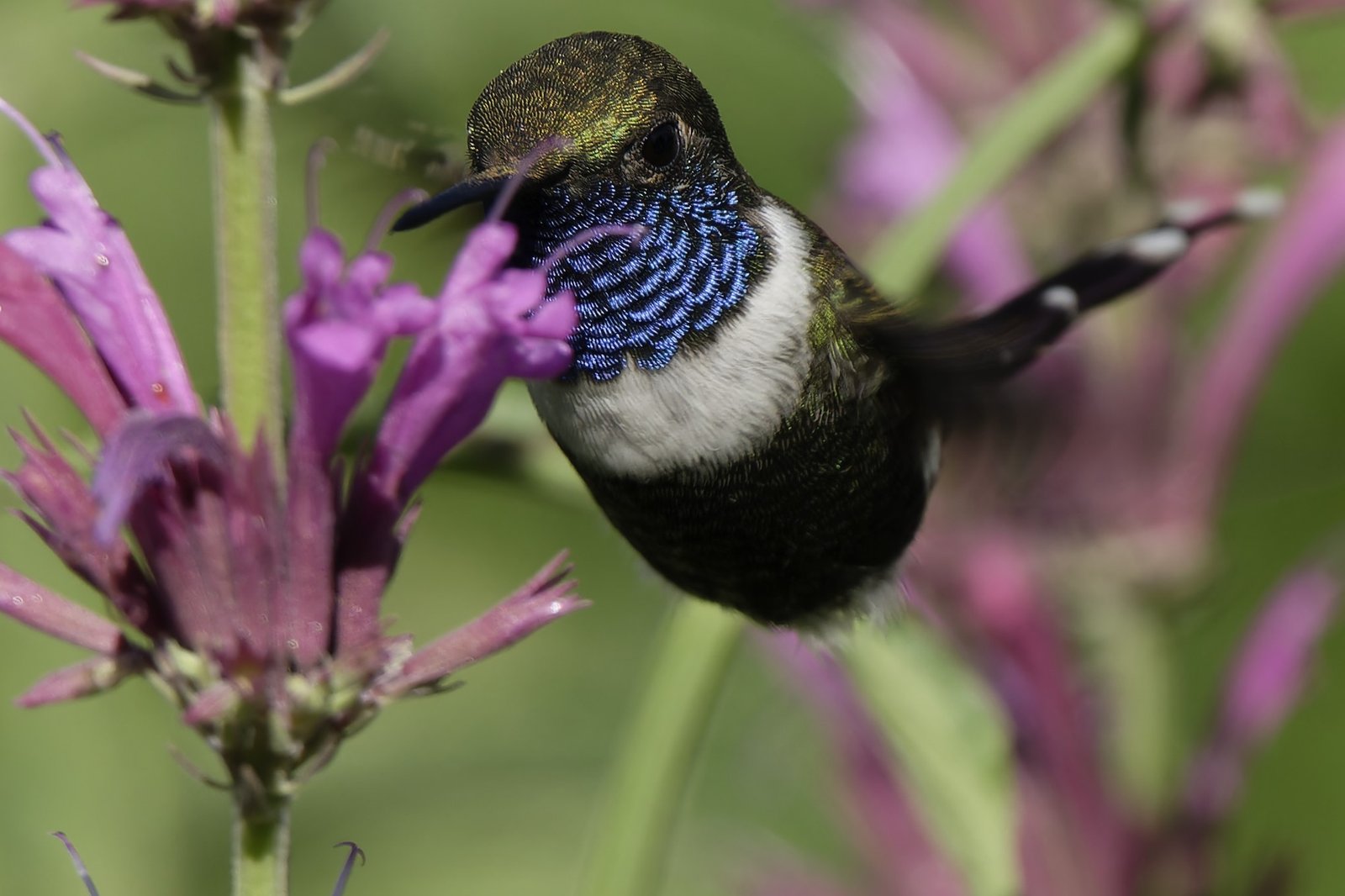
The Sparkling-tailed Woodstar is a small hummingbird of the highlands of Mexico and northern Central America. The male has a long, deeply forked tail banded black and white, often held almost upright. It flies slowly and with a buzzing sound from flower to flower like a bumblebee, and is often overlooked.
Voice
Mostly silent. A high, dry tsit or tsik; the wings give a soft, insect-like buzz in flight.
Recording: Manuel Grosselet — CC BY-NC-SA 4.0 · converted to mono · xeno-canto
Identification
7–8 cm without the male's elongated tail feathers, with a short, straight black bill. Both sexes have a white spot behind the eye and a white patch on each side of the rump. The male is green above, with a glittering blue to violet throat, a white band across the breast, green flanks and a long, deeply forked tail with the outer feathers barred black and white. The female has a whitish throat, cinnamon underparts and a short, rounded tail with a black band and pale tips.
Confusion species
Male Slender Sheartail Doricha enicura has a longer, slightly decurved bill, a magenta throat and a plain black tail without bands, and lacks the white rump patches. Females of Wine-throated Hummingbird Selasphorus ellioti and Bumblebee Hummingbird Selasphorus heloisa show rufous at the base of the tail and no white rump patches. Ruby-throated Hummingbird Archilochus colubris, present in the guide area in winter, has a white belly and lacks the white rump patches.
Habitat
Pine-oak and oak forest, forest edges, semi-open country with flowering shrubs, coffee plantations and gardens in the mountains, at about 600 to 2500 m. It feeds low to mid-level at small flowers of shrubs and herbs and catches small insects.
Where the bird is most at home, classified by the vegetation units of Mexico and Central America.






Range and movements
Endemic to the guide area. From Sinaloa and Nayarit along the Pacific slope and through the central highlands of Mexico, including Jalisco, Michoacán, Mexico City, Morelos, Guerrero, Oaxaca and Chiapas, and on through the highlands of Guatemala, El Salvador, Honduras and Nicaragua. Local everywhere and in varying numbers.
- Resident
- Summer visitor (c. Apr–Sep)
- Winter visitor (c. Oct–Mar)
- Passage (Mar–Apr, Oct–Nov)
- dark = core range, pale = thinly spread
How and when to look
In gardens and parks with flowering shrubs in the south of Mexico City, in the mountains of Jalisco and around San Cristóbal de las Casas in Chiapas; in Guatemala on the slopes around Antigua. A bird buzzing low with a raised, banded tail is usually the male.
Conservation status
Least Concern. The range is large, but the species is scarce and local almost everywhere. Loss of highland forest and scrub affects it locally.
Scientific name
Tilmatura dupontii | (Lesson, 1832)
Lesson described the species in 1832 as Ornismya dupontii; because it was later moved to another genus, the author and year stand in brackets. The genus Tilmatura was introduced in 1854 by Reichenbach. Tilmatura is Greek, from tilma 'something plucked or torn' and oura 'tail', after the ragged, forked tail. dupontii honours the French natural history dealer Léonard Puech Dupont (1796–1828), or possibly his brother Richard-Henry (1798–1873), who supplied the specimen to Lesson. The specimen the first description was based on came from Mexico.