All species › Waders, gulls and terns › Auks, puffins and murres › Rhinoceros Auklet
Position in the tree Birds Aves › Birds with a flexible palate Neognathae › All other modern birds Neoaves › Birds of the elements Elementaves › Cranes and waders Gruimorphae
Rhinoceros Auklet | Cerorhinca monocerata
Neushoornalk | Alca rinoceronte
The Rhinoceros Auklet is a stocky, sooty-grey auk of the North Pacific with a heavy, orange-yellow bill. In the breeding season it carries an upright horn on the bill and two thin white plumes on the head. In the guide area it occurs only in winter, in the cool waters off the north-west coast of Baja California.
Voice
Silent in the guide area. At the colonies low mooing and barking calls at night.
Recording: KEISUKE KAGOSHIMA — CC BY 4.0 · converted to mono · xeno-canto
Identification
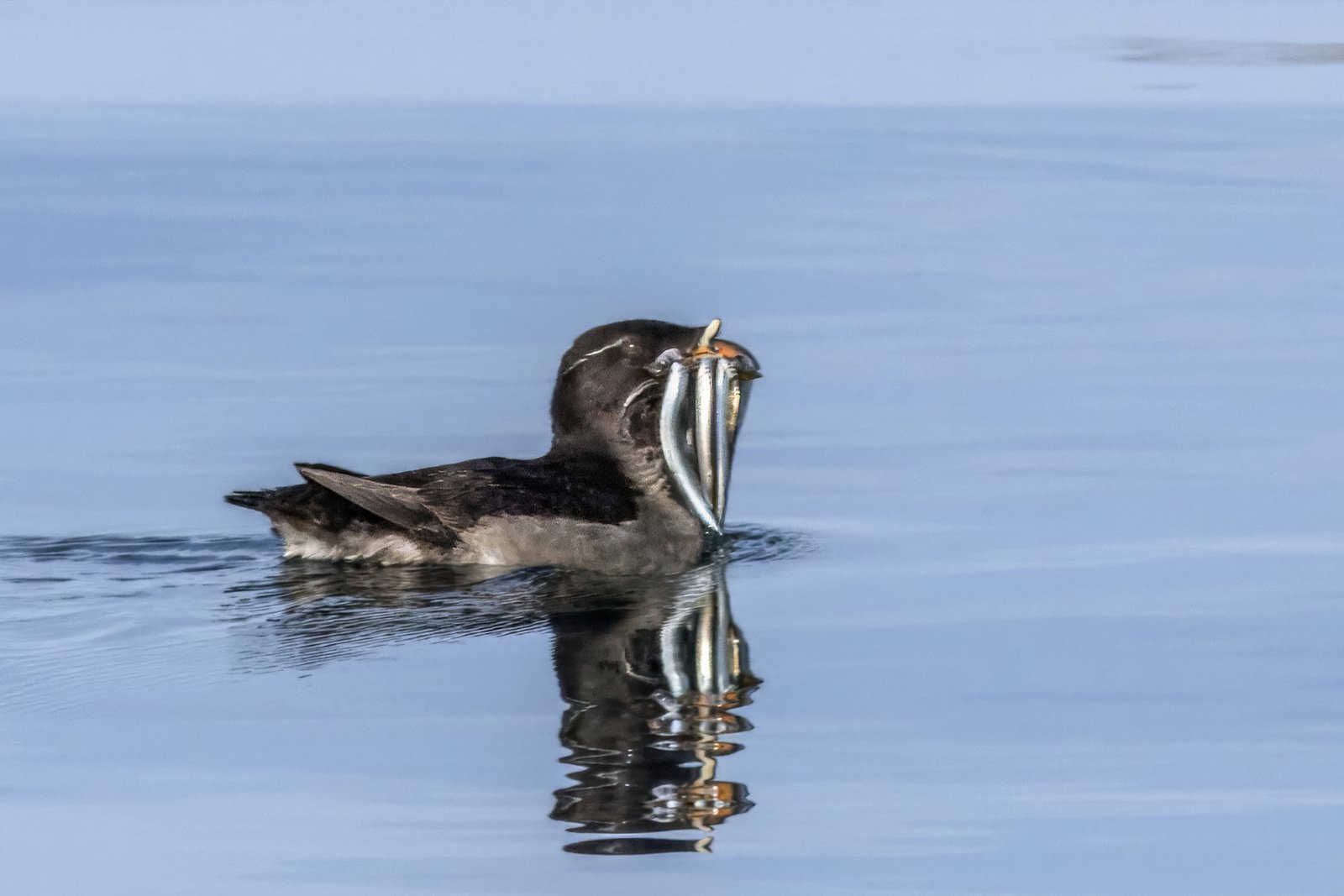
35–38 cm, heavy and short-necked, with a large head, short legs and pointed wings. The plumage is dark grey-brown, slightly paler on the breast and flanks and dirty white on the belly, without sharp borders. In breeding plumage a pale, upright horn stands at the base of the orange-yellow bill, and two thin white plumes run across the head, one from above the eye and one from the gape. In non-breeding plumage, the one seen in the guide area, the horn is absent, the plumes are faint or missing and the bill is duller. Juveniles have a smaller, darker bill. It flies low and straight over the water with fast wingbeats.
Confusion species
Cassin's Auklet Ptychoramphus aleuticus is much smaller, with a short dark bill, a pale eye and a small white spot above the eye. Tufted Puffin Fratercula cirrhata, which turns up in the guide area at most exceptionally, is blacker with a deeper, heavier bill. Black-vented Shearwaters Puffinus opisthomelas alternate flapping with glides and have white underparts.
Habitat
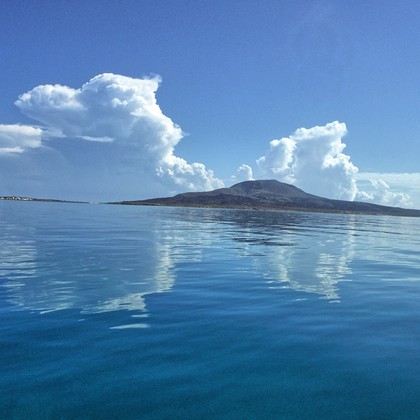
In winter at sea over the continental shelf, often in the cool water of upwelling zones and usually a few kilometres offshore, alone or in small groups. It dives for small schooling fish such as anchovies and sardines.
Where the bird is most at home, classified by the vegetation units of Mexico and Central America.

Range and movements
In the guide area only off the Pacific coast of northern Baja California, south to about Isla de Cedros and Sebastián Vizcaíno Bay. Outside the guide area the species breeds along the North Pacific, from northern Japan and Sakhalin through the Aleutians and southern Alaska to British Columbia, Washington, Oregon and California; in winter birds move south along the west coast of North America.
- Winter visitor (c. Oct–Mar)
- dark = core range, pale = thinly spread
How and when to look
Pelagic trips from Ensenada or San Diego to the Coronado Islands and Todos Santos give the best chance in February and March; birds sit low on the water and dive as the boat approaches.
Conservation status
Not threatened. The world population is large. Introduced rats and foxes on breeding islands, drowning in gillnets, oil and fluctuations in fish supply during warm-water years are local threats.
Scientific name
Cerorhinca monocerata | (Pallas, 1811)
Pallas described the species in 1811 as Alca monocerata; because it was later moved to another genus, the author and year stand in brackets. The genus Cerorhinca was introduced in 1828 by Bonaparte. Cerorhinca is Greek, from keras 'horn' and rhis, rhinos 'nose', after the horn-like projection at the base of the bill in the breeding season. monocerata is Greek, from monokerōs 'one-horned', after the single horn on the bill in the breeding season. The specimen the first description was based on came from Cape St. Elias and Kodiak Island, Alaska.