All species › Passerines › Tyrant flycatchers and allies › Piratic Flycatcher
Position in the tree Birds Aves › Birds with a flexible palate Neognathae › All other modern birds Neoaves › Landbirds Telluraves › Falcons, parrots and passerines Australaves › Falcons and passerines Eufalconimorphae › Parrots and passerines Psittacopasserae
Piratic Flycatcher | Legatus leucophaius
Piraattiran | Papamoscas pirata
The Piratic Flycatcher is a small, dark tyrant flycatcher with a boldly striped head, named for its breeding habits: it builds no nest of its own but takes over the nests of other birds. In the guide area it is a summer visitor that breeds from southern Mexico to Panama.
Voice
A plaintive, high wee-yee and a rising, trilled pirr-ee-ee-ee, repeated endlessly from a high, bare branch.
Recording: Daan van der Hoeven — CC BY-NC-SA 4.0 · converted to mono · xeno-canto
Identification
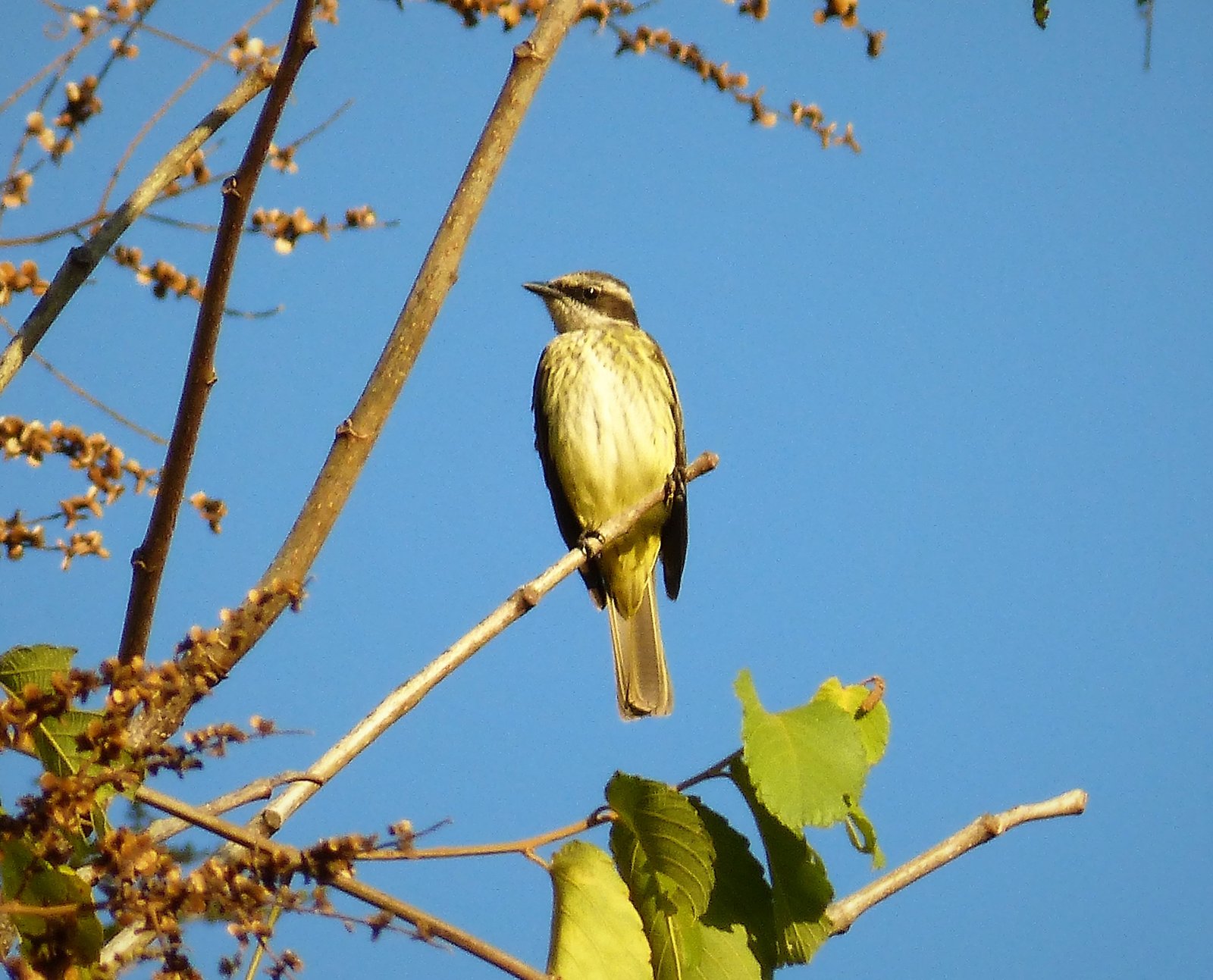
15 cm, stocky, with a short, broad black bill. Upperparts plain dark olive-brown. Head with a broad dark eye-stripe, a white supercilium and a white moustachial stripe; a concealed yellow crown patch. Throat white, breast dingy white with blurry dark streaks, belly pale yellow. Wings and tail dark brown without rufous. Male and female are alike.
Confusion species
Streaked Flycatcher Myiodynastes maculatus and Sulphur-bellied Flycatcher Myiodynastes luteiventris are much larger, with a heavier bill, a streaked back and a rufous tail. Social Flycatcher Myiozetetes similis and Grey-capped Flycatcher Myiozetetes granadensis have an unstreaked breast and a bright yellow belly.
Habitat
Forest edges, clearings in humid forest, secondary forest, gallery forest, pasture and open country with scattered tall trees; also villages and parks. It often perches high and exposed. It eats mainly small fruits, including mistletoe berries, as well as insects. It drives other birds from their nests, often oropendolas, caciques, becards or Social Flycatchers, and breeds in them.
Where the bird is most at home, classified by the vegetation units of Mexico and Central America.





Range and movements
From south-eastern Mexico through Belize, Guatemala, Honduras, Nicaragua and Costa Rica to Panama. Outside the guide area over much of tropical South America, to northern Argentina; birds breeding in the guide area winter in South America.
- Summer visitor (c. Apr–Sep)
- dark = core range, pale = thinly spread
How and when to look
Look for it near colonies of oropendolas and other birds with hanging or domed nests. The endlessly repeated call from a high perch gives it away.
Conservation status
Not threatened. Widespread and fairly common in semi-open country with tall trees.
Scientific name
Legatus leucophaius | (Vieillot, 1818)
Vieillot described the species in 1818 as Platyrhynchos leucophaius; because it was later moved to another genus, the author and year stand in brackets. The genus Legatus was introduced in 1859 by Sclater. Legatus is Latin for 'envoy, governor', from legare 'to appoint'; why Sclater chose the name is not known. leucophaius is Greek, from leukos 'white' and phaios 'dusky': 'whitish-grey', after the plumage. The specimen the first description was based on came from Cayenne, French Guiana.