All species › Passerines › Tyrant flycatchers and allies › Brown-crested Flycatcher
Position in the tree Birds Aves › Birds with a flexible palate Neognathae › All other modern birds Neoaves › Landbirds Telluraves › Falcons, parrots and passerines Australaves › Falcons and passerines Eufalconimorphae › Parrots and passerines Psittacopasserae
Brown-crested Flycatcher | Myiarchus tyrannulus
Cayennetiran | Papamoscas tirano
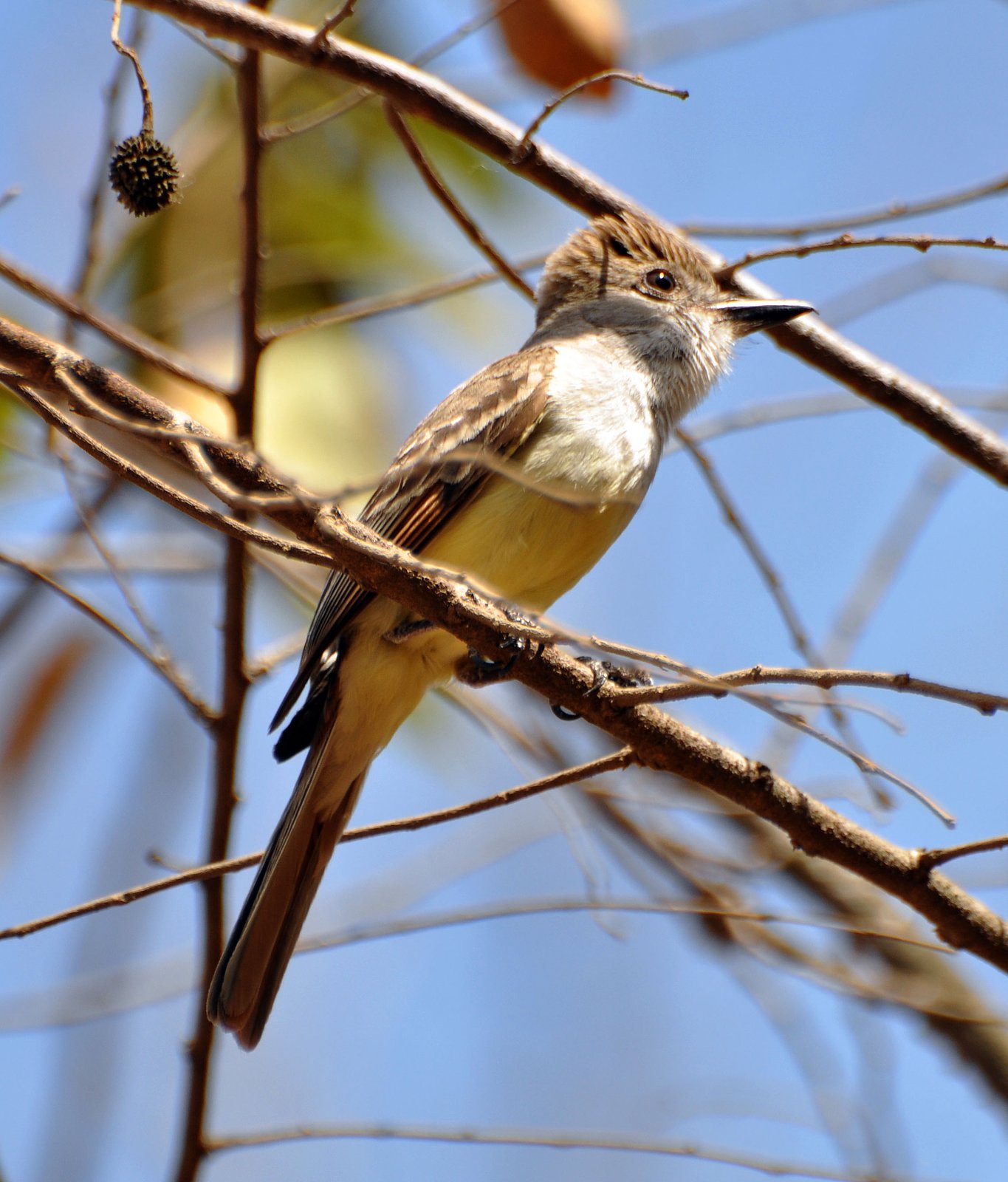
The Brown-crested Flycatcher is the largest and heaviest-billed Myiarchus flycatcher of the guide area, a bird of dry forest, scrub and semi-open country. In northern Mexico it is mainly a summer visitor; further south it stays all year.
Voice
A sharp, loud whit and a rough, rolling brrrek; at dawn a repeated, whistled song.
Recording: JAYRSON ARAUJO DE OLIVEIRA — CC BY-NC-SA 4.0 · converted to mono · xeno-canto
Identification
18–20 cm. Head and back greyish olive-brown, crown slightly bushy and a little browner. Wings dark with pale wing-bars and rufous edges to the primaries. Tail with much rufous on the inner webs. Throat and breast pale grey, merging gradually into the pale yellow belly. Bill heavy and all black. Male and female are alike.
Confusion species
Great Crested Flycatcher Myiarchus crinitus (winter visitor) has a darker grey breast sharply contrasting with a brighter yellow belly, and a pale base to the lower mandible. Ash-throated Flycatcher Myiarchus cinerascens and Nutting's Flycatcher Myiarchus nuttingi are smaller, with a shorter, finer bill. Panama Flycatcher Myiarchus panamensis has little rufous in wings and tail. Dusky-capped Flycatcher Myiarchus tuberculifer is smaller, with a dark cap.
Habitat
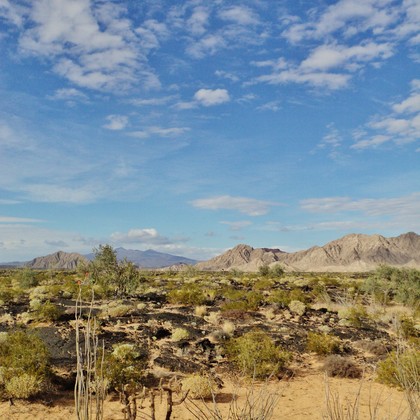
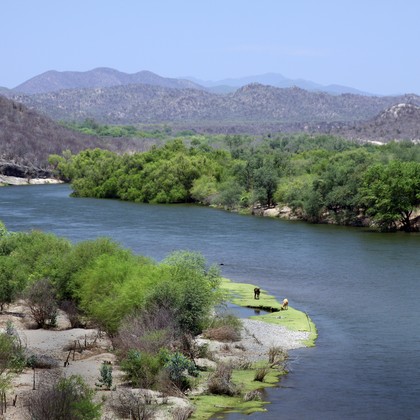
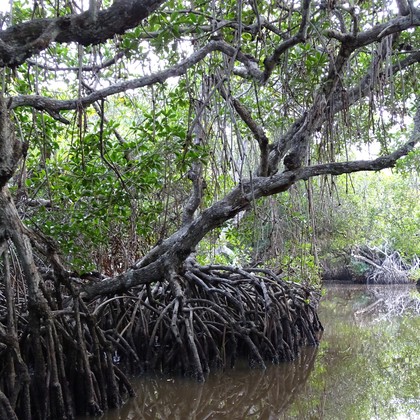
Dry deciduous forest, seasonal forest, thorn scrub, cactus forest, riparian woodland in arid regions and mangroves, also semi-open country with tall trees; in the north also desert with large columnar cacti. It sallies for insects from a perch and also eats fruit. It nests in a cavity in a tree or cactus.
Where the bird is most at home, classified by the vegetation units of Mexico and Central America.



Range and movements
From northern Mexico through the lowlands on both slopes, including the Yucatán Peninsula, and on through Central America, mainly on the Pacific slope, to north-western Costa Rica. Outside the guide area in the south-western United States and over much of South America.
- Resident
- Summer visitor (c. Apr–Sep)
- Winter visitor (c. Oct–Mar)
- Passage (Mar–Apr, Oct–Nov)
- dark = core range, pale = thinly spread
How and when to look
In dry lowland forest it is often the commonest large Myiarchus. The heavy, all-black bill and the gradual transition from grey breast to yellow belly are good features.
Conservation status
Not threatened. Widespread and common in dry, semi-open country.
Scientific name
Myiarchus tyrannulus | (Müller, 1776)
Müller described the species in 1776 as Muscicapa tyrannulus; because it was later moved to another genus, the author and year stand in brackets. The genus Myiarchus was introduced in 1844 by Cabanis. Myiarchus is Greek, from muia 'fly' and arkhos 'ruler': 'fly-ruler'. tyrannulus is Latin for 'little tyrant', diminutive of tyrannus. The specimen the first description was based on came from Cayenne, French Guiana.