All species › Passerines › Tyrant flycatchers and allies › Bright-rumped Attila
Position in the tree Birds Aves › Birds with a flexible palate Neognathae › All other modern birds Neoaves › Landbirds Telluraves › Falcons, parrots and passerines Australaves › Falcons and passerines Eufalconimorphae › Parrots and passerines Psittacopasserae
Bright-rumped Attila | Attila spadiceus
Goudstuitattila | Atila polimorfo
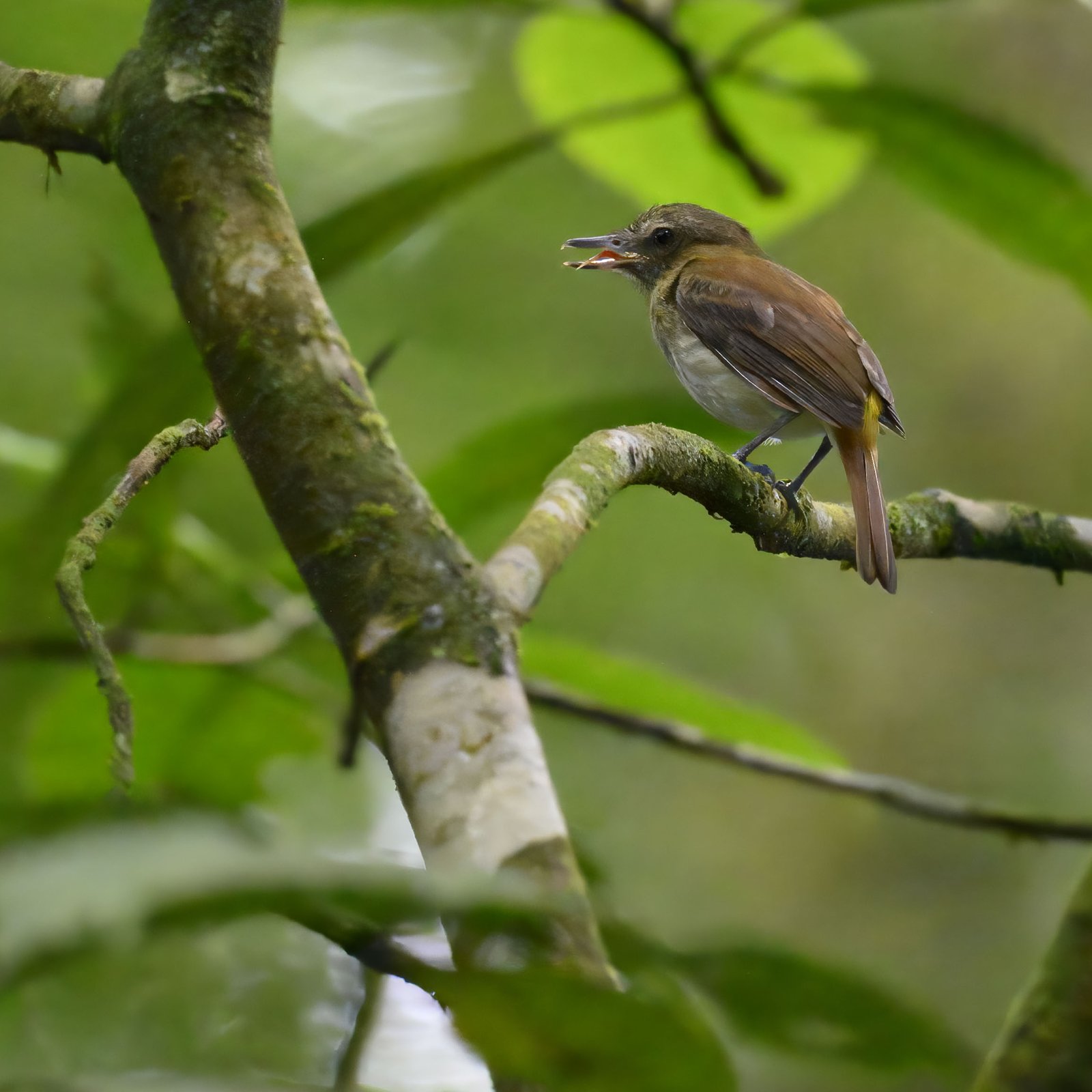
The Bright-rumped Attila is a robust, hook-billed tyrant flycatcher that is heard far more often than seen: its loud whistled series, building in strength, rings through almost every lowland forest. It sits still for long periods in the middle levels and is recognised by its yellow rump and streaked breast. In the guide area it lives from north-western Mexico to Panama.
Voice
A loud whistled series that builds in strength and ends with one or two falling notes, something like wee-ree, wee-ree, wee-ree, WEE-REE, wee-oo. Sings mainly at dusk and early in the morning, often for long periods. Also a sharp wheep and rapidly repeated calls.
Recording: JAYRSON ARAUJO DE OLIVEIRA — CC BY-NC-SA 4.0 · shortened to the first 60 s, mono · xeno-canto
Identification
18–20 cm, with a large head and a stout, slightly hooked bill with a paler base to the lower mandible. The plumage is very variable: the upperparts are olive, rufous or greyish, the head usually greyer and finely streaked. The rump is bright yellow to ochre-yellow and shows when the bird flies off. Two pale wing-bars. Throat and breast yellowish to greyish with dark streaks, belly whitish and undertail-coverts yellow. The eye is often reddish but can be brown. Male and female are alike.
Confusion species
Rufous Mourner Rhytipterna holerythra is uniformly rufous-brown, without a yellow rump or breast streaks, and has a straight bill. Flycatchers of the genus Myiarchus, such as Dusky-capped Flycatcher Myiarchus tuberculifer, have an unstreaked grey throat and breast, a straight bill and rufous edges to the wing and tail feathers, but no yellow rump.
Habitat
Humid evergreen forest, semi-deciduous and dry forest, forest edges, mature secondary forest and shade plantations, from sea level to about 2000 m. It usually perches in the middle and upper levels and waits on a branch for a long time before dropping onto prey. It eats large insects and other invertebrates as well as small lizards and frogs, and some fruit. The cup-shaped nest is built in a cavity or niche, for example among epiphytes or against a tree trunk.
Where the bird is most at home, classified by the vegetation units of Mexico and Central America.






Range and movements
On the Pacific slope from southern Sonora to Oaxaca, on the Atlantic slope from Veracruz through south-eastern Mexico and the Yucatán Peninsula, including Cozumel, and on through all of Central America to Panama. Outside the guide area over much of tropical South America, to Amazonia and south-eastern Brazil.
- Resident
- dark = core range, pale = thinly spread
How and when to look
Common in forest areas such as Tikal in Guatemala and along Pipeline Road (Camino del Oleoducto) in Panama. The song gives it away; with patience it can then be found on a branch in the middle level of the forest.
Conservation status
Not threatened. Widespread and common in most forest areas; also persists in secondary forest and shade plantations.
Scientific name
Attila spadiceus | (Gmelin, 1789)
Gmelin described the species in 1789 as [Muscicapa] spadicea; because it was later moved to another genus, the author and year stand in brackets. The genus Attila was introduced in 1831 by Lesson. Attila is named after Attila the Hun, who attacked Rome and Orléans in the 5th century, after the fierce, predatory nature of these birds. spadiceus is Latin for 'chestnut-brown, date-coloured', after the rufous tones in the plumage. The specimen the first description was based on came from Cayenne, French Guiana.