All species › Grebes › Grebes › Pied-billed Grebe
Position in the tree Birds Aves › Birds with a flexible palate Neognathae › All other modern birds Neoaves › Flamingos and grebes Mirandornithes
Pied-billed Grebe | Podilymbus podiceps
Dikbekfuut | Zampullín picogrueso
The Pied-billed Grebe is a stocky brown grebe with a short, thick bill that carries a black band in breeding plumage. It breeds throughout the guide area, from Baja California to Panama; in the northern winter birds from North America join them. Until the late 1980s Lake Atitlán in Guatemala held the Atitlan Grebe Podilymbus gigas, a larger, almost flightless relative that is now extinct.
Voice
A loud, hollow series that starts with rapid kuk-kuk-kuk notes and turns into a slower, falling cow-cow-cow-cowp; mainly in the breeding season, also from dense vegetation. Wintering birds are usually silent.
Recording: Stanislas Wroza — CC BY-NC-SA 4.0 · converted to mono · xeno-canto
Identification
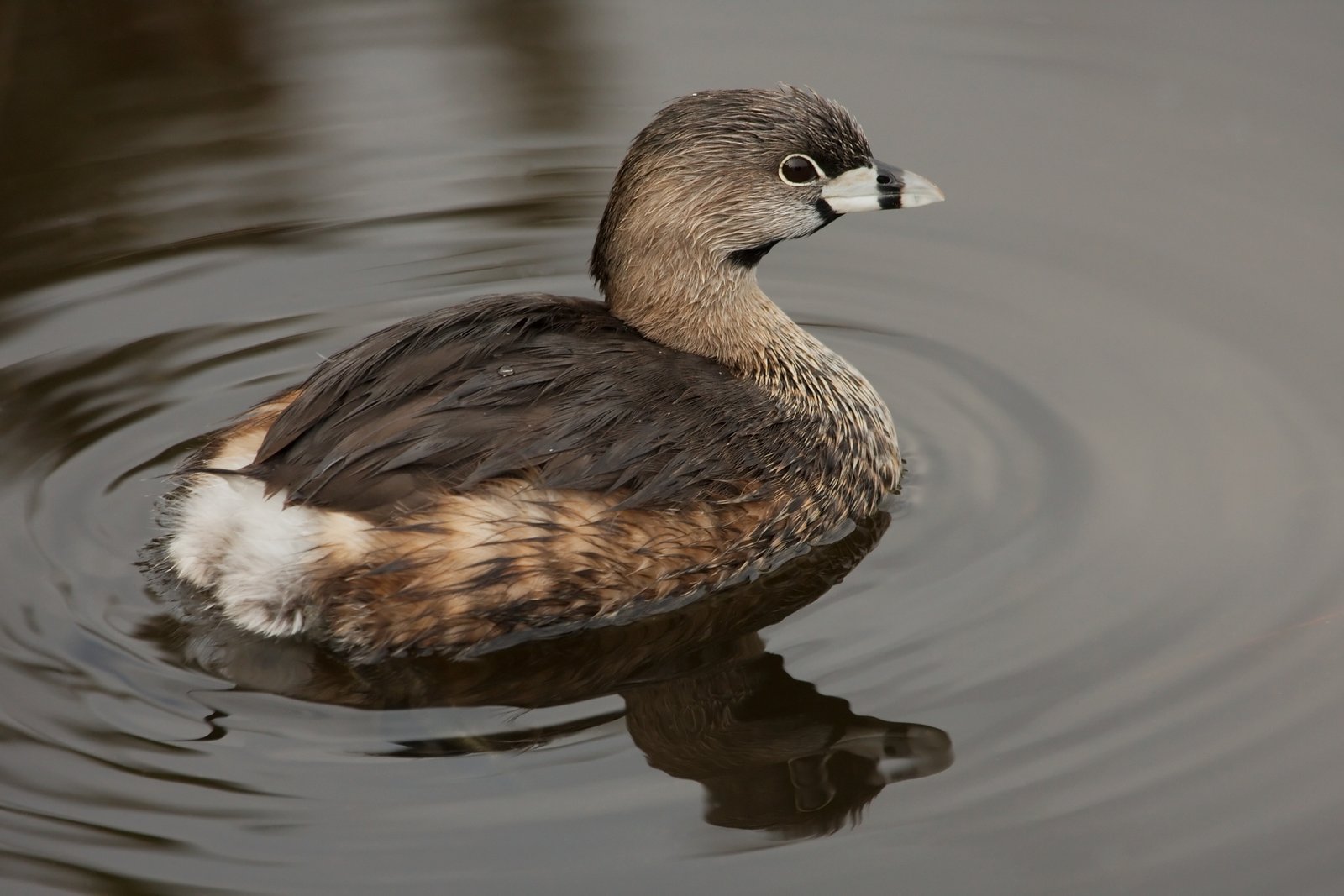
30–38 cm, stocky, with a large head, short neck and fluffy white rear end. The plumage is plain grey-brown, with darker crown and back. The bill is short, deep and chicken-like: in breeding plumage pale greyish-white with a broad black band, with a black throat and a white ring round the dark eye. Outside the breeding season the band is absent, the bill yellowish horn and the throat paler. Juveniles have brown and white stripes on head and neck. When alarmed it often sinks slowly until only the head shows above the water.
Confusion species
Least Grebe Tachybaptus dominicus is smaller and darker, with a thin, pointed bill and a yellow eye. Eared Grebe Podiceps nigricollis and Horned Grebe Podiceps auritus have a thin bill, a red eye and, in winter plumage, more black-and-white contrast on head and neck. Females and young of Masked Duck Nomonyx dominicus and Ruddy Duck Oxyura jamaicensis also sit low in the water and dive, but have a broad duck's bill, a stiff tail and stripes or a pale cheek on the head.
Habitat
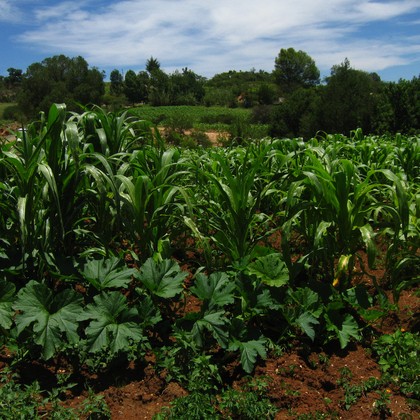
Freshwater lakes and ponds, cattail marshes and other fringing vegetation, reservoirs, rice fields and fish ponds, from sea level to the lakes of the plateau; outside the breeding season also brackish lagoons and larger open waters. It eats fish, crustaceans, aquatic insects and other invertebrates, caught by diving. The nest is a floating platform of plant material among the fringing vegetation.
Where the bird is most at home, classified by the vegetation units of Mexico and Central America.



Range and movements
Resident over almost all of Mexico, from Baja California and Sonora to Chiapas and the Yucatán Peninsula, and further in Guatemala, Belize, Honduras, El Salvador, Nicaragua, Costa Rica and Panama; more local in Central America than in Mexico. In the northern winter birds from North America join them, mainly in northern and eastern Mexico, from Sonora and Coahuila to Tamaulipas and Quintana Roo. Outside the guide area from Canada through the United States and the Caribbean to southern South America.
- Resident
- Summer visitor (c. Apr–Sep)
- Winter visitor (c. Oct–Mar)
- Passage (Mar–Apr, Oct–Nov)
- dark = core range, pale = thinly spread
How and when to look
On almost every freshwater lake and larger pond with fringing vegetation, most numerous from October to April, when the winter visitors are present. In Costa Rica regular at Palo Verde, in Guatemala still on Lake Atitlán. The breeding plumage with the black bill band is mainly seen in spring and summer.
Conservation status
Not threatened; widespread over almost the whole of the Americas. Breeding sites are lost locally through the draining and pollution of wetlands; reservoirs and fish ponds, on the other hand, provide new habitat.
Scientific name
Podilymbus podiceps | (Linnaeus, 1758)
Linnaeus described the species in 1758 as Colymbus Podiceps; because it was later moved to another genus, the author and year stand in brackets. The genus Podilymbus was introduced in 1831 by Lesson. Podilymbus is a contraction of Latin podicipes 'feet at the buttocks', the stem of Podiceps, and Ancient Greek kolumbos 'diver', familiar from the old genus name Colymbus. podiceps is the older genus name Podiceps, Latin podex, podicis 'vent' and pes 'foot', kept on here as the specific epithet. The specimen the first description was based on came from South Carolina.