All species › Cuckoos › Cuckoos › Pheasant Cuckoo
Position in the tree Birds Aves › Birds with a flexible palate Neognathae › All other modern birds Neoaves › Doves, turacos and allies Columbaves › Bustards, turacos and cuckoos Otidimorphae
Pheasant Cuckoo | Dromococcyx phasianellus
Fazantkoekoek | Cuclillo faisán
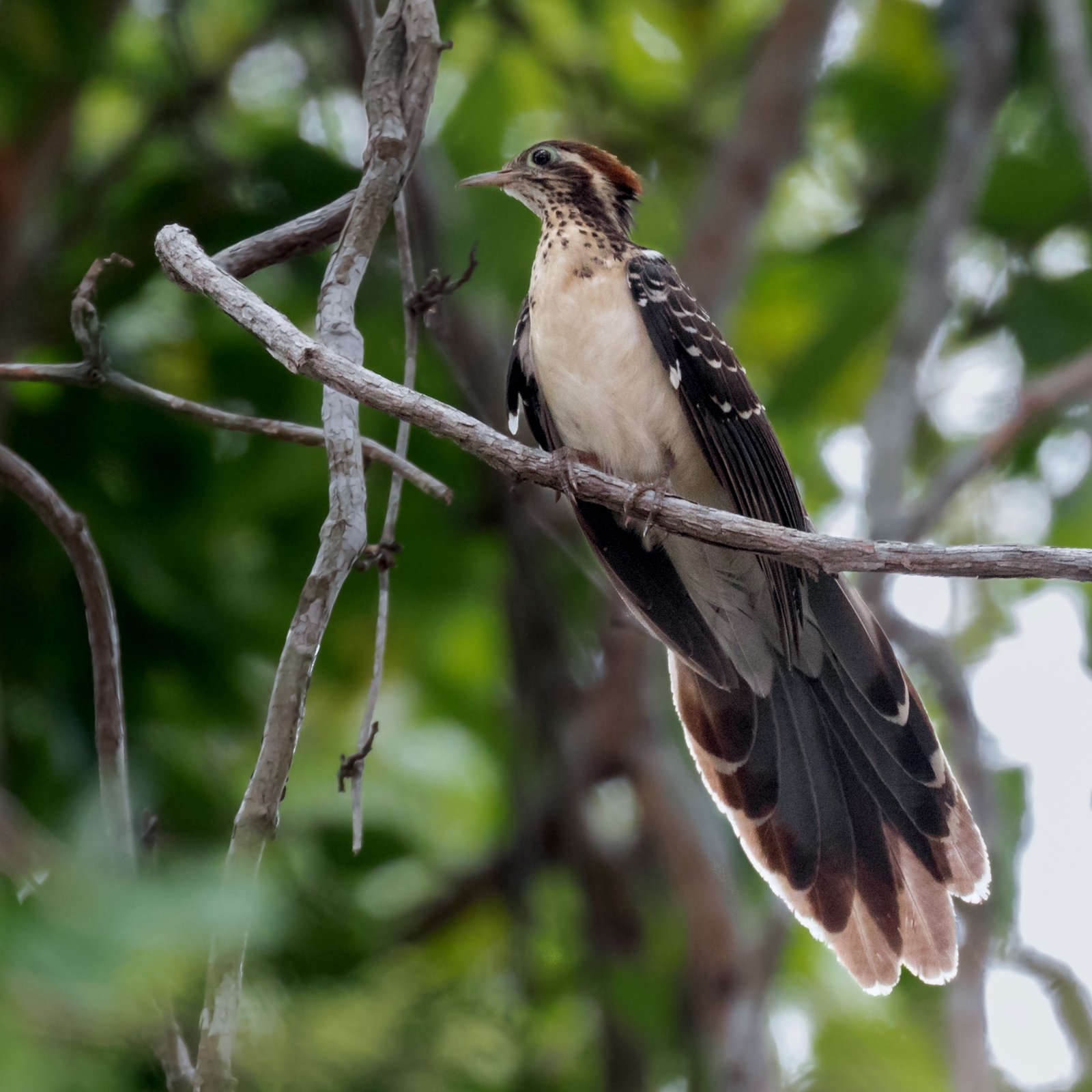
The Pheasant Cuckoo is a shy, ground-dwelling cuckoo of the forest floor, with a small head, a thin neck and a strikingly long, broad tail, which gives it its name. It occurs patchily from southern Mexico to Panama, but is scarce everywhere and is mostly found by its call. Like Striped Cuckoo it is a brood parasite.
Voice
The song consists of two clear whistled notes followed by a quavering trill, poo-pee-prrrr, or of three whistles without a trill; often repeated for hours from a hidden perch, especially at dusk and at night, in the breeding season. A calling bird is ventriloquial and can seldom be pinpointed.
Recording: Juan Freile — CC BY-NC-SA 4.0 · shortened to the first 60 s, mono · xeno-canto
Identification
35–38 cm, more than half of it tail. The upperparts are dark brown with pale ochre feather edges, so the back and wings look scaly. The crown has a short rufous crest; a pale ochre stripe runs behind the eye. The throat and breast are ochre with black spots and streaks, the belly white. The tail is long, broad and graduated, dark with white tips; the uppertail coverts are greatly elongated, reaching far over the tail, and have pale tips. The bill is short and dark. The sexes are alike; young birds are plainer dark brown with fewer markings on the breast.
Confusion species
Striped Cuckoo Tapera naevia is smaller and paler, with streaked upperparts, an unmarked breast and a narrower tail, and lives in open country. Common Squirrel Cuckoo Piaya cayana is plain chestnut with a grey belly and a yellow bill. Rufous-vented Ground Cuckoo Neomorphus geoffroyi is much larger, with a dark crest, a scaly breast band and a rufous belly.
Habitat
The interior and edges of dry and humid lowland and foothill forest, also dense secondary forest and bamboo and vine tangles; from sea level to about 1500 m. It walks over the forest floor and through low undergrowth, taking large insects, also lizards and nestling birds. The female lays her eggs in the nests of small passerines, as far as known mainly tyrant flycatchers; the chick is raised by the host.
Where the bird is most at home, classified by the vegetation units of Mexico and Central America.





Range and movements
Patchy and scarce from southern Mexico, in Oaxaca, Veracruz, Tabasco, Chiapas and the Yucatán Peninsula, through Belize, Guatemala, Honduras and Nicaragua to Costa Rica and Panama; in Costa Rica mainly on the Pacific side in the north-west. Outside the guide area in South America to Bolivia, Paraguay and north-eastern Argentina.
- Resident
- dark = core range, pale = thinly spread
How and when to look
At dusk and early in the night during the rainy season the call is best heard in suitable forest. A calling bird often sits a few metres up on a branch, swinging its long tail from side to side; if approached carefully it sometimes stays put for a long time.
Conservation status
Least Concern. The species has a large range but is scarce everywhere and sensitive to the clearance of lowland forest. In the guide area it is known mainly from large forest tracts such as those of the Yucatán Peninsula and northern Guatemala.
Scientific name
Dromococcyx phasianellus | (Spix, 1824)
Spix described the species in 1824 as Macropus phasianellus; because it was later moved to another genus, the author and year stand in brackets. The genus Dromococcyx was introduced in 1832 by Wied-Neuwied. Dromococcyx is Greek, from dromos 'runner' and kokkux 'cuckoo': 'running cuckoo'. phasianellus is New Latin for 'little pheasant', after the long, pheasant-like tail. The specimen the first description was based on came from Tonantins, Amazonas, Brazil.