All species › Cuckoos › Cuckoos › Lesser Ground Cuckoo
Position in the tree Birds Aves › Birds with a flexible palate Neognathae › All other modern birds Neoaves › Doves, turacos and allies Columbaves › Bustards, turacos and cuckoos Otidimorphae
Lesser Ground Cuckoo | Morococcyx erythropygus
Lijsterkoekoek | Cuclillo terrestre
The Lesser Ground Cuckoo is a small, terrestrial cuckoo of dry forest and thorn scrub along the Pacific side of the guide area, from Sinaloa to north-western Costa Rica. It walks hidden through the leaf litter and is mostly noticed by its rolling song. Unlike Pheasant and Striped Cuckoos it builds its own nest.
Voice
The song is a series of ten or more loud, rolling trills, usually introduced by two or three clear, rising whistles. Also a clear whistle and a rough, growling call. It sings mainly at the start of the rainy season, often from the ground or a low branch.
Recording: Manuel Grosselet — CC BY-NC-SA 4.0 · converted to mono · xeno-canto
Identification
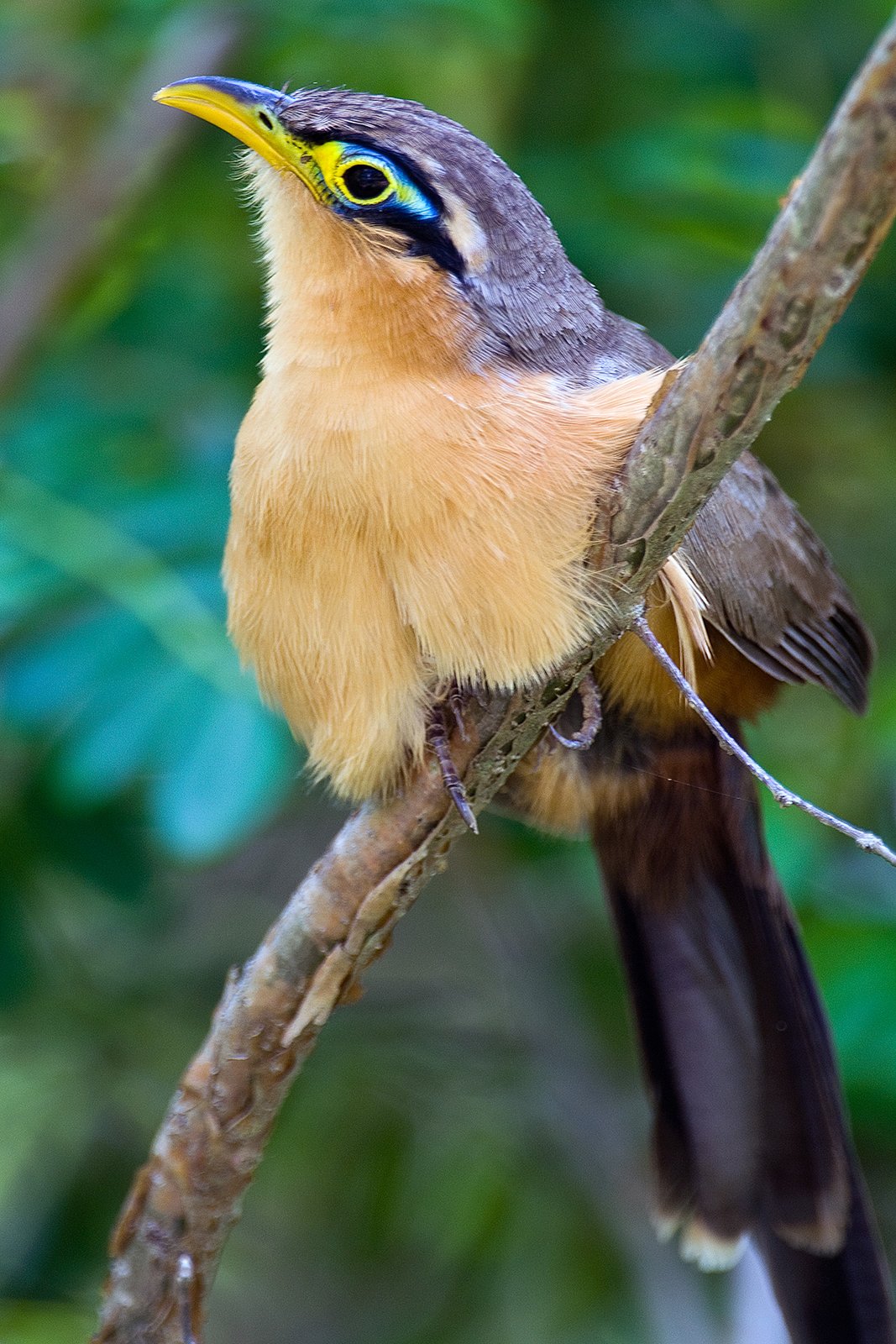
25–28 cm, with a fairly long, graduated tail and long legs. The upperparts are olive-brown to grey-brown, the tail olive-brown with pale tips and dark bands on the underside. The underparts are uniform cinnamon to ochre from chin to undertail. The head has a distinctive pattern: a yellow eye-ring with a patch of bare blue skin behind it, outlined by thin black lines, and a white stripe above the eye. The bill is slightly decurved, with a dark upper mandible and an orange lower mandible. The female is slightly paler; young birds are duller and lack the pale tail tips. Birds of western Mexico (M. e. mexicanus) are larger, greyer and paler below.
Confusion species
There is no species in the guide area with which it is likely to be confused. Striped Cuckoo Tapera naevia has streaked upperparts, a crest and pale, unmarked underparts. Lesser Roadrunner Geococcyx velox is much larger, streaked and crested, with a very long tail.
Habitat
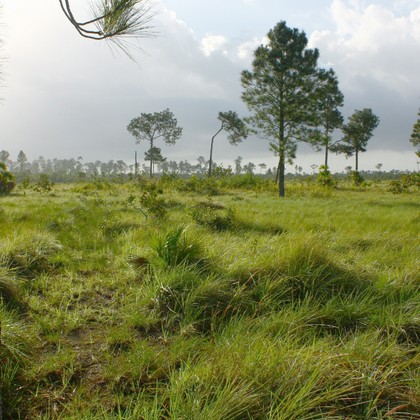
Semi-arid to arid country: the interior and edges of tropical dry forest, thorn scrub, brushland, young secondary forest and savanna with bushes; in south-western Mexico almost exclusively in thorn forest. Mainly in the lowlands and foothills. It walks over the ground and takes insects, picked from the ground or with a short leap from low vegetation. The nest is a shallow cup of twigs or leaves on or just above the ground; the clutch is two eggs, incubated by both parents.
Where the bird is most at home, classified by the vegetation units of Mexico and Central America.




Range and movements
Along the Pacific side of Mexico from Sinaloa through Nayarit, Jalisco, Colima, Michoacán, Guerrero and Oaxaca to Chiapas, also in dry interior valleys, and further in Guatemala, El Salvador, Honduras and Nicaragua to Guanacaste in north-western Costa Rica. The species does not occur outside the guide area.
- Resident
- dark = core range, pale = thinly spread
How and when to look
In the dry season it is rarely detected; with the first rains it starts singing and can then be traced mainly in dry forest and thorn scrub along the Pacific coast. A bird walking away over the ground shows the uniform cinnamon underparts and the blue-and-yellow pattern around the eye.
Conservation status
Least Concern. The species is a resident that is fairly common in suitable dry forest and scrub; the loss of dry forest on the Pacific side affects it locally.
Scientific name
Morococcyx erythropygus | (Lesson, 1842)
Lesson described the species in 1842 as Coccyzus erythropyga; because it was later moved to another genus, the author and year stand in brackets. The genus Morococcyx was introduced in 1862 by Sclater. Morococcyx is Greek, from mōros 'foolish, sluggish' and kokkux 'cuckoo'. erythropygus is Greek, from eruthros 'red' and -pugos '-rumped', after the rufous rump. The specimen the first description was based on came from San Carlos, Central America (not specified further).