All species › Passerines › New World warblers › Palm Warbler
Position in the tree Birds Aves › Birds with a flexible palate Neognathae › All other modern birds Neoaves › Landbirds Telluraves › Falcons, parrots and passerines Australaves › Falcons and passerines Eufalconimorphae › Parrots and passerines Psittacopasserae
Palm Warbler | Setophaga palmarum
Palmzanger | Chipe playero
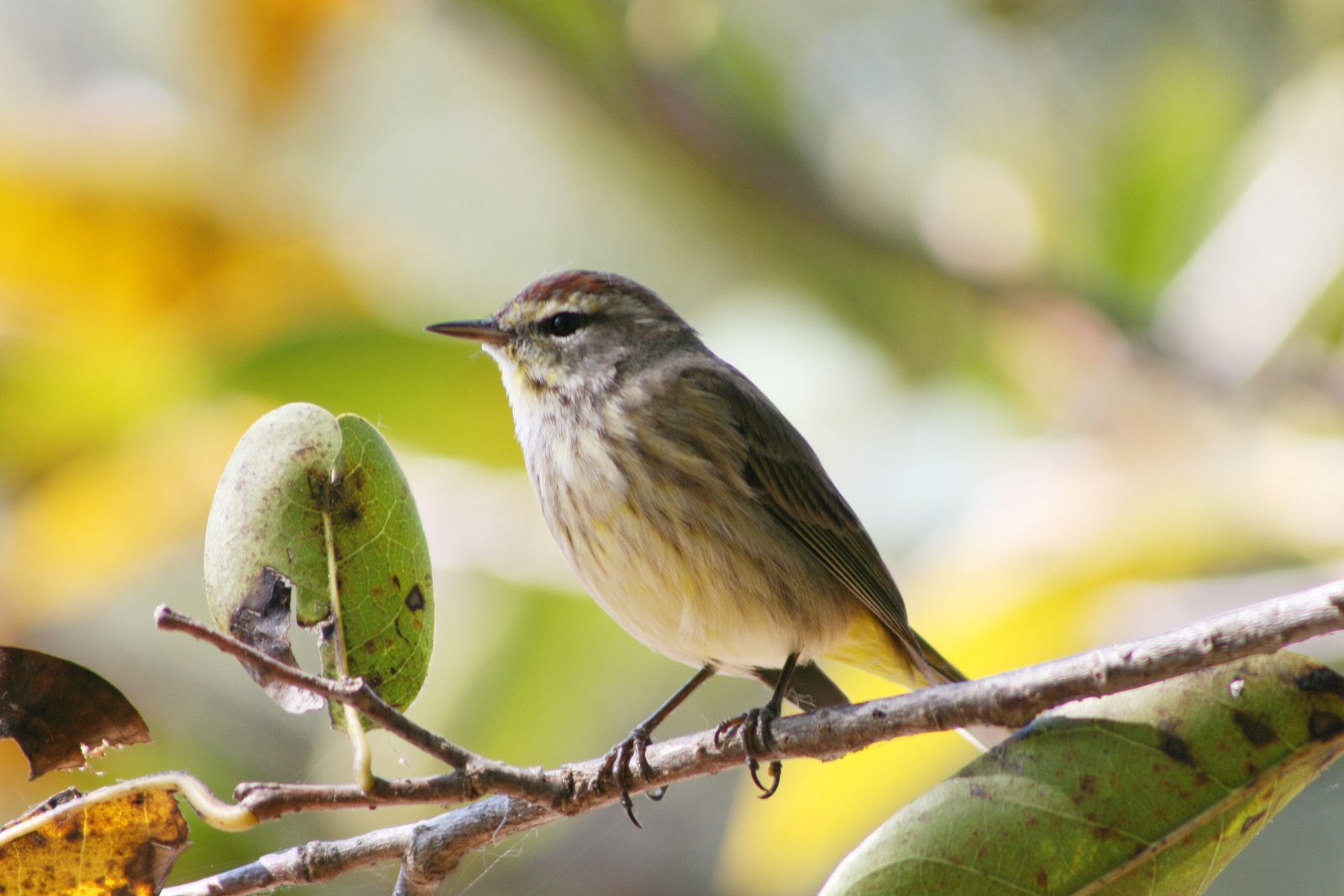
The Palm Warbler is a brownish warbler that feeds much on the ground and constantly bobs its tail up and down. It breeds in bogs and open coniferous forest in Canada. In the guide area it is a winter visitor, mainly along the coast and in open country on the Yucatán Peninsula and the Caribbean coast.
Voice
The song is a weak, rapid trill on one pitch, roughly sisisisisisi. The call is a sharp, somewhat metallic tchik or chip, often heard while feeding; the flight call is a high see.
Recording: Stanislas Wroza — CC BY-NC-SA 4.0 · shortened to the first 60 s, mono · xeno-canto
Identification
12–14 cm. In every plumage bright yellow undertail coverts, an olive-yellow rump, a pale supercilium, a dark eye-stripe and the constant tail-bobbing. In winter plumage, as usually seen in the guide area: grey-brown upperparts, dull white to pale yellow underparts with faint grey-brown streaks on the breast and a brownish crown. In spring the bird acquires a rufous crown. The eastern form S. p. hypochrysea is entirely yellow below even in winter; the western form S. p. palmarum, the more numerous in the guide area, has only yellow undertail coverts and sometimes a yellowish throat.
Confusion species
Cape May Warbler Setophaga tigrina has a yellowish-green rump, white undertail coverts and does not bob its tail. Prairie Warbler Setophaga discolor also bobs its tail, but is entirely yellow below, with black flank streaks and a dark cheek stripe. Pipits (Anthus) are larger, have a longer tail with white outer edges and no yellow.
Habitat
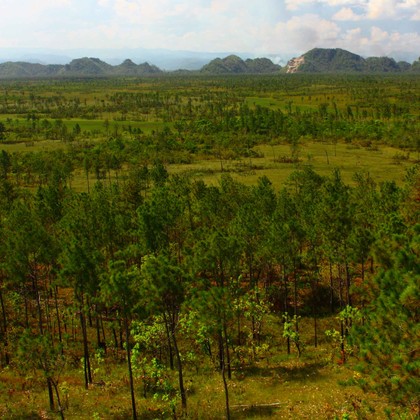
In winter open terrain with scattered shrubs and trees: coastal vegetation, mangrove edges, pastures, field margins, lawns, gardens and villages, also pine savanna; almost only in the lowlands. It searches the ground and low shrubs for insects and seeds, often in small groups.
Where the bird is most at home, classified by the vegetation units of Mexico and Central America.





Range and movements
Breeds in Canada and the north-eastern United States. Winters in the south-eastern United States, the West Indies and northern Central America. In the guide area fairly common on the Yucatán Peninsula and along the coast of Belize and the Bay Islands of Honduras, scarcer along the Gulf coast of Mexico and the Caribbean coast of Honduras and Nicaragua; rare further south and on the Pacific slope.
- Winter visitor (c. Oct–Mar)
- dark = core range, pale = thinly spread
How and when to look
On lawns, along coastal paths and in villages on the Yucatán Peninsula, a warbler walking on the ground and bobbing its tail incessantly is first of all a Palm Warbler.
Conservation status
Not threatened (LC). Common and widespread; the population appears stable.
Scientific name
Setophaga palmarum | (Gmelin, 1789)
Gmelin described the species in 1789 as Motacilla palmarum; because it was later moved to another genus, the author and year stand in brackets. The genus Setophaga was introduced in 1827 by Swainson. Setophaga is Greek, from sēs, sētos 'moth' and -phagos '-eating': 'moth-eater'. palmarum is Latin for 'of the palms', after the palm trees in which the species was observed on Hispaniola. The specimen the first description was based on came from Hispaniola.