All species › Passerines › New World warblers › Cape May Warbler
Position in the tree Birds Aves › Birds with a flexible palate Neognathae › All other modern birds Neoaves › Landbirds Telluraves › Falcons, parrots and passerines Australaves › Falcons and passerines Eufalconimorphae › Parrots and passerines Psittacopasserae
Cape May Warbler | Setophaga tigrina
Tijgerzanger | Chipe atigrado
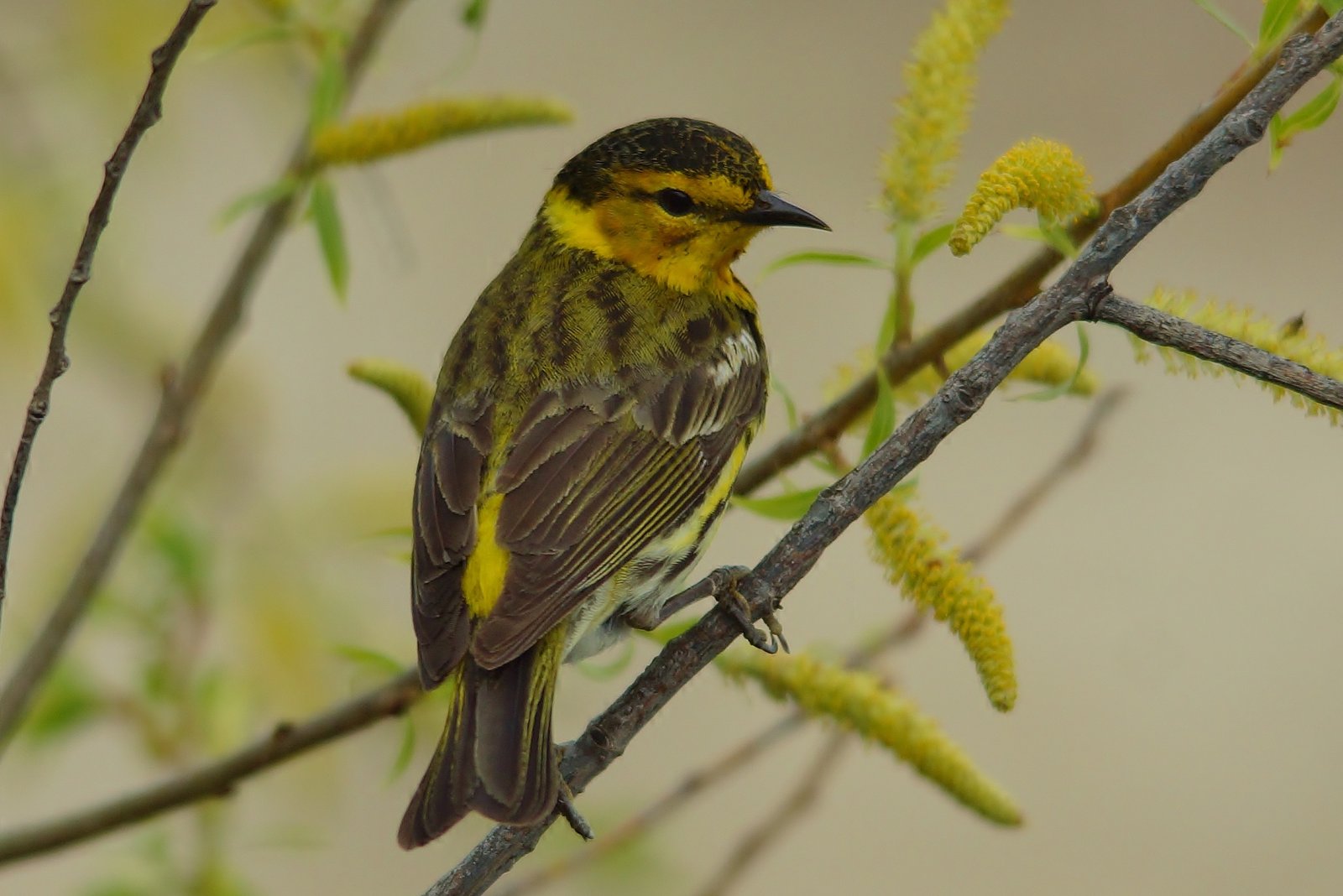
The Cape May Warbler is a small, streaked warbler with a yellowish-green rump and a thin, slightly decurved bill. It breeds in the coniferous forest of Canada and winters mainly in the West Indies. In the guide area it is a scarce winter visitor, mainly on the Yucatán Peninsula and the islands off the Caribbean coast.
Voice
The song is a series of four to eight very high, thin, even notes, roughly see see see see; rarely heard in the guide area. The call is a high, thin tseet, the flight call a fine, buzzy tsee.
Recording: Stanislas Wroza — CC BY-NC-SA 4.0 · converted to mono · xeno-canto
Identification
12–14 cm. Thin, pointed, slightly decurved bill and a short tail. The breeding male has a chestnut cheek, yellow neck sides, a large white wing patch and yellow underparts with dense black streaks. In winter plumage, as usually seen in the guide area: greyish-green upperparts, a yellowish-green rump, a faint yellow patch on the neck side, a narrow white wing bar and dull white to pale yellow underparts with fine dark streaks across breast and flanks. Young females are very drab, with hardly any yellow.
Confusion species
Yellow-rumped Warbler Setophaga coronata has a bright yellow rump, yellow patches on the flanks and a thicker bill. Palm Warbler Setophaga palmarum has yellow undertail coverts, a pale supercilium and wags its tail constantly. Magnolia Warbler Setophaga magnolia has a yellow rump and a white band across the middle of the tail. Blackburnian Warbler Setophaga fusca in winter plumage has pale stripes on the back and a yellow-orange throat.
Habitat
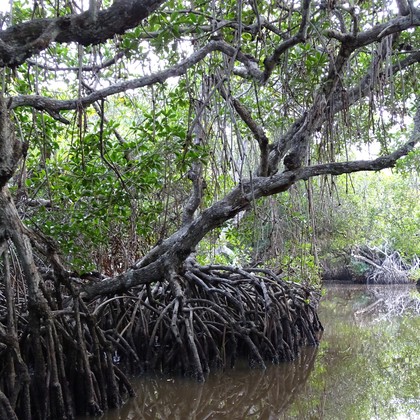
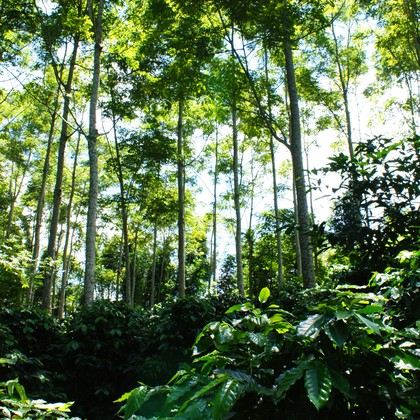
In winter gardens, parks, forest edges, dry seasonal forest, coastal vegetation and mangroves, often at flowering trees; mostly below 500 m. It searches the canopy for insects and also takes nectar and juice from ripe fruit, piercing flowers and fruit with its bill.
Where the bird is most at home, classified by the vegetation units of Mexico and Central America.



Range and movements
Breeds in the boreal coniferous forest of Canada and the northern United States. Winters mainly in the West Indies. In the guide area scarce on the Yucatán Peninsula, mainly in Quintana Roo and on Cozumel, and on the islands off the coast of Belize and Honduras; rare elsewhere in Central America and in eastern Mexico.
- Resident
- Summer visitor (c. Apr–Sep)
- Winter visitor (c. Oct–Mar)
- Passage (Mar–Apr, Oct–Nov)
- dark = core range, pale = thinly spread
How and when to look
Flowering trees in gardens and villages on the Yucatán Peninsula and the islands off the Caribbean coast are the place to find this species in winter; look there for a streaked warbler feeding on nectar.
Conservation status
Not threatened (LC). The population is large but fluctuates strongly with outbreaks of spruce budworm in the breeding range.
Scientific name
Setophaga tigrina | (Gmelin, 1789)
Gmelin described the species in 1789 as Motacilla tigrina; because it was later moved to another genus, the author and year stand in brackets. The genus Setophaga was introduced in 1827 by Swainson. Setophaga is Greek, from sēs, sētos 'moth' and -phagos '-eating': 'moth-eater'. tigrina is Latin for 'tiger-striped', after the black streaks on the yellow breast. The specimen the first description was based on came from Canada (not specified further).