All species › Loons › Loons › Pacific Loon
Position in the tree Birds Aves › Birds with a flexible palate Neognathae › All other modern birds Neoaves › Birds of the elements Elementaves › Tropicbirds and waterbirds Phaethoquornithes › Core waterbirds Aequornithes
Pacific Loon | Gavia pacifica
Pacifische parelduiker | Colimbo del Pacífico
The Pacific Loon is the most numerous loon in the guide area. It breeds on tundra lakes in Alaska, Canada and eastern Siberia and winters in large numbers at sea along the west coast of North America. In the guide area it is a regular winter visitor off Baja California and in the Gulf of California, sometimes in groups of hundreds of birds.
Voice
Almost silent in winter. On the breeding grounds a plaintive, rising wail, a rasping, crow-like croak and a rhythmic, cackling kow-a-kow.
Recording: Logan McLeod — CC BY-NC-SA 4.0 · shortened to the first 60 s, mono · xeno-canto
Identification
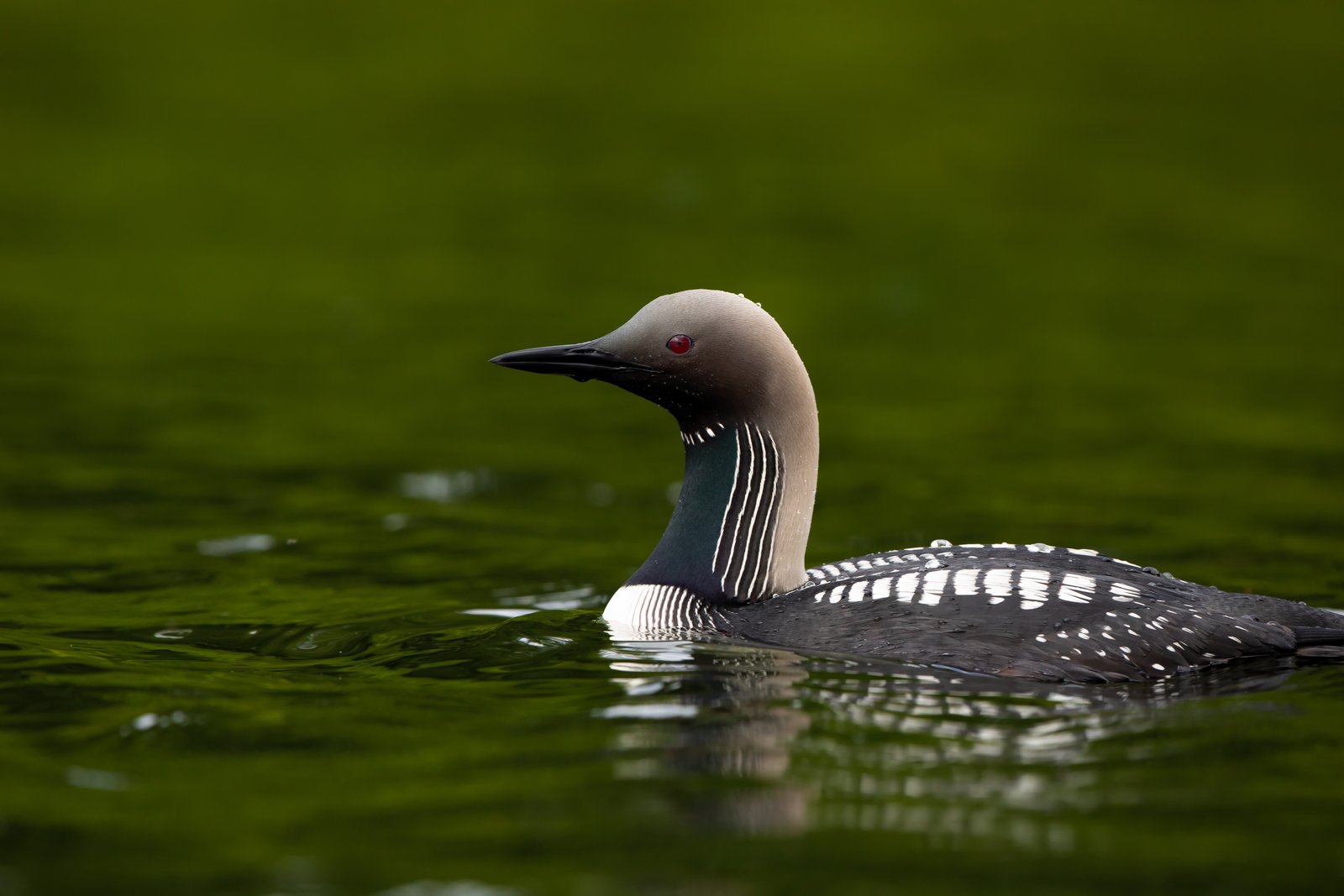
58–74 cm. A medium-sized loon with a rounded, smooth head, a rather thin, straight bill held horizontally and a clearly demarcated neck. In winter plumage the crown, hindneck and upperside are dark grey-brown, the hindneck slightly paler than the back; the border with the white throat and foreneck is sharp and straight, and the eye sits in the dark. A thin, dark chinstrap is often visible, and there is no white patch on the flank. In breeding plumage the head is silvery grey, the throat purple- to green-glossed black, the side of the neck striped white and the back black with white spots in blocks. Juveniles have a scaly back.
Confusion species
The Common Loon Gavia immer is larger, with an angular head, a heavy bill, white around the eye and a white notch in the side of the neck. The Red-throated Loon Gavia stellata is slimmer, with a thin, upward-held bill, more white on the face and a spotted back. The Arctic Loon Gavia arctica, a winter visitor elsewhere in the Pacific and at most a vagrant in the guide area, is larger and shows a white patch on the rear flank above the waterline.
Habitat
Coastal waters, bays and the continental shelf, often further offshore than the other loons; also in straits and off headlands where strong currents concentrate food. Dives for schools of small fish. Migrates in long lines low over the water along the coast.
Where the bird is most at home, classified by the vegetation units of Mexico and Central America.

Range and movements
Along the whole Pacific coast of Baja California and Baja California Sur and in the Gulf of California, along Baja California and Sonora; further south to Sinaloa rare. A single bird inland in northern Mexico. Outside the guide area it breeds on the tundra of Alaska, northern Canada and eastern Siberia, and winters along the coasts of the northern Pacific, from Alaska to California and from Kamchatka to Japan.
- Winter visitor (c. Oct–Mar)
- dark = core range, pale = thinly spread
How and when to look
From headlands and points along the coast of Baja California, lines of migrating birds can be seen in winter and during spring migration in March and April. At sea the smooth, rounded head, the horizontally held bill and the sharp, straight border on the neck help.
Conservation status
Least Concern. The global population is large. Bycatch in gillnets and oil pollution in the wintering areas are the main threats. In the guide area a regular winter visitor.
Scientific name
Gavia pacifica | (Lawrence, 1858)
Lawrence described the species in 1858 as Colymbus pacificus; because it was later moved to another genus, the author and year stand in brackets. The genus Gavia was introduced in 1788 by Forster. Gavia is the Latin word for an unidentified seabird. pacifica refers to the Pacific Ocean, where the species winters; the Latin word itself means 'peaceful'. The specimen the first description was based on came from San Diego, California.