All species › Falcons › Falcons and caracaras › Orange-breasted Falcon
Position in the tree Birds Aves › Birds with a flexible palate Neognathae › All other modern birds Neoaves › Landbirds Telluraves › Falcons, parrots and passerines Australaves › Falcons and passerines Eufalconimorphae
Orange-breasted Falcon | Falco deiroleucus
Bonte slechtvalk | Halcón pecho rufo
The Orange-breasted Falcon is a powerful, dark falcon of tropical forest with cliffs or tall emergent trees. It hunts from a high perch for birds such as pigeons, parrots and swallows, which it strikes in fast stoops or chases in the air. In the guide area it is a rare resident with an estimated few dozen pairs, mainly in Belize, Guatemala and Panama.
Voice
A shrill, rapid kek-kek-kek or kee-kee-kee around the nest; also wailing calls during feeding.
Recording: Dante Buzzetti — CC BY-NC-SA 4.0 · converted to mono · xeno-canto
Identification
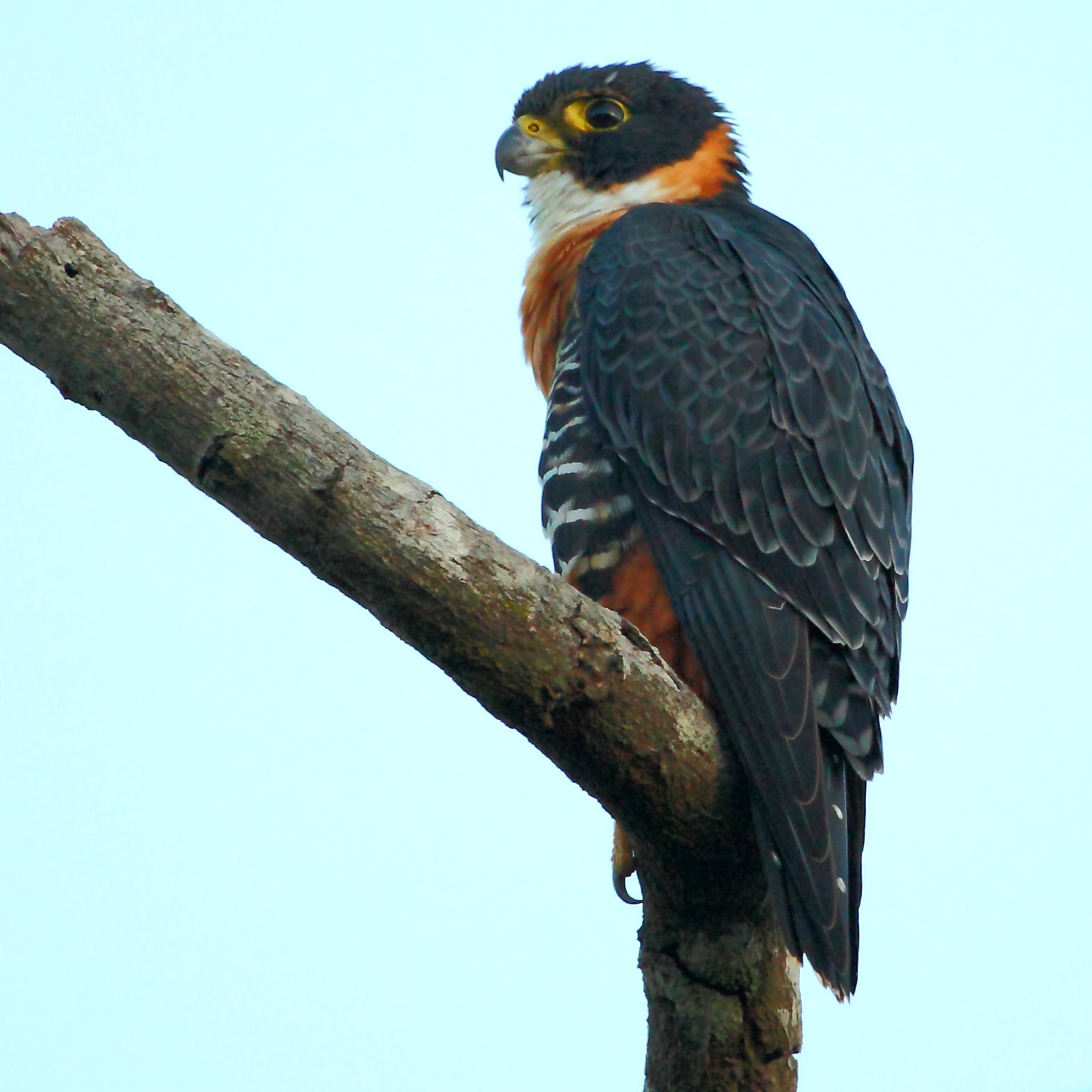
33–40 cm, stocky, with a large head, broad-based wings, a fairly short tail and large yellow feet. Hood, cheeks and upperparts are blue-black. Throat and upper breast are white to buff and bordered by a broad orange-rufous band; below lies a black vest with coarse buff or white bars. Belly, thighs and undertail coverts are deep rufous. Young birds are brownish black above, with a buff breast streaked dark. The female is clearly larger than the male.
Confusion species
The Bat Falcon Falco rufigularis is very similar but much smaller, with small feet, a more finely barred vest and a narrower or absent orange band below the white throat. Size is only reliable when both can be seen together; note the proportions of head, feet and bill. The Peregrine Falcon Falco peregrinus is grey above, with a white cheek behind the black moustache and pale underparts.
Habitat
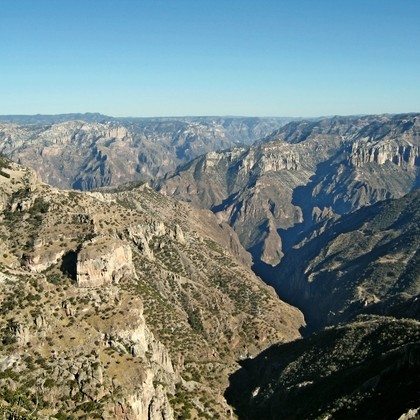
Humid lowland and foothill forest and seasonal forest with cliffs, rock faces, ravines or tall emergent trees, often near rivers; in Guatemala also on the temples of Maya ruins in the forest. It nests in a cavity or on a ledge in a rock face. It hunts above the canopy and over forest clearings.
Where the bird is most at home, classified by the vegetation units of Mexico and Central America.




Range and movements
Very local. Most pairs breed in the Maya Mountains and adjacent hills of Belize and in northern Guatemala (Petén, including Tikal). A small number of pairs lives in eastern Panama (Darién). From southern Mexico, Honduras, Nicaragua and Costa Rica only a few, often old records are known; the species has disappeared from most of its former range in Central America. Outside the guide area very scattered in tropical South America to northern Argentina.
- Resident
- dark = core range, pale = thinly spread
How and when to look
Tikal in Guatemala is a well-known site: pairs sometimes sit high on the temples or on dead treetops above them, especially early in the morning and late in the afternoon. A hunting bird stoops from a great height on birds above the canopy.
Conservation status
Near Threatened. Threatened by forest clearance and disturbance of nest sites; the Central American population is small and has been studied and protected for decades.
Scientific name
Falco deiroleucus | Temminck, 1825
Temminck described the species in 1825 and placed it straight away in the genus where it still stands. The genus Falco was introduced in 1758 by Linnaeus. Falco is Late Latin for 'falcon', from falx, falcis 'sickle', after the sickle-shaped claws of the bird. deiroleucus is Greek, from deirē 'neck, throat' and leukos 'white', after the white throat. The specimen the first description was based on came from São Francisco Island, Santa Catarina, Brazil.