All species › Falcons › Falcons and caracaras › Merlin
Position in the tree Birds Aves › Birds with a flexible palate Neognathae › All other modern birds Neoaves › Landbirds Telluraves › Falcons, parrots and passerines Australaves › Falcons and passerines Eufalconimorphae
Merlin | Falco columbarius
Smelleken | Esmerejón
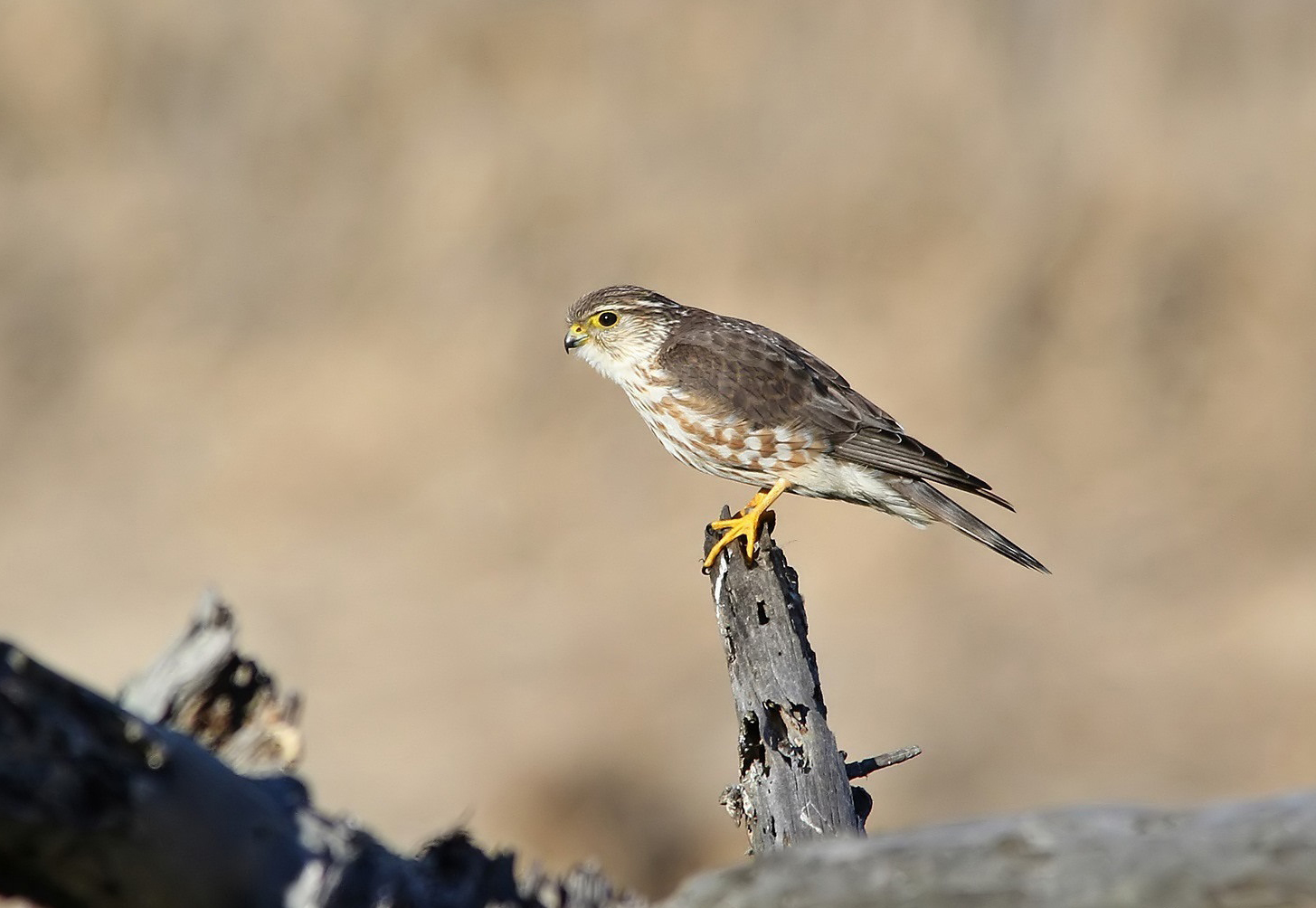
The Merlin is a small, compact falcon that hunts small birds in fast, low flight: sandpipers, swallows, pipits and sparrows. It does not breed in the guide area but winters there and passes through, from September–October to April. In winter birds of all three North American forms occur: the pale prairie form, the widespread taiga form and, scarce in the northwest, the very dark coastal form.
Voice
Usually silent in the guide area; sometimes a rapid, shrill kee-kee-kee-kee.
Recording: Don Profota — CC BY-NC-SA 4.0 · converted to mono · xeno-canto
Identification
24–33 cm, compact, with fairly short, pointed wings and a medium-length tail. The male is blue-grey above, the female and young are brown. Both have a weak moustache, a pale eyebrow and pale to ochre underparts densely streaked brown; the tail has broad dark and narrow pale bands. Prairie birds are much paler, coastal birds almost blackish brown with hardly any pale markings. The female is clearly larger than the male.
Confusion species
The American Kestrel Falco sparverius is slimmer, rufous on the back and tail and has two black cheek marks; it often hovers. The Peregrine Falcon Falco peregrinus is much larger, with a broad black moustache. The Bat Falcon Falco rufigularis has a black breast and rufous belly and thighs. The Sharp-shinned Hawk Accipiter striatus has rounded wings and flies with alternating flaps and glides.
Habitat
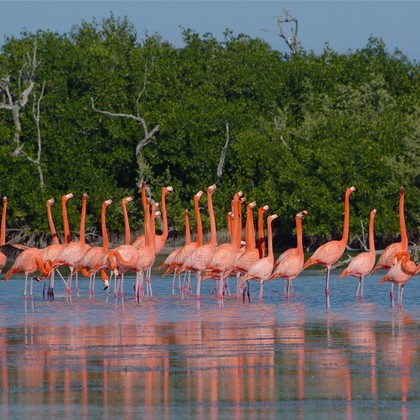
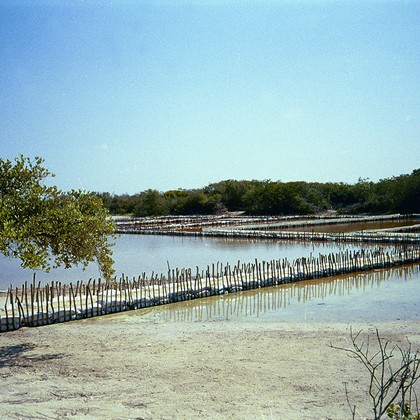
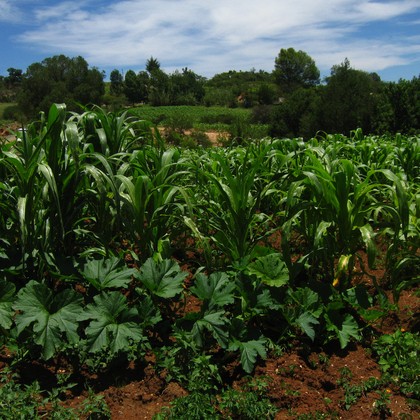
Open country with good prey: coasts, tidal flats, lagoons and salt pans with shorebirds, marshes, savanna, fields and pasture, and also villages and towns, where it hunts sparrows and doves. It perches on a post, a dead branch or a building and sets off in a fast, low chase.
Where the bird is most at home, classified by the vegetation units of Mexico and Central America.




Range and movements
Winter visitor to almost all of Mexico and Central America south to Panama, commonest in northern and central Mexico, on the Yucatán Peninsula and along the coasts. Passage is heaviest in September–October and March–April, especially along the Gulf coast of Veracruz and the coasts of Central America. From May to August there are almost no birds in the guide area. Outside the guide area it breeds in northern North America and Eurasia; it winters south to northern South America.
- Winter visitor (c. Oct–Mar)
- dark = core range, pale = thinly spread
How and when to look
Best watched for from a vantage point over a tidal flat or salt pan, where a flock of shorebirds suddenly taking flight often points to a hunting Merlin. In October many birds pass along the coast of Veracruz with the large raptor migration.
Conservation status
Not threatened. North American numbers recovered after the DDT ban and are increasing; the species now also breeds in cities.
Scientific name
Falco columbarius | Linnaeus, 1758
Linnaeus described the species in 1758 and placed it straight away in the genus where it still stands. He introduced the genus Falco in that same work. Falco is Late Latin for 'falcon', from falx, falcis 'sickle', after the sickle-shaped claws of the bird. columbarius is Latin for 'of doves', from columba 'dove'. The specimen the first description was based on came from South Carolina.