All species › Falcons › Falcons and caracaras › Bat Falcon
Position in the tree Birds Aves › Birds with a flexible palate Neognathae › All other modern birds Neoaves › Landbirds Telluraves › Falcons, parrots and passerines Australaves › Falcons and passerines Eufalconimorphae
Bat Falcon | Falco rufigularis
Vleermuisvalk | Halcón murcielaguero
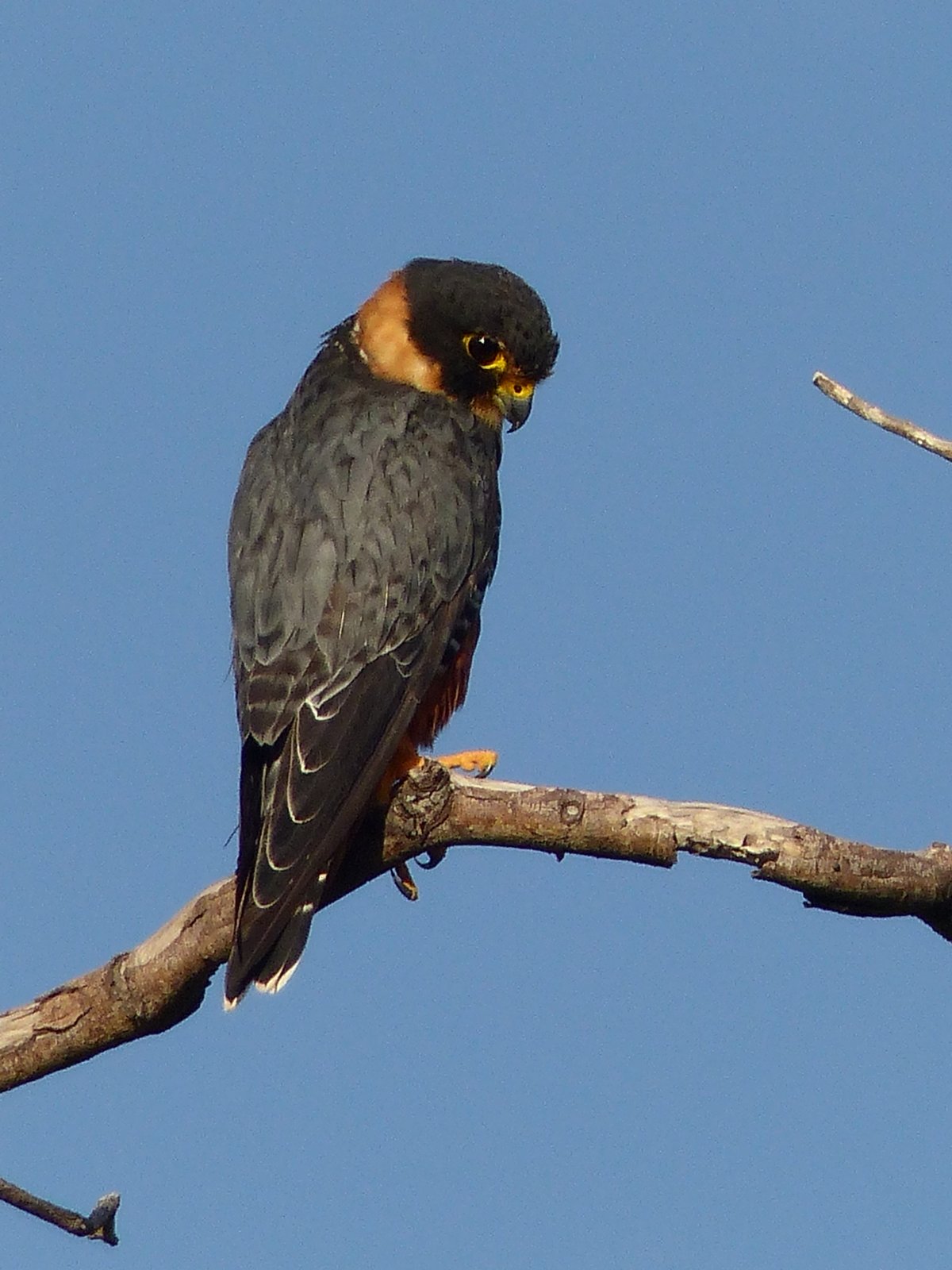
The Bat Falcon is a small, dark falcon of forest edges and clearings in tropical forest. It often sits upright for long periods on a dead branch high above the forest and hunts bats, swallows, swifts, hummingbirds and large insects such as dragonflies in fast flight, especially at dusk and dawn. In the guide area it is a widespread resident of the lowlands and foothills, from Mexico to Panama.
Voice
A rapid, high kee-kee-kee-kee or tee-tee-tee, mainly near the nest site and when alarmed.
Recording: Jacob Wijpkema — CC BY-NC-SA 4.0 · converted to mono · xeno-canto
Identification
23–30 cm, compact, with long, pointed wings and a fairly short tail. Head and upperparts are blue-black. Throat and sides of the neck are white to buff; below lies a black vest finely barred with white. Belly, thighs and undertail coverts are rufous. The tail is black with narrow pale bars. The female is larger than the male and often has a buff tinge to the throat.
Confusion species
The Orange-breasted Falcon Falco deiroleucus is very similar but larger and heavier, with large feet, a broad orange-rufous band below the throat and a more coarsely barred vest; it is rare and very local. The Merlin Falco columbarius is streaked below and lacks the black breast. The American Kestrel Falco sparverius is rufous above and has pale, spotted underparts.
Habitat
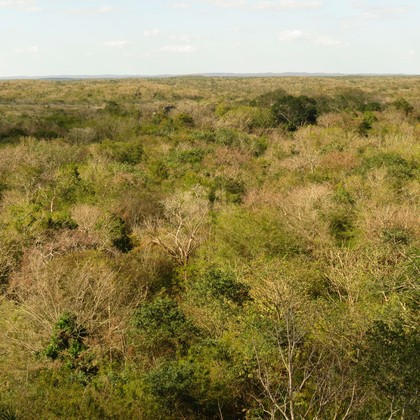
Edges of humid lowland, foothill, dry and seasonal forest, clearings with tall dead trees, riverbanks and gallery forest, and also villages and towns with tall buildings or towers; mainly below 1500 m. It nests in a tree cavity, on a ledge of a building or ruin, or in an old nest. It hunts from a high perch.
Where the bird is most at home, classified by the vegetation units of Mexico and Central America.






Range and movements
Resident from southern Sinaloa on the Pacific side and southern Tamaulipas on the Gulf side through the lowlands of Mexico, including the Yucatán Peninsula, and through all of Central America to Panama. Most often seen in Belize, northern Guatemala, Costa Rica and Panama; scarce in El Salvador and on the dry Pacific slopes. Outside the guide area south to northern Argentina.
- Resident
- dark = core range, pale = thinly spread
How and when to look
Best at dusk at a clearing or river in the forest, where the bird rises from a dead treetop towards emerging bats. At Maya ruins such as Tikal, Calakmul and Palenque it often sits by day on a temple or a bare branch above it.
Conservation status
Not threatened. Common in forested regions; locally lost through forest clearance, but also breeds in towns.
Scientific name
Falco rufigularis | Daudin, 1800
Daudin described the species in 1800 and placed it straight away in the genus where it still stands. The genus Falco was introduced in 1758 by Linnaeus. Falco is Late Latin for 'falcon', from falx, falcis 'sickle', after the sickle-shaped claws of the bird. rufigularis is Latin, from rufus 'rufous' and gula 'throat': 'red-throated', although adults' throats are mostly whitish to buff. The specimen the first description was based on came from Cayenne, French Guiana.