All species › Passerines › New World sparrows › Orange-billed Sparrow
Position in the tree Birds Aves › Birds with a flexible palate Neognathae › All other modern birds Neoaves › Landbirds Telluraves › Falcons, parrots and passerines Australaves › Falcons and passerines Eufalconimorphae › Parrots and passerines Psittacopasserae
Orange-billed Sparrow | Arremon aurantiirostris
Goudsnavelgors | Rascador pico naranja
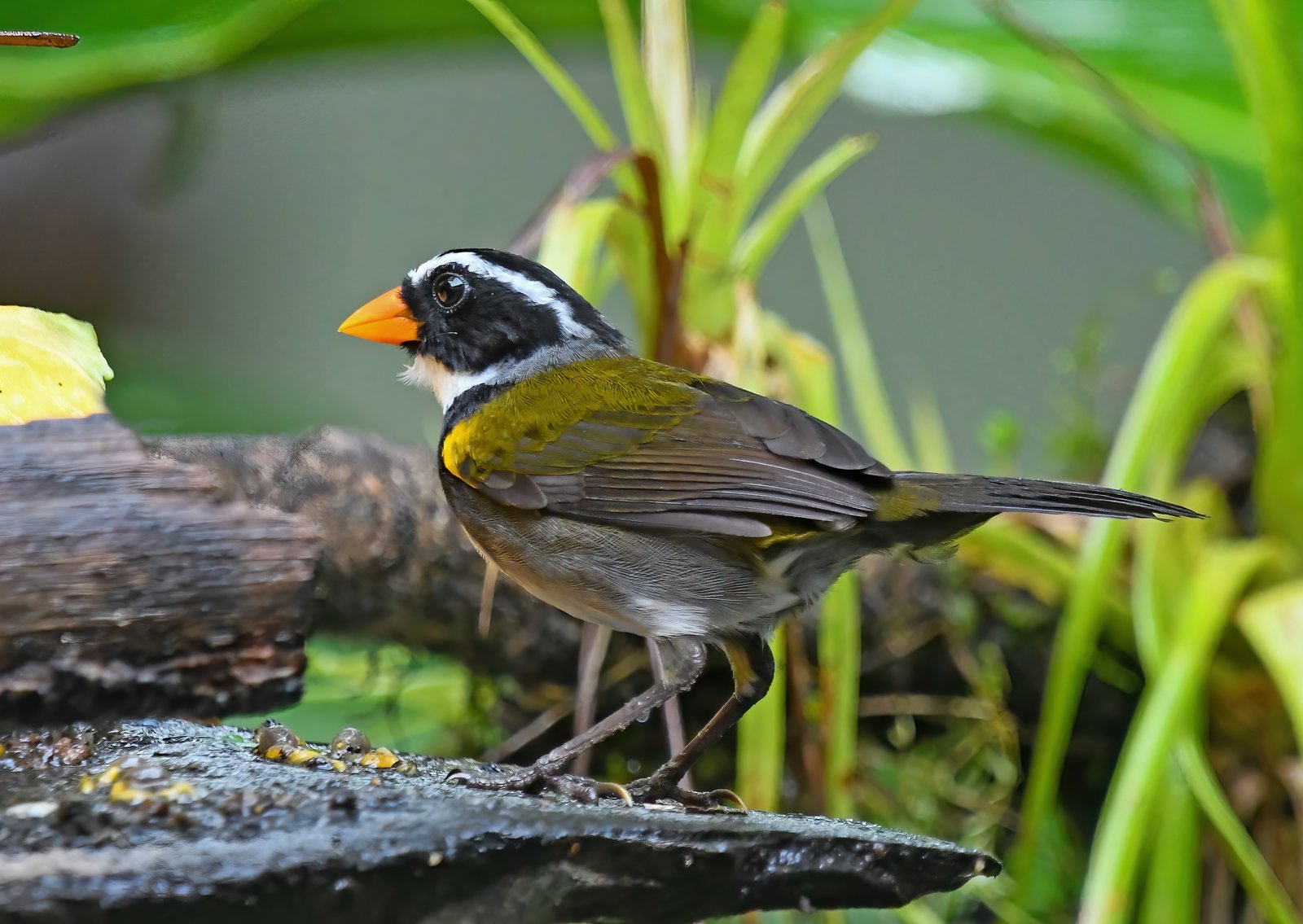
The Orange-billed Sparrow is an Arremon sparrow of the floor of humid lowland forest, instantly recognised by the bright orange bill in the black-and-white head. It rummages in the leaf litter in the dim undergrowth. In the guide area it lives from south-eastern Mexico to Panama.
Voice
Very high, thin notes such as tseet; the song is a short, high, faint series of whistles and trills, often at dawn and dusk.
Recording: Juan Freile — CC BY-NC-SA 4.0 · shortened to the first 60 s, mono · xeno-canto
Identification
15–16 cm. Bill bright orange. Head black with a grey central crown stripe and a white supercilium behind the eye. Throat white, below it a broad black breast band. Upperparts olive-green; a small yellow patch at the bend of the wing. Flanks grey to olive-grey, belly white. The sexes are alike; juveniles are duller, with a dark bill and a dingy yellowish throat.
Confusion species
Chestnut-capped Brushfinch Arremon brunneinucha is larger, with a chestnut crown and a black bill, and lives higher up in montane forest. Black-striped Sparrow Arremonops conirostris and Green-backed Sparrow Arremonops chloronotus have a grey head with black stripes, a dark bill and no black breast band, and live in scrub and at forest edges. Sooty-faced Finch Arremon crassirostris has a dark grey face with a white malar stripe.
Habitat
Undergrowth of humid lowland and foothill forest, mature secondary forest and shady forest edges, from sea level to about 1200 m. It forages on and just above the ground for insects, seeds and fallen fruit, alone or in pairs.
Where the bird is most at home, classified by the vegetation units of Mexico and Central America.




Range and movements
Caribbean slope of south-eastern Mexico (southern Veracruz, Oaxaca, Tabasco, Chiapas and the southern Yucatán Peninsula) through Belize, Guatemala, Honduras and Nicaragua to Costa Rica; in Costa Rica and Panama on both slopes. Outside the guide area in western Colombia and Ecuador, and east of the Andes to northern Peru.
- Resident
- dark = core range, pale = thinly spread
How and when to look
Regularly seen on the forest trails at La Selva in Costa Rica and along Pipeline Road (Camino del Oleoducto) in Panama. Look for the orange bill that stands out in the dark undergrowth.
Conservation status
Not threatened (LC). Fairly common in humid forest; disappears where the undergrowth is cleared or the forest becomes fragmented.
Scientific name
Arremon aurantiirostris | de Lafresnaye, 1847
De Lafresnaye described the species in 1847 and placed it straight away in the genus where it still stands. The genus Arremon was introduced in 1816 by Vieillot. Arremon is Greek, from arrhēmōn 'silent, speechless', after Buffon's 'Oiseau silencieux', a bird said to be rarely heard. aurantiirostris is Latin, from aurantius 'orange' and -rostris '-billed', after the bright orange bill. The specimen the first description was based on came from Panama.