All species › Passerines › Olive warbler › Olive Warbler
Position in the tree Birds Aves › Birds with a flexible palate Neognathae › All other modern birds Neoaves › Landbirds Telluraves › Falcons, parrots and passerines Australaves › Falcons and passerines Eufalconimorphae › Parrots and passerines Psittacopasserae
Olive Warbler | Peucedramus taeniatus
Oranjekopzanger | Ocotero enmascarado
The Olive Warbler is a small songbird of high-elevation pine and pine-oak forests. It resembles a New World warbler but is the only species in its own family, Peucedramidae, and is not closely related to the New World warblers. In the guide area it lives in the mountains of Mexico and northern Central America, south to Nicaragua.
Voice
The song is a repeated, clear whistled peeta peeta peeta or cheery cheery, somewhat like a titmouse. The call is a soft, descending whistled phew, often heard in mixed flocks.
Recording: Ryan Douglas — CC BY-SA 4.0 · shortened to the first 60 s, mono · xeno-canto
Identification
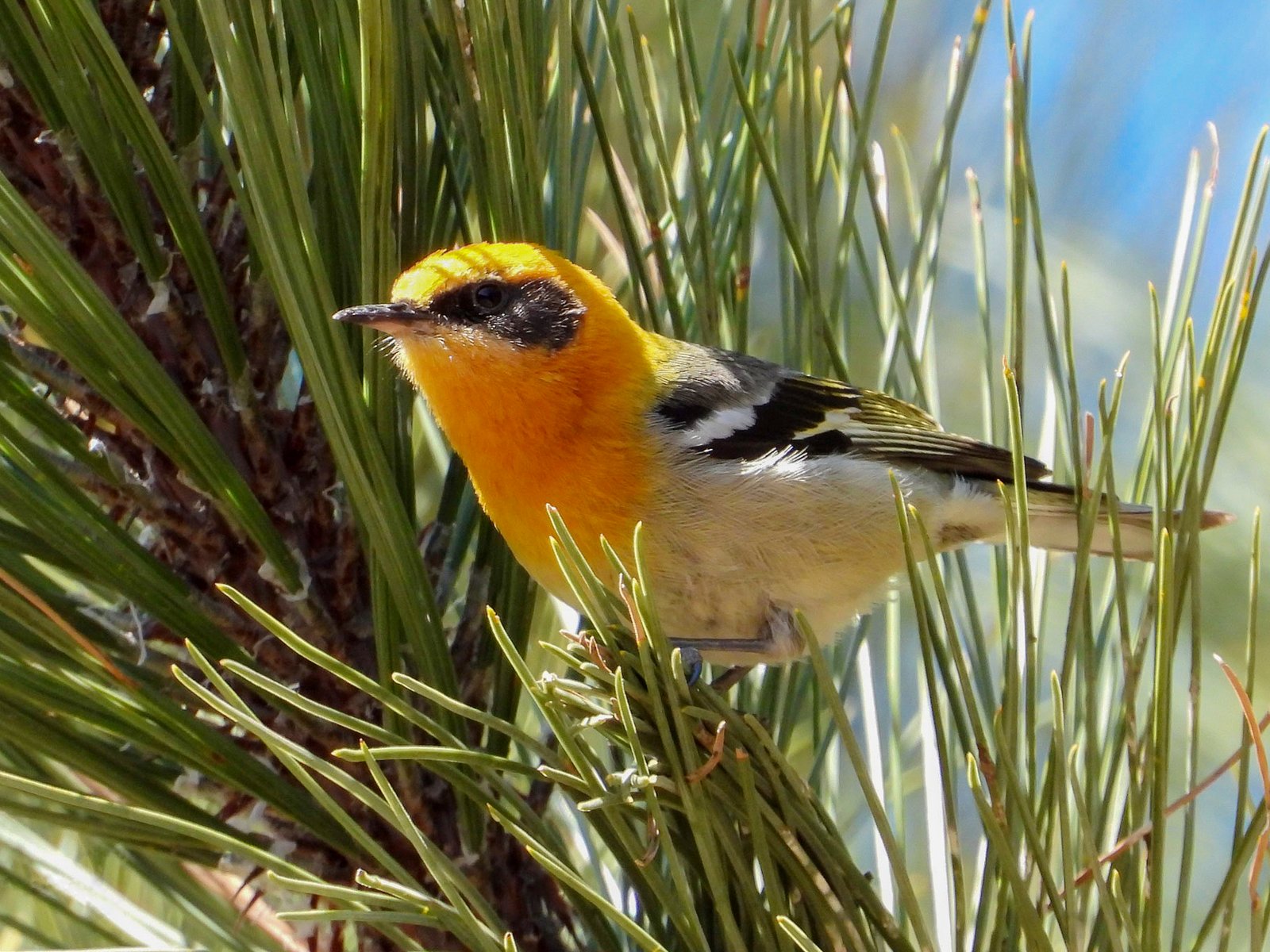
13–14 cm. Slender, with a thin, pointed bill and a fairly long, slightly forked tail. The male has an orange-tawny head, throat and upper breast with a black mask through the eye; back grey, belly greyish white. Females and young birds have a yellow head and breast and a fainter, grey eye mask. Both sexes show two broad white wing bars, a small white patch at the base of the primaries and much white in the outer tail feathers. Young males at first resemble females and acquire the full orange head only in their second year.
Confusion species
Hermit Warbler Setophaga occidentalis winters in the same pine forests and also has a yellow head with white wing bars, but lacks the dark eye mask and has an olive-green, streaked back; the male has a black throat. Townsend's Warbler Setophaga townsendi has a black or olive cheek patch framed in yellow and streaked flanks. Grace's Warbler Setophaga graciae has a yellow throat and supercilium, but a grey head without a mask and streaked flanks.
Habitat
Open, dry pine and pine-oak forests in the mountains, mostly between about 1800 and 3500 m, lower in Honduras and Nicaragua. It searches for insects high in the canopy among the needles and at the tips of branches, and outside the breeding season often joins mixed flocks of warblers, chickadees and creepers. It builds a cup nest high in a pine.
Where the bird is most at home, classified by the vegetation units of Mexico and Central America.



Range and movements
From south-eastern Arizona and south-western New Mexico through the Sierra Madre Occidental and Sierra Madre Oriental, the Trans-Mexican Volcanic Belt and the Sierra Madre del Sur to the highlands of Chiapas, Guatemala, El Salvador and Honduras and into northern and central Nicaragua. Birds from the north of the range partly move away or to lower forest in winter.
- Resident
- dark = core range, pale = thinly spread
How and when to look
Found in the pine forests of Cerro San Felipe near Oaxaca and around San Cristóbal de las Casas in Chiapas. Best searched for with mixed flocks high in the pines, listening for the soft whistled call.
Conservation status
Not threatened (LC). Fairly common in high-elevation conifer forest; sensitive to logging and fires in pine-oak forests.
Scientific name
Peucedramus taeniatus | (Du Bus de Gisignies, B-AL, 1847)
Du Bus de Gisignies, B-AL described the species in 1847 as Sylvia taeniata; because it was later moved to another genus, the author and year stand in brackets. The genus Peucedramus was introduced in 1875 by Coues. Peucedramus is Greek, from peukē 'pine' and -dromos 'runner', after its foraging in pine forests. taeniatus is New Latin for 'banded', from taenia 'band, ribbon', after the dark band through the eye. The specimen the first description was based on came from Mexico; restricted to San Cristóbal, Chiapas, but probably San Pedro, Oaxaca.